
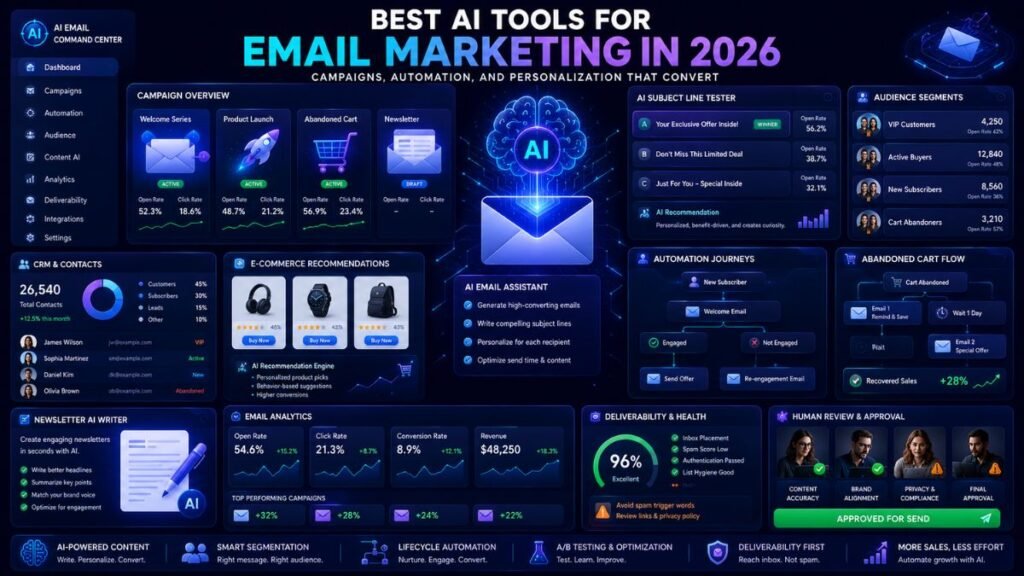
The best AI tools for email marketing help teams write better campaigns, generate subject lines, personalize messages, segment audiences, automate follow-ups, test performance, and improve customer journeys. The right tool depends on your business model. Ecommerce brands, newsletters, B2B teams, creators, and small businesses need different AI email workflows.
In Simple Terms
AI email marketing tools help you create, send, and improve email campaigns with less manual work.
They can write subject lines, draft email copy, suggest send times, build customer segments, personalize product recommendations, summarize campaign results, and trigger automated journeys. The best tools do not just write emails. They connect AI writing with customer data, automation, and performance tracking.
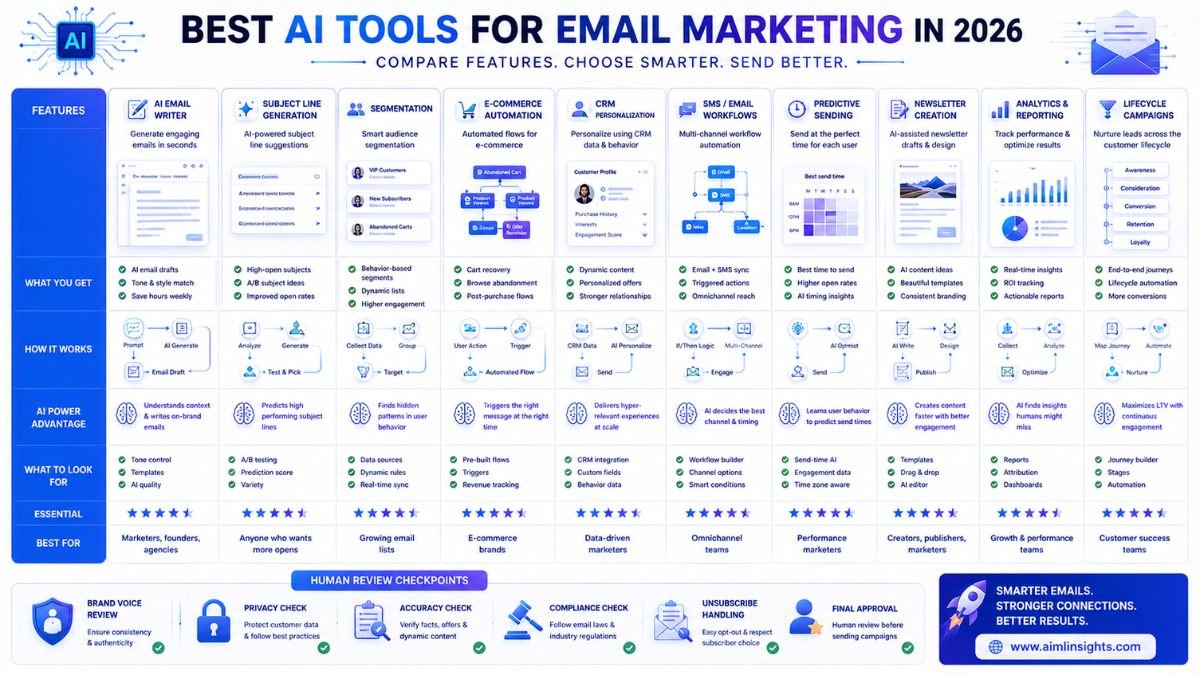
Best AI Tools for Email Marketing: Quick Comparison
| Tool | Best For | Strong AI Email Use Case | Main Limitation |
| Mailchimp | Beginners and small businesses | AI copy, send-time tools, campaign help | Advanced features depend on plan |
| Klaviyo | Ecommerce brands | Personalized email/SMS, customer journeys, ecommerce segmentation | Best for ecommerce data-heavy teams |
| HubSpot | B2B and CRM-led marketing | Email automation connected to CRM data | Can become expensive as needs grow |
| ActiveCampaign | Advanced automation | AI campaign builder, predictive sending, segments | Learning curve for beginners |
| Brevo | Affordable multichannel marketing | Email, SMS, CRM, Aura AI content creation | Some advanced AI may vary by plan |
| Omnisend | Ecommerce email and SMS | Product recommendations, segments, campaigns | Best suited to online stores |
| MailerLite | Creators and simple newsletters | AI writing assistant, smart sending, automation | Less advanced for enterprise workflows |
| GetResponse | Funnels and webinars | Email marketing plus automation and landing pages | May be more than simple newsletter users need |
| Kit | Creators and newsletters | Audience growth, creator email sequences | Less CRM-heavy than B2B platforms |
| Sender | Budget-friendly email marketing | Simple newsletters, automation, transactional email | Less advanced CRM depth |
1. Mailchimp: Best AI Email Marketing Tool for Beginners
Mailchimp is a strong starting point for small businesses, creators, and beginner marketers. Its AI marketing tools are powered by Intuit Assist and include support for writing email copy, improving campaigns, and optimizing send timing. Mailchimp notes that Intuit Assist availability depends on plan, country, and language, so users should check what is included before choosing a plan.
Use Mailchimp if you need a familiar email platform with templates, basic automation, audience management, and AI-assisted campaign creation. It works well for newsletters, product announcements, welcome emails, and simple customer journeys.
Best for: beginners, newsletters, small business campaigns, simple AI email writing.
Use carefully for: scaling costs and plan-specific AI access.
2. Klaviyo: Best AI Tool for Ecommerce Email Marketing
Klaviyo is one of the best AI email marketing tools for ecommerce brands because it is built around customer data, shopping behavior, email, SMS, and product-driven personalization. Klaviyo says its AI can generate and personalize campaigns, optimize interactions, and support customers through tools and agents. Its AI email features include generating drafts with subject lines, copy, layouts, tone changes, and smart send-time optimization.
Use Klaviyo for abandoned cart emails, browse abandonment flows, post-purchase sequences, win-back campaigns, product recommendations, and customer lifecycle messaging.
Best for: Shopify-style ecommerce, segmentation, email/SMS, product recommendations.
Use carefully for: non-ecommerce brands that do not need deep commerce data.
3. HubSpot: Best for CRM-Based Email Personalization
HubSpot is a strong option for B2B teams and businesses that want email marketing connected to CRM data. HubSpot’s email marketing page says users can design campaigns, use AI to write subject lines and email copy, and automate follow-ups based on contact engagement and CRM data. HubSpot’s Breeze AI platform also includes AI agents, an assistant, and embedded AI features across marketing, sales, and service.
Use HubSpot when email is part of a larger customer journey: lead nurturing, sales follow-up, lifecycle marketing, and account-based communication.
Best for: B2B, CRM personalization, lead nurturing, marketing-sales alignment.
Use carefully for: cost and platform complexity.
4. ActiveCampaign: Best for Advanced AI Automation
ActiveCampaign is strong for marketers who need deeper automation than basic newsletters. Its AI marketing page lists AI Campaign Builder, AI Brand Kit, Predictive Sending, AI-Suggested Segments, and AI Actions Library. ActiveCampaign positions its newer platform around autonomous marketing and AI agents across email, SMS, WhatsApp, and more.
Use ActiveCampaign if you need multi-step funnels, behavior-based automation, segmentation, customer journeys, and sales or CRM-related workflows.
Best for: advanced automation, lifecycle campaigns, segmentation, predictive sending.
Use carefully for: beginner teams that may find the setup heavy.
5. Brevo: Best Affordable AI Email Marketing Platform
Brevo is useful for small and mid-sized businesses that want email, SMS, CRM, automation, and multichannel messaging without enterprise complexity. Brevo describes itself as an all-in-one customer engagement platform for email, SMS, automation, CRM, live chat, and transactional email. Its Aura AI assistant can help generate email designs, subject lines, images, translations, and SMS content.
Brevo is especially practical when pricing and contact management matter. It is a good fit for local businesses, service brands, ecommerce beginners, and teams that want email plus SMS.
Best for: affordability, email/SMS, CRM, small business marketing.
Use carefully for: advanced enterprise analytics or complex landing-page needs.
6. Omnisend: Best for Ecommerce Email and SMS Campaigns
Omnisend is built for ecommerce email and SMS marketing. Its official page positions the platform around ecommerce brands, while its AI support documentation says Omnisend AI helps users write emails, build segments, personalize campaigns, and create forms faster.
Use Omnisend for online stores that want prebuilt ecommerce automations, product-based campaigns, customer segmentation, SMS, push notifications, and sales-focused workflows.
Best for: ecommerce campaigns, product recommendations, email/SMS automation.
Use carefully for: non-ecommerce newsletters or B2B lead nurturing.
7. MailerLite: Best for Simple Newsletters and Creators
MailerLite is a strong AI email marketing tool for creators, freelancers, educators, and small businesses that want simplicity. MailerLite says its AI writing assistant can create email content, subject lines, and CTAs, then fine-tune them with different tones and styles. It also offers AI-powered Smart Sending and an MCP server that can connect campaign data to AI tools.
Use MailerLite for newsletters, creator updates, digital products, welcome sequences, and simple email automation.
Best for: newsletters, creators, simple automation, AI writing help.
Use carefully for: advanced CRM, enterprise segmentation, or complex B2B funnels.
8. GetResponse: Best for Email Funnels and Webinars
GetResponse is useful for teams that want email marketing combined with landing pages, funnels, webinars, and automation. It fits marketers who need more than a newsletter but do not necessarily want a full CRM-heavy platform.
Use it for lead magnets, webinar funnels, email sequences, product launches, and small business sales funnels. AI can support copy, segmentation, and workflow creation, but final campaign strategy still needs human direction.
Best for: funnels, webinars, launches, lead magnets, automation.
Use carefully for: users who only need basic newsletters.
9. Kit: Best for Creators and Newsletter Businesses
Kit, formerly ConvertKit, is useful for creators who sell courses, memberships, newsletters, digital products, or audience-based businesses. It is not always the deepest AI platform, but it fits creator email workflows well.
Use Kit for welcome sequences, audience tagging, newsletter publishing, product launches, and creator funnels. It is strong when the goal is building a direct audience relationship rather than running a large CRM operation.
Best for: creators, newsletter businesses, digital products, simple funnels.
Use carefully for: advanced ecommerce product recommendations or enterprise CRM needs.
10. Sender: Best Budget-Friendly Email Marketing Tool
Sender is useful for small businesses that want essential email marketing without heavy complexity. Recent 2026 coverage describes Sender as a cost-effective platform for newsletters, automation workflows, transactional emails, and SMS, with a free plan and simple setup.
Use Sender if you need practical email marketing basics: newsletters, welcome emails, forms, automation, and campaign tracking.
Best for: budget-conscious businesses, simple automation, essential campaigns.
Use carefully for: advanced AI personalization or deep CRM workflows.
How to Choose the Best AI Email Marketing Tool
Start with your business model.
If you are a beginner or small business, start with Mailchimp, Brevo, MailerLite, or Sender. If you run ecommerce, compare Klaviyo and Omnisend first. If you are a B2B company with CRM needs, HubSpot is strong. If automation depth matters most, ActiveCampaign is a better fit. If you are a creator, Kit or MailerLite may be enough.
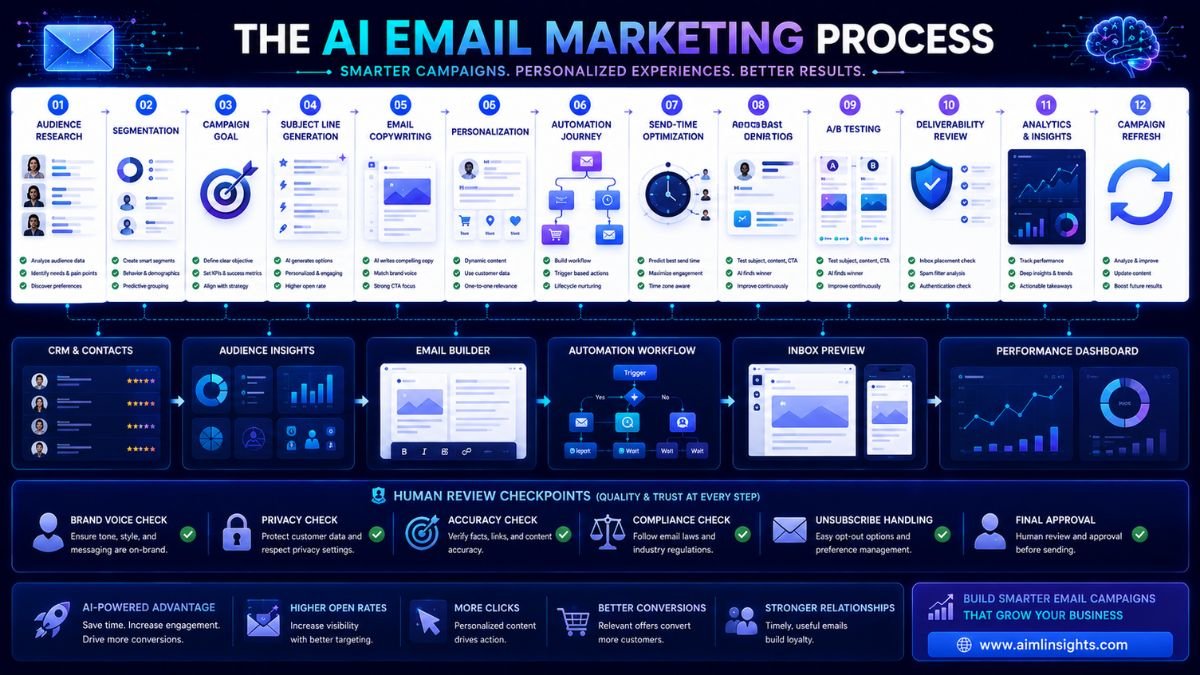
Then check five things: contact pricing, automation depth, segmentation, deliverability tools, and AI features that are actually available on your plan.
Common Mistakes to Avoid
The first mistake is choosing an AI email tool only because it writes copy. Copy is just one part of email marketing. Segmentation, timing, deliverability, list quality, and offer relevance matter more.
The second mistake is sending generic AI-written emails. AI can write fast, but customers respond to relevance.
The third mistake is ignoring compliance. Email marketing must respect consent, unsubscribe rules, privacy, and regional regulations.
The fourth mistake is automating too much too soon. Start with a welcome sequence, abandoned cart flow, re-engagement campaign, or newsletter schedule before building complex journeys.
Suggested Read:
- Best AI Tools for Beginners in 2026
- Best AI Tools for Business
- Best AI Tools for Bloggers and Content Writers
- Best AI Tools for Blog Writing
- Best AI Workflow Automation Tools for Teams
- AI Tools With Free Plans Worth Using in 2026
- Prompt Engineering for Beginners: A Practical Guide
- Best Prompt Templates for Summarization and Research
FAQ: Best AI Tools for Email Marketing in 2026
What are the best AI tools for email marketing?
The best AI tools for email marketing include Mailchimp, Klaviyo, HubSpot, ActiveCampaign, Brevo, Omnisend, MailerLite, GetResponse, Kit, and Sender.
Which AI tool is best for email campaigns?
Mailchimp is beginner-friendly, Klaviyo is strong for ecommerce campaigns, HubSpot is best for CRM-led campaigns, and ActiveCampaign is strong for advanced automation.
Can AI write marketing emails?
Yes. Many AI email marketing tools can write subject lines, email copy, CTAs, SMS messages, and campaign drafts. Human review is still important for brand voice, accuracy, compliance, and relevance.
Which AI email marketing tool is best for small businesses?
Mailchimp, Brevo, MailerLite, and Sender are strong options for small businesses because they are relatively accessible and cover common campaign needs.
Which AI tool is best for ecommerce email marketing?
Klaviyo and Omnisend are strong ecommerce choices because they focus on customer behavior, product recommendations, segmentation, email/SMS workflows, and ecommerce automations.
Are AI email marketing tools worth it?
AI email marketing tools are worth it when they save time, improve segmentation, help personalize campaigns, and support better automation. They are not worth it if they create generic emails without a clear strategy.
Final Takeaway
The best AI tools for email marketing depend on your workflow. Mailchimp is easy for beginners, Klaviyo and Omnisend are strong for ecommerce, HubSpot is best for CRM-led campaigns, ActiveCampaign is powerful for automation, Brevo is practical for affordable multichannel marketing, and MailerLite works well for creators and newsletters.
The winning strategy is not to let AI send more emails. It is to use AI to send more relevant emails, to the right people, with better timing, clearer copy, and stronger human review.