
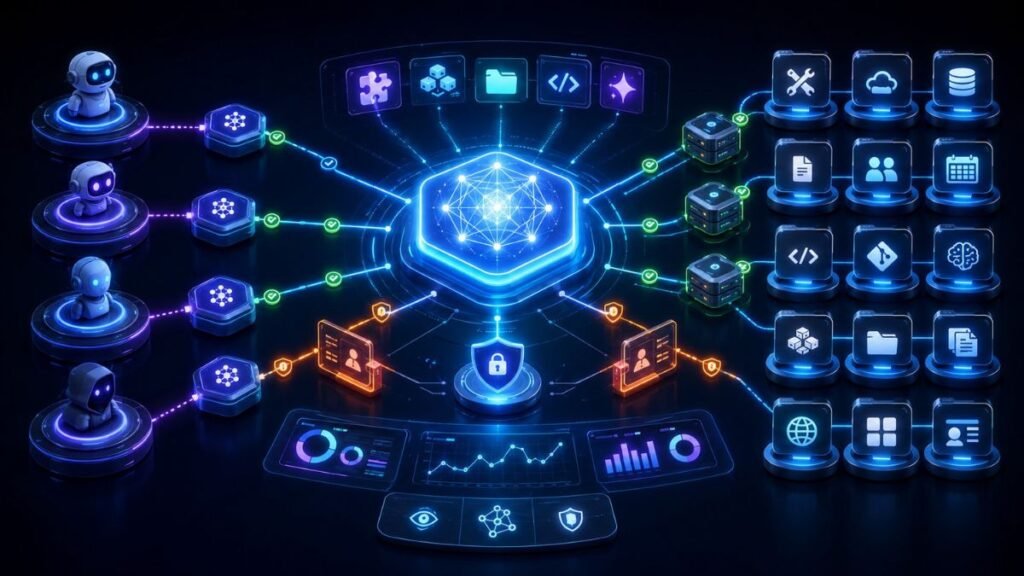
MCP, or Model Context Protocol, is an open standard that helps AI applications connect to external tools, data sources, APIs, and services in a consistent way. MCP matters for agentic AI because AI agents need reliable access to context and tools before they can plan, act, retrieve data, and complete real workflows.
In Simple Terms
MCP is a standard connection layer for AI agents.
Instead of building a custom integration every time an AI agent needs access to a database, file system, CRM, search tool, code repository, or business app, developers can connect through MCP servers.
That makes MCP important for agentic AI because agents are only useful when they can safely reach the right tools and context.
What Is MCP?
MCP stands for Model Context Protocol. The official MCP documentation describes it as an open-source standard for connecting AI applications to external systems. Anthropic introduced MCP in November 2024 as an open standard for building secure, two-way connections between data sources and AI-powered tools.
The easiest analogy is this: MCP is like a standard port for AI integrations.
Without MCP, every AI app may need a custom connector for every tool. With MCP, an AI application can connect to MCP servers that expose tools, resources, and prompts in a standard format.
Why MCP Matters for Agentic AI
Agentic AI systems are not just chatbots. They plan, call tools, retrieve context, act, observe results, and continue through multi-step workflows.
That means the agent needs safe access to external capabilities:
A support agent needs CRM and ticket data.
A coding agent needs files, test runners, and repositories.
A research agent needs document stores and search tools.
An operations agent needs logs, runbooks, and monitoring systems.
MCP matters because it can reduce custom integration work and make tool access more modular. OpenAI describes agents as applications that plan, call tools, collaborate across specialists, and keep enough state to complete multi-step work. MCP fits this world because tool access becomes a standard part of the agent architecture.
How MCP Works
MCP usually involves three parts.
| Component | What It Does |
| MCP host | The AI application or environment using the model |
| MCP client | The connector inside the host that talks to servers |
| MCP server | The external service exposing tools, resources, or prompts |
An MCP server can expose:
Tools — functions an AI model can call, such as searching files or querying an API.
Resources — file-like or data-like context the agent can read.
Prompts — reusable prompt templates for specific tasks.
Microsoft’s Copilot Studio documentation explains this clearly: connecting to an MCP server can give an agent access to resources, tools, and prompts.
What Are MCP Servers?
MCP servers are the services that expose external capabilities to AI agents.
For example, an MCP server might connect to a company’s documentation, GitHub repository, database, calendar, Slack workspace, cloud logs, browser automation, or CRM system.
A developer can use an existing MCP server or build a custom one. The benefit is standardization. Once the AI application supports MCP, it can potentially connect to many different tools through the same protocol style.
The official MCP GitHub organization describes MCP as an open protocol for seamless integration between LLM applications and external data sources and tools.
MCP vs APIs: What Is the Difference?
MCP does not replace APIs. It usually sits above or beside APIs.
| Feature | API | MCP |
| Main purpose | Let software systems communicate | Let AI applications discover and use tools/context |
| Audience | Developers and applications | AI apps, agents, tool servers |
| Structure | Endpoint-specific | Standardized tool/resource/prompt exposure |
| Agent use | Requires custom integration | Designed for agent-tool integration |
| Example | Payment API endpoint | MCP server exposing payment lookup tool |
Think of an API as the underlying service. MCP can act as the standardized interface that makes that service easier for AI agents to use.
Why Developers and Teams Care Commercially
MCP is commercially important because it can reduce integration cost.
If a company wants to build AI agents for support, sales, coding, operations, or research, the hard part is often not the model. It is connecting the agent to tools safely.
MCP can help teams:
Reuse connectors across apps.
Avoid building one-off integrations.
Connect agents to internal systems faster.
Standardize tool descriptions.
Support multiple agent platforms.
Make agent ecosystems more modular.
This is why MCP is relevant when choosing AI agent frameworks, platforms, and enterprise agent builders.
Platform Support: Who Uses MCP?
MCP support is expanding across major agent platforms and frameworks.
OpenAI’s Agents SDK documentation says MCP is an open protocol that standardizes how applications provide context to LLMs, and the SDK supports MCP servers. Microsoft Agent Framework documentation says individual agents can call tools and MCP servers, and its MCP guide says the framework supports integration with MCP servers so agents can access external tools and services. Google’s ADK positioning also highlights MCP setup and agent development resources, while Google Cloud’s ADK documentation describes ADK as an open-source framework for building, debugging, and deploying reliable agents at enterprise scale.
For buyers, this matters because MCP is becoming part of the agent platform checklist.
When MCP Is Useful
MCP is useful when your AI agent needs access to multiple external systems.
Good use cases include:
Developer agents that inspect code and run tools.
Support agents that retrieve customer and policy data.
Research agents that search internal knowledge bases.
Operations agents that inspect logs and runbooks.
Enterprise assistants that connect to business apps.
Multi-agent systems that share standardized tool access.
MCP is especially useful when you expect tools to change over time or when several AI applications need access to the same services.
When MCP May Be Overkill
MCP is not required for every LLM app.
If your application only needs one fixed API call, a direct integration may be simpler. If your workflow is small, static, and internal, MCP may add unnecessary architecture.
MCP becomes more valuable as the number of tools, agents, environments, and integrations grows.
A simple rule: use direct APIs for simple fixed workflows; consider MCP when you need reusable, discoverable, standardized tool access across agentic systems.
MCP Security Risks
MCP also expands the agent attack surface.
Because MCP exposes tools and data to AI agents, teams must think about permissions, prompt injection, tool poisoning, identity, logging, and unsafe actions.
Recent research has focused specifically on MCP threats. One 2026 paper, MCP-38, proposes a threat taxonomy for MCP systems and identifies risks such as tool description poisoning, indirect prompt injection, parasitic tool chaining, and dynamic trust violations. Another 2026 paper on MCP threat modeling found tool poisoning to be a major client-side vulnerability and recommended defenses such as static metadata analysis, decision-path tracking, behavioral anomaly detection, and user transparency.
For commercial adoption, this means MCP should not be treated as “plug and play” without governance.
MCP Readiness Checklist
Before adopting MCP for agentic AI, check:
| Area | What to Ask |
| Tool scope | Does the agent really need this tool? |
| Permissions | Is access least-privilege? |
| Authentication | How does the server verify users and agents? |
| Tool descriptions | Could metadata mislead the model? |
| Logging | Are tool calls traceable? |
| Human approval | Are risky actions reviewed? |
| Error handling | Can the agent recover from failed tools? |
| Vendor support | Does your framework support MCP well? |
| Security review | Has the MCP server been audited? |
A 2026 preprint on deploying agents with MCP argues that MCP provides a solid protocol foundation but does not yet solve every production concern, highlighting gaps around identity propagation, tool budgeting, structured errors, and observability.
MCP and the Future of Agentic AI Platforms
MCP is likely to matter because agentic AI is moving from demos to connected systems.
As more platforms support MCP, developers may be able to connect agents to tools more easily, switch platforms with less rewiring, and share tool servers across workflows. This could make AI agent ecosystems more modular.
But MCP will not remove the need for good architecture. Teams still need context engineering, tool permissions, observability, evaluation, governance, and human-in-the-loop controls.
Suggested Read:
- What Is an AI Agent? A Simple Explanation With Examples
- Agentic AI Architecture Explained Simply
- Tool Use in Agentic AI: Function Calling, APIs, and External Actions
- How Orchestration Works in Agentic AI Systems
- Best Agentic AI Frameworks for Developers in 2026
- Best Platforms for Building Agentic AI Applications
- Agentic AI Security Risks You Should Understand
- How to Evaluate Agentic AI Systems
FAQ: What Is MCP and Why Does It Matter for Agentic AI?
What is MCP in AI?
MCP, or Model Context Protocol, is an open standard for connecting AI applications to external tools, data sources, resources, and prompts.
Why does MCP matter for agentic AI?
MCP matters because agentic AI systems need reliable access to tools and context before they can plan, act, retrieve data, and complete workflows.
How does MCP work with AI agents?
An AI application uses an MCP client to connect to MCP servers, which expose tools, resources, and prompts the agent can use during a task.
What are MCP servers?
MCP servers are services that expose external capabilities, such as APIs, files, databases, knowledge bases, code tools, or business systems, to AI applications.
Is MCP the same as an API?
No. APIs expose service functionality. MCP standardizes how AI applications discover and use tools, resources, and prompts, often backed by APIs.
What are the benefits of MCP for developers?
MCP can reduce custom integration work, improve tool reuse, support modular agent systems, and make it easier to connect AI agents to external systems.
What are the security risks of MCP?
Risks include prompt injection, tool poisoning, excessive permissions, data leakage, malicious server behavior, weak authentication, and poor tool-call observability.
Final Takeaway
What is MCP and why does it matter for agentic AI? MCP is a standard way to connect AI agents to tools, resources, prompts, APIs, and data sources. It matters because agentic AI depends on external context and safe tool use. For developers and enterprises, MCP can reduce integration friction, but it still requires security, observability, and governance.
To continue learning, read What Is an AI Agent?, Tool Use in Agentic AI, and Best Platforms for Building Agentic AI Applications next.