
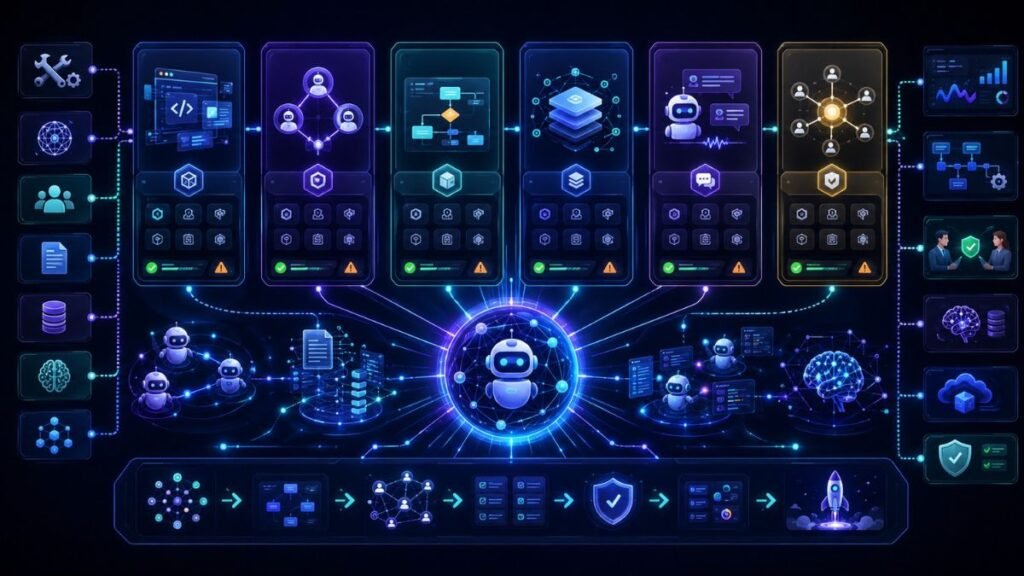
The best platforms for building agentic AI applications in 2026 include OpenAI Agents SDK, Google ADK, Microsoft Copilot Studio, Salesforce Agentforce, Amazon Bedrock Agents, LangGraph Platform, CrewAI, Dify, Dust, Stack AI, and Voiceflow. The right choice depends on whether you need developer control, enterprise workflow automation, low-code building, customer support agents, RAG, or production orchestration.
In Simple Terms
An agentic AI platform helps you build AI agents that can use tools, retrieve data, follow workflows, remember state, and take actions.
Some platforms are developer-first SDKs. Some are enterprise low-code builders. Some are better for customer support. Some are better for internal knowledge agents, workflow automation, or production orchestration.
The best platform is the one that fits your workflow and risk level.
Quick Comparison: Best Agentic AI Platforms
| Platform | Best For | Main Strength | Main Trade-Off |
| OpenAI Agents SDK | Developer-built agent apps | Tools, handoffs, tracing, state | Best for OpenAI-centered stacks |
| Google ADK | Enterprise-scale agent development | Multi-language SDK, debugging, deployment | Strongest in Google ecosystem |
| Microsoft Copilot Studio | Low-code enterprise agents | M365, connectors, agent flows | Best for Microsoft environments |
| Salesforce Agentforce | CRM and industry agents | Salesforce data, workflows, actions | Best inside Salesforce ecosystem |
| Amazon Bedrock Agents | AWS-native agents | AWS integration and managed agents | Requires AWS architecture fit |
| LangGraph Platform | Stateful production workflows | Durable orchestration and checkpoints | More developer architecture work |
| CrewAI | Role-based multi-agent apps | Fast crews and flows | Needs production controls |
| Dify | Open-source app/agent builder | Visual workflows and self-hosting | Less enterprise-native than hyperscalers |
| Dust | Internal knowledge agents | Company data and permissions | Best for internal assistant use cases |
| Voiceflow | Conversational agents | Voice/chat design workflows | Less ideal for deep backend automation |
1. OpenAI Agents SDK: Best for Developer-Built Agent Apps
OpenAI Agents SDK is a strong option for developers building custom agentic AI applications around OpenAI models. OpenAI describes agents as applications that plan, call tools, collaborate across specialists, and keep enough state to complete multi-step work.
It is especially useful when you need tool calling, handoffs between specialist agents, guardrails, structured outputs, and tracing. OpenAI’s tracing documentation says the Agents SDK records LLM generations, tool calls, handoffs, guardrails, and custom events during an agent run.
Choose OpenAI Agents SDK if your team wants developer control and is already comfortable building with OpenAI APIs.
2. Google ADK: Best for Google Cloud Agent Development
Google ADK is a strong platform for developers and enterprises building reliable agents at scale. Google’s documentation describes ADK as an open-source agent development framework for building, debugging, and deploying reliable AI agents at enterprise scale. The ADK site also says it supports Python, TypeScript, Go, Java, and Kotlin.
Use Google ADK if you are building around Gemini, Google Cloud, Vertex AI, or enterprise deployment requirements. It is a good fit for multi-agent orchestration, graph workflows, evaluation, and cloud-native agent development.
The trade-off is ecosystem fit. ADK is most attractive when your data, models, and deployment stack already lean toward Google.
3. Microsoft Copilot Studio: Best Low-Code Platform for Microsoft Environments
Microsoft Copilot Studio is one of the strongest low-code platforms for building enterprise agents inside Microsoft environments. Microsoft describes Copilot Studio as a graphical low-code tool for building agents and agent flows, with connectors to other data sources and the ability to orchestrate sophisticated logic.
Copilot Studio also supports generative orchestration, where an agent can select tools, topics, other agents, or knowledge sources to respond to user queries and events. Microsoft also announced improvements to multi-agent orchestration that let teams orchestrate Copilot Studio agents alongside agents built for Microsoft 365 experiences.
Choose Copilot Studio if your organization runs on Microsoft 365, Teams, Power Platform, Dynamics, or Azure.
4. Salesforce Agentforce: Best for CRM and Industry Workflows
Salesforce Agentforce is a strong platform for companies that want agents close to CRM data, sales workflows, service cases, and industry-specific processes.
Salesforce says Agentforce can harness workflows, data, and actions within Industry Clouds to create relevant autonomous agents for industries, using existing business logic such as prompts, flows, Apex, and APIs.
Choose Agentforce if your company already uses Salesforce heavily and wants agents for sales, service, marketing, commerce, or industry workflows.
The trade-off is that Agentforce is most valuable when your business data and processes already live in Salesforce.
5. Amazon Bedrock Agents: Best for AWS-Native Agentic Apps
Amazon Bedrock Agents is a strong option for teams building agentic applications on AWS. It is especially relevant if your agents need to work with AWS infrastructure, enterprise data, Lambda functions, knowledge bases, or Bedrock-supported models.
Choose Bedrock Agents when your organization already runs on AWS and wants managed agent infrastructure rather than assembling everything from scratch.
The trade-off is that AWS-native design can be powerful but may require stronger cloud architecture knowledge than simpler low-code builders.
6. LangGraph Platform: Best for Stateful Production Orchestration
LangGraph Platform is a good fit when the hard part is not just building an agent, but running a durable workflow. LangGraph focuses on durable execution, streaming, human-in-the-loop, and other capabilities important for agent orchestration.
Use LangGraph Platform for long-running agents, approval workflows, stateful support agents, coding agents, incident investigation, and workflows where you need checkpoints, retries, and traceable state.
The trade-off is that LangGraph is more developer-oriented. It gives control, but your team must design the workflow carefully.
7. CrewAI: Best for Role-Based Multi-Agent Applications
CrewAI is useful when you want to build agents around roles such as researcher, planner, writer, reviewer, or executor. It is popular for multi-agent prototypes, research workflows, content operations, and internal automation.
Choose CrewAI if your agentic AI application naturally resembles a team of specialized workers.
The trade-off is production discipline. Role-based agents can become noisy without clear state, stopping rules, observability, and human approval.
8. Dify: Best Open-Source Visual App and Agent Builder
Dify is a practical choice for teams that want a visual builder plus open-source flexibility. It can fit AI app development, RAG workflows, internal assistants, and prototype-to-production experiments.
Choose Dify if you want a more visual building experience without giving up self-hosting options.
The trade-off is that enterprise governance, security, and deployment patterns may require more setup compared with hyperscaler platforms.
9. Dust: Best for Internal Knowledge and Workspace Agents
Dust is a strong fit for internal company assistants connected to business knowledge, documents, and workplace data. It is often useful for teams that want department-specific agents for support, sales, operations, research, and internal knowledge work.
Choose Dust if your main use case is helping employees query, summarize, and act on company knowledge with permission-aware access.
The trade-off is that it is less of a general developer framework and more of a workplace agent platform.
10. Voiceflow: Best for Conversational Agent Experiences
Voiceflow is useful for designing conversational experiences across chat and voice channels. It fits customer-facing conversational agents, support flows, and guided assistants.
Choose Voiceflow when conversation design, dialog flows, customer support, and channel deployment matter more than deep backend orchestration.
The trade-off is that complex tool-heavy workflows may require additional backend integration.
How to Choose the Best Agentic AI Platform
Start with your use case.
Use a developer SDK like OpenAI Agents SDK or Google ADK if your team wants code-level control. Use Microsoft Copilot Studio if your company lives in Microsoft 365. Use Salesforce Agentforce if CRM workflows are central. Use Amazon Bedrock Agents if your stack is AWS-native. Use LangGraph Platform if you need durable stateful orchestration. Use CrewAI for role-based multi-agent workflows. Use Dify, Dust, or Voiceflow for visual building, internal assistants, or conversation-first agents.
Commercial Buying Criteria
| Criteria | Why It Matters |
| Tool calling | Agents need safe access to APIs, files, and systems |
| Data integrations | Platform must connect to your real business context |
| State and memory | Long-running agents need continuity |
| Human approval | Risky actions need review checkpoints |
| Observability | Teams need traces, errors, cost, and latency |
| Security | Agents need permissions, audit logs, and guardrails |
| Deployment | Prototype platforms may not fit production needs |
| Ecosystem fit | Microsoft, Salesforce, AWS, Google, or custom stack matters |
| Pricing model | Costs can rise with seats, tokens, actions, and integrations |
Common Mistakes to Avoid
The first mistake is comparing platforms only by feature lists. A platform that looks powerful may be wrong for your stack.
The second mistake is using a low-code builder for a workflow that needs deep custom orchestration. Low-code is useful, but not every agentic system is simple.
The third mistake is ignoring observability. Agent failures often happen in tool calls, memory, retrieval, or handoffs, not just final answers.
The fourth mistake is giving agents too much autonomy too soon. Start with read-only tools, then draft actions, then supervised writes.
Suggested Read:
- What Is an AI Agent? A Simple Explanation With Examples
- Best Agentic AI Frameworks for Developers in 2026
- How to Choose the Right Agentic AI Framework
- LangGraph vs CrewAI vs Microsoft Agent Framework
- Agentic AI Architecture Explained Simply
- Tool Use in Agentic AI: Function Calling, APIs, and External Actions
- Observability for Agentic AI: What Teams Need to Track
- Agentic AI Governance: Risks, Controls, and Accountability
FAQ: Best Platforms for Building Agentic AI Applications
What are the best platforms for building agentic AI applications?
Top options include OpenAI Agents SDK, Google ADK, Microsoft Copilot Studio, Salesforce Agentforce, Amazon Bedrock Agents, LangGraph Platform, CrewAI, Dify, Dust, Stack AI, and Voiceflow.
Which AI agent platform is best for developers?
OpenAI Agents SDK, Google ADK, LangGraph Platform, CrewAI, and Amazon Bedrock Agents are strong developer-focused choices, depending on your model and cloud stack.
Which agentic AI platform is best for enterprises?
Microsoft Copilot Studio, Salesforce Agentforce, Google ADK, Amazon Bedrock Agents, and LangGraph Platform are strong enterprise candidates.
What is the best low-code AI agent builder?
Microsoft Copilot Studio is strong for Microsoft environments. Salesforce Agentforce is strong for Salesforce workflows. Voiceflow and Dify can be useful for conversation-first or visual-building workflows.
Which platform is best for multi-agent workflows?
Google ADK, LangGraph Platform, CrewAI, Microsoft Copilot Studio, and Microsoft Agent Framework are strong options for multi-agent workflows.
How do you choose an agentic AI platform?
Choose by workflow complexity, data integrations, tool access, state, observability, security, deployment requirements, ecosystem fit, and total cost.
Final Takeaway
The best platforms for building agentic AI applications depend on your stack and workflow. Choose OpenAI Agents SDK for developer-built OpenAI apps, Google ADK for Google Cloud agents, Microsoft Copilot Studio for Microsoft environments, Agentforce for Salesforce workflows, Bedrock Agents for AWS-native systems, and LangGraph Platform for durable orchestration.
To continue learning, read Best Agentic AI Frameworks for Developers in 2026, How to Choose the Right Agentic AI Framework, and How to Evaluate Agentic AI Systems next.