
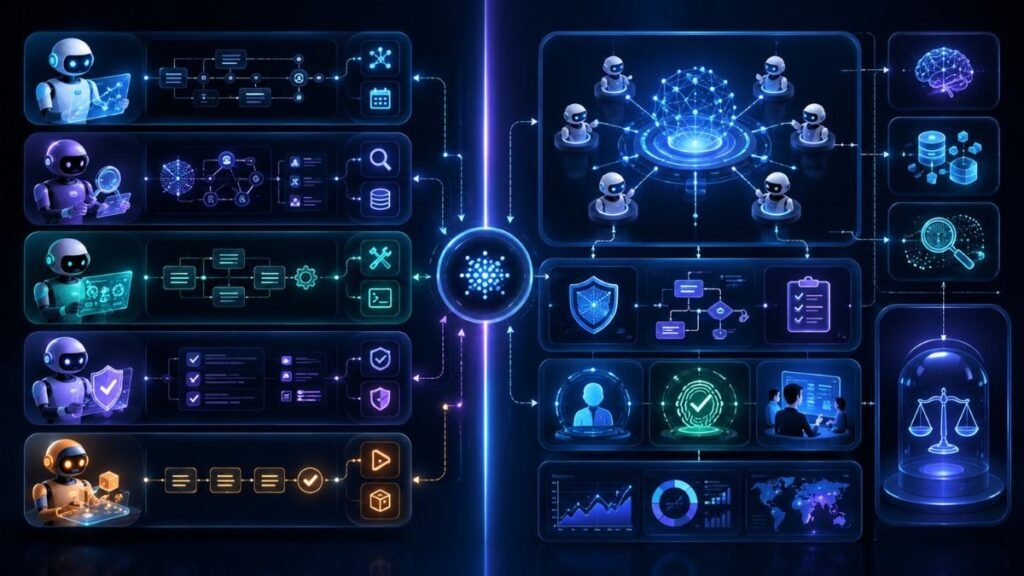
Agentic AI vs AI agents is mostly a difference between the broader system and the software component. An AI agent is a program that can pursue a goal and perform tasks. Agentic AI is the broader approach or system design that uses agents, tools, memory, planning, and feedback to complete workflows.
In Simple Terms
Think of an AI agent as a worker.
Think of agentic AI as the full workplace system around that worker.
The agent may research, plan, use tools, or draft a response. The agentic AI system defines the goal, gives the agent context, connects it to tools, controls permissions, monitors actions, and decides when humans should review the result.
So, they are closely related, but they are not always the same thing.
What Is an AI Agent?
An AI agent is a software system that uses AI to complete tasks on behalf of a user or another system.
Google Cloud defines AI agents as software systems that use AI to pursue goals and complete tasks on behalf of users, showing reasoning, planning, memory, and some level of autonomy. AWS describes an AI agent as a software program that can interact with its environment, collect data, and use that data to perform self-directed tasks that meet predetermined goals.
A simple AI agent might:
- Read a user request.
- Choose a tool.
- Retrieve information.
- Draft a response.
- Ask for approval.
- Return a final answer.
For example, a support agent may read a ticket, retrieve the relevant help-center article, and draft a reply for a human support specialist.
What Is Agentic AI?
Agentic AI is the broader design pattern or system category where AI can act toward goals with limited supervision.
Google Cloud describes agentic AI as AI focused on autonomous decision-making and action, where systems can set goals, plan, and execute tasks with minimal human intervention. IBM describes agentic AI as broader than a single AI agent: agentic AI is the broader concept of solving issues with limited supervision, while an AI agent is a specific component within that system.
Agentic AI usually includes more than one piece:
- A goal or task.
- One or more AI agents.
- Planning logic.
- Memory or context.
- Tools and APIs.
- Retrieval or RAG.
- Human approval.
- Observability and governance.
That is why agentic AI is better understood as a system, not just a single model or chatbot.
Agentic AI vs AI Agents: Quick Comparison
| Feature | AI Agent | Agentic AI |
| Meaning | A software entity that performs tasks | Broader system or design approach |
| Scope | Usually one component or worker | Full workflow or ecosystem |
| Main job | Act toward a task or goal | Coordinate goal-driven AI behavior |
| Includes tools? | Often, yes | Usually includes tool governance |
| Includes memory? | Often, yes | Usually includes memory strategy |
| Includes governance? | Not always | Should include oversight and controls |
| Example | A coding agent that runs tests | A coding workflow with planner, coder, reviewer, tools, logs, and approvals |
The simplest rule is this: AI agents are the actors; agentic AI is the system that lets those actors work toward goals.
Are They Ever Used Interchangeably?
Yes. In everyday writing, people often use “agentic AI” and “AI agents” almost interchangeably. That is understandable because both terms refer to AI systems that can act with some autonomy.
But for technical and business planning, the distinction matters.
If someone says, “We need an AI agent,” they may mean one task-specific assistant. If someone says, “We need agentic AI,” they may mean a larger workflow: orchestration, tools, policies, memory, evaluation, human approval, and monitoring.
A 2025 arXiv taxonomy paper also argues that AI agents and agentic AI need clearer conceptual separation. It characterizes AI agents as modular systems for narrow task automation, while agentic AI represents a broader shift involving dynamic task decomposition, persistent memory, multi-agent collaboration, and orchestrated autonomy.
How AI Agents Fit Inside Agentic AI Systems
An agentic AI system may use one agent or many agents.
In a single-agent setup, one agent handles most of the workflow. For example, a customer support agent may classify a ticket, retrieve policy, draft a response, and escalate risky cases.
In a multi-agent setup, different agents specialize. One agent plans, another retrieves information, another writes, and another reviews. Microsoft’s Agent Framework documentation describes individual agents that process inputs, call tools and MCP servers, and generate responses, as well as graph-based workflows that connect agents and functions for multi-step tasks with checkpointing and human-in-the-loop support.
That shows the relationship clearly: agents do the work, while the agentic system organizes how the work happens.
Example: Customer Support
A single AI agent might read a support ticket and draft a reply.
An agentic AI system for support might do more:
- Classify the customer issue.
- Retrieve account history.
- Check the refund policy.
- Ask a policy-checking agent to verify the response.
- Draft the reply.
- Escalate refund approval to a human.
- Log the full trace for audit.
The AI agent is part of the workflow. The agentic AI system is the full workflow.
Example: Coding
A coding agent might inspect a file and suggest a fix.
An agentic AI system for coding might include a planner agent, code-editing agent, test-running tool, reviewer agent, sandbox, pull-request workflow, and human approval step.
The difference matters because coding tasks can affect real repositories. A serious agentic AI system needs permissions, tests, logs, and rollback, not just a code-generating model.
Example: Business Operations
An AI agent may schedule a meeting.
An agentic AI system may identify the need for a meeting, check calendars, draft the agenda, retrieve relevant documents, notify participants, update a CRM, and escalate conflicts to a human.
That is why agentic AI is often described as workflow-oriented AI. It is not just about one smart assistant; it is about connecting AI to real business processes.
Common Mistakes to Avoid
The first mistake is treating every chatbot as an AI agent. A chatbot that only answers questions is not necessarily an agent. An agent usually has a goal, some autonomy, and often tool access.
The second mistake is treating one AI agent as a complete agentic AI strategy. A useful enterprise system also needs context engineering, security, evaluation, observability, and governance.
The third mistake is giving agents too much autonomy too early. Start with agents that observe, advise, or draft. Add supervised actions before allowing narrow autonomous actions.
Risks and Limitations
AI agents can fail by misunderstanding the goal, choosing the wrong tool, using stale memory, retrieving irrelevant context, or taking unsafe actions.
Agentic AI systems add more system-level risks: poor orchestration, unclear accountability, weak monitoring, prompt injection, excessive permissions, and multi-agent coordination failures.
A recent research article on terminology warns that “agentic AI” is sometimes used as a buzzword for concepts already studied under autonomous agents and multi-agent systems. This is a useful caution: teams should focus less on labels and more on architecture, safety, and measurable workflow value.
Suggested Read:
- What Is Agentic AI? A Practical Guide for Beginners
- Agentic AI Explained Simply: How It Differs From Traditional AI
- How Agentic AI Works: Planning, Memory, Tools, and Action
- Agentic AI Architecture Explained Simply
- Single-Agent vs Multi-Agent Systems in Agentic AI
- How to Evaluate Agentic AI Systems
- Agentic AI Governance: Risks, Controls, and Accountability
- Best Agentic AI Frameworks for Developers in 2026
FAQ: Agentic AI vs AI Agents
Are agentic AI and AI agents the same thing?
Not exactly. AI agents are software components that perform tasks. Agentic AI is the broader system or design approach that uses agents, tools, memory, planning, and oversight to complete goals.
What is the difference between agentic AI and AI agents?
An AI agent is usually one actor in the system. Agentic AI describes the overall goal-driven AI system or paradigm that may include one or more agents.
What is an AI agent?
An AI agent is a software system that uses AI to pursue goals, make decisions, use context, and complete tasks on behalf of a user or system.
What is agentic AI?
Agentic AI is AI designed to plan, act, use tools, remember context, and complete workflows with limited human supervision.
Can AI agents be part of agentic AI?
Yes. AI agents are often the core building blocks inside agentic AI systems.
Is every AI agent agentic AI?
Not always. A simple AI agent may perform one narrow task. Agentic AI usually refers to a broader goal-driven system with planning, tools, feedback, and oversight.
Final Takeaway
Agentic AI vs AI agents is best understood as system versus component. AI agents are the software actors that perform tasks. Agentic AI is the broader goal-driven system that coordinates agents, tools, memory, workflows, evaluation, and human oversight.
To continue learning, read What Is Agentic AI?, How Agentic AI Works, and Agentic AI Architecture Explained next.