
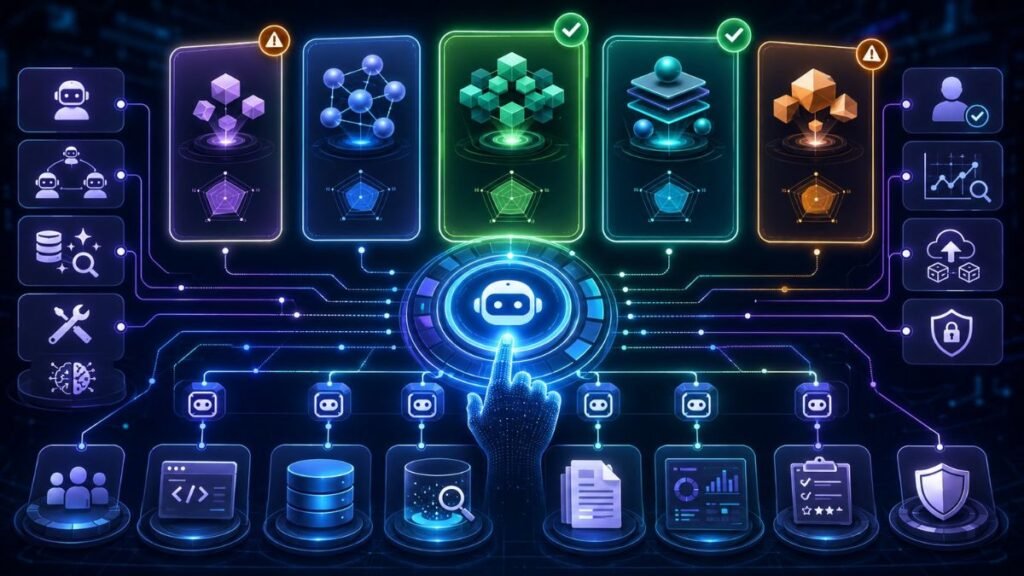
How to choose the right agentic AI framework depends on what your agent must do: follow a fixed workflow, use tools, retrieve documents, remember context, coordinate multiple agents, pause for human approval, or run in production. The best framework is the one that matches your workflow complexity, not the one with the most hype.
In Simple Terms
An agentic AI framework helps developers build AI agents that can plan, use tools, retrieve context, remember information, and complete tasks.
But not every project needs the same framework. A simple support assistant may only need an LLM API, retrieval, and a few tools. A production workflow with approvals, retries, state, and audit logs may need a stronger orchestration framework such as LangGraph, Google ADK, Microsoft Agent Framework, or another production-ready stack.
First Ask: Do You Really Need an Agentic AI Framework?
Before comparing frameworks, ask whether your task actually needs one.
You may not need a full framework if the workflow is simple: one model call, one or two tools, clear input, and a predictable output. OpenAI’s agent guidance describes agents as applications that plan, call tools, collaborate across specialists, and maintain enough state to complete multi-step work. If your app does not need those abilities, a simpler API workflow may be easier.
Use a framework when you need state, multi-step execution, tool orchestration, memory, human approvals, retries, tracing, evaluation, or multi-agent collaboration.
Step 1: Map the Workflow Shape
Start with the workflow, not the framework name.
Ask what the agent must do from start to finish. Does it answer questions from documents? Does it update business systems? Does it coordinate specialists? Does it need a human approval step? Does it need to resume later?
| Workflow Type | Better Framework Fit |
| Simple tool-using agent | OpenAI Agents SDK or lightweight API logic |
| Stateful production workflow | LangGraph |
| Google Cloud enterprise agent | Google ADK |
| Microsoft enterprise workflow | Microsoft Agent Framework |
| Role-based multi-agent process | CrewAI |
| Document/RAG agent | LlamaIndex or Haystack |
| Coding/software agent | OpenHands |
This simple mapping prevents over-engineering.
Step 2: Check State and Durable Execution
State is one of the most important selection criteria. A production agent may need to remember completed steps, resume after delay, retry failed actions, or pause for review.
LangGraph is strong here because its documentation emphasizes durable execution, streaming, and human-in-the-loop capabilities for agent orchestration. LangGraph’s durable execution documentation also explains that its persistence layer saves workflow state so a process can resume without reprocessing completed steps.
Choose strong state management when agents handle long-running tasks, approvals, customer cases, coding workflows, or business processes. For short interactions, simpler state may be enough.
Step 3: Evaluate Tool Calling and Permissions
Agentic AI becomes powerful when agents use tools. It also becomes risky.
Check whether the framework supports clean tool definitions, typed arguments, permission boundaries, validation, retries, and tool-call tracing. If the agent can write to files, execute SQL, send messages, issue refunds, or update records, the framework should support human approval and logs.
LangChain’s human-in-the-loop middleware, for example, can pause execution when a model proposes a tool action that requires review, such as writing to a file or executing SQL.
A good framework should make risky actions visible and controllable.
Step 4: Decide Whether You Need Multi-Agent Orchestration
Do not choose a multi-agent framework just because it sounds advanced. Multi-agent systems add cost, latency, coordination problems, and debugging complexity.
Use multi-agent orchestration when the task genuinely benefits from role separation. For example, a coding system may need planner, developer, tester, and reviewer agents. A research workflow may need source finder, extractor, synthesizer, and fact-checker roles.
Google ADK supports composing multiple agents into multi-agent systems and also supports graph-based workflows that mix AI-powered agents with deterministic code. CrewAI is also useful when you want role-based crews and flows.
Start with a single-agent baseline. Add agents only when specialization improves reliability.
Step 5: Check RAG and Data Integration Needs
If your agent’s main job is answering from documents, searching knowledge bases, or working with PDFs, the framework should support retrieval well.
LlamaIndex and Haystack are strong candidates for data-heavy and RAG-heavy systems. They help with connectors, indexing, retrieval, reranking, document workflows, and pipeline control. LangGraph can also orchestrate RAG workflows, but it is not only a retrieval framework.
Choose based on where the hard part is. If the hard part is document retrieval, choose a data/RAG-first stack. If the hard part is long-running workflow orchestration, choose a stateful agent framework.
Step 6: Compare Observability and Evaluation
Agent frameworks should help you inspect what the agent did. You need traces, model calls, tool calls, retrieved context, memory events, errors, latency, cost, and human approvals.
Without observability, agent failures become black boxes. You cannot know whether the agent misunderstood the goal, retrieved bad context, called the wrong tool, or failed during handoff.
OpenAI’s newer agent tools emphasize building and evaluating agent workflows with tracing and related tooling, while Microsoft Agent Framework includes telemetry as part of its enterprise feature set.
Choose a framework that supports your evaluation process, not just your demo.
Step 7: Review Deployment and Ecosystem Fit
Framework choice should match your deployment environment.
Google ADK is a natural fit for teams building around Gemini, Vertex AI, and Google Cloud. Its official site positions ADK as a path from prompts and tool calls to multi-agent orchestration, graph workflows, performance evaluation, and enterprise deployment. Microsoft Agent Framework fits teams using Azure, .NET, Python, Semantic Kernel, telemetry, and enterprise workflows; Microsoft says it combines AutoGen abstractions with Semantic Kernel features such as state management, type safety, filters, telemetry, and model support. OpenAI Agents SDK is a good fit for OpenAI-centered applications. LangGraph is strong when you want model-flexible orchestration and durable control.
Step 8: Consider Security and Governance
Agent frameworks connect models to tools, memory, APIs, files, browsers, and business systems. That means the framework must support secure design.
Look for:
- Least-privilege tool access.
- Human approval for risky actions.
- Traceable tool calls.
- Sandboxing for code or browser tasks.
- Memory controls.
- Audit logs.
- Deployment controls.
- Clear ownership.
OpenHands is notable for software engineering agents because its SDK paper describes sandboxed execution, lifecycle control, model-agnostic routing, and built-in security analysis for coding workflows.
For regulated or enterprise use, governance support may matter more than fast prototyping.
Decision Table: Which Framework Should You Choose?
| Need | Best Starting Point |
| Durable stateful workflows | LangGraph |
| OpenAI-native tool agents | OpenAI Agents SDK |
| Google Cloud multi-agent apps | Google ADK |
| Microsoft enterprise agents | Microsoft Agent Framework |
| Role-based agent teams | CrewAI |
| Document and RAG agents | LlamaIndex or Haystack |
| Coding agents | OpenHands |
| Simple fixed workflow | LLM API + app logic |
Common Mistakes to Avoid
The first mistake is choosing the most popular framework instead of the right fit. A framework that is excellent for orchestration may be unnecessary for a simple RAG assistant.
The second mistake is building multi-agent systems too early. Recent research argues that for some procedural tasks, simpler in-context approaches can outperform external orchestration, though this is task-dependent and should be tested rather than assumed.
The third mistake is ignoring production needs. A demo can work without strong tracing, permissions, evaluation, and deployment controls. A real agent cannot.
Suggested Read:
- Best Agentic AI Frameworks for Developers in 2026
- What Is Agentic AI? A Practical Guide for Beginners
- How Agentic AI Works: Planning, Memory, Tools, and Action
- Agentic AI Architecture Explained Simply
- Single-Agent vs Multi-Agent Systems in Agentic AI
- How to Evaluate Agentic AI Systems
- Observability for Agentic AI: What Teams Need to Track
- Agentic AI Security Risks You Should Understand
FAQ: How to Choose the Right Agentic AI Framework
How do you choose the right agentic AI framework?
Choose based on workflow complexity, tool needs, state management, memory, RAG, multi-agent requirements, observability, security, deployment environment, and team skills.
What should developers look for in an AI agent framework?
Look for tool calling, state, memory, human-in-the-loop support, tracing, evaluation, deployment support, security controls, and ecosystem fit.
Do you need an agentic AI framework?
Not always. Simple workflows may only need an LLM API and application logic. Use a framework when the workflow becomes multi-step, stateful, tool-heavy, or production-critical.
Which agent framework is best for production?
LangGraph, Google ADK, Microsoft Agent Framework, Haystack, OpenAI Agents SDK, and OpenHands can be production candidates depending on workflow and environment.
Which framework is best for multi-agent systems?
Google ADK, Microsoft Agent Framework, CrewAI, LangGraph, and OpenAI Agents SDK can support multi-agent workflows. Choose based on orchestration style and deployment needs.
What is the difference between LangGraph and CrewAI?
LangGraph is stronger for explicit stateful orchestration. CrewAI is often easier for role-based agent crews. The better choice depends on whether you need graph control or role-based collaboration.
Final Takeaway
How to choose the right agentic AI framework comes down to workflow fit. Start with the task, then compare state, tools, RAG, multi-agent needs, observability, security, and deployment. The best framework is not always the biggest one. It is the one that helps your team build a reliable, testable, safe agent.
To continue learning, read Best Agentic AI Frameworks for Developers in 2026, Agentic AI Architecture Explained, and How to Evaluate Agentic AI Systems next.