
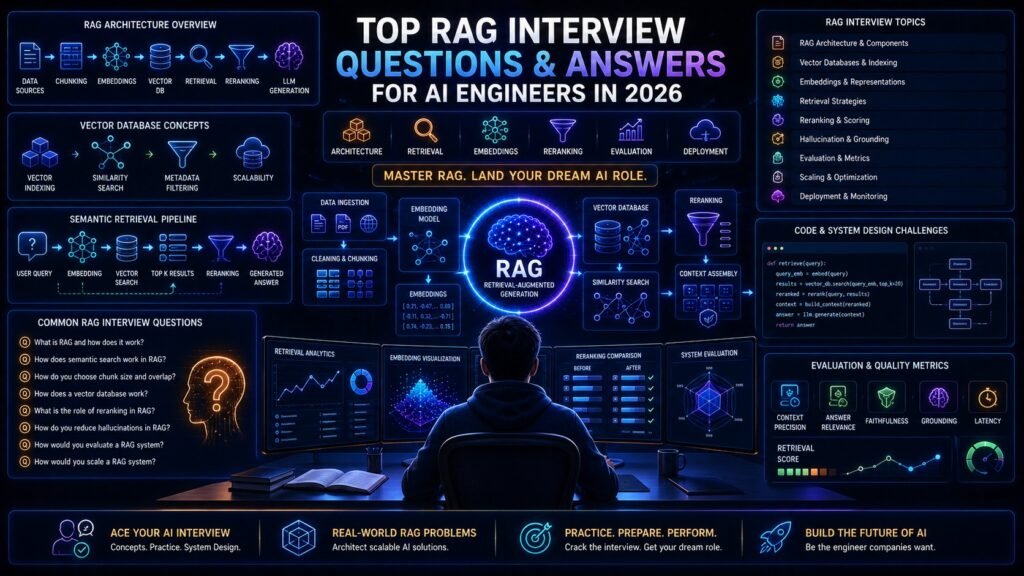
Retrieval-Augmented Generation (RAG) has become one of the most important skills in modern AI engineering.
Companies building AI copilots, enterprise search systems, AI agents, customer support assistants, and document intelligence platforms increasingly expect engineers to understand:
- semantic search
- embeddings
- vector databases
- retrieval pipelines
- reranking
- hallucination reduction
- chunking
- evaluation
- observability
- deployment optimization
As a result,:
RAG interview questions
are becoming common in:
- AI engineer interviews
- LLM engineer interviews
- machine learning system design rounds
- applied AI interviews
- enterprise AI architecture interviews
- GenAI product engineering roles
Interviewers increasingly test whether candidates understand not only theory but also production-grade retrieval systems.
Many candidates know basic LLM concepts but struggle with:
- retrieval architectures
- vector indexing
- hybrid search
- metadata filtering
- context recall
- answer faithfulness
- retrieval evaluation
- production scaling
This guide covers beginner to advanced Retrieval-Augmented Generation interview questions and answers designed for modern AI engineering interviews.
In Simple Terms
What Is RAG?
RAG stands for Retrieval-Augmented Generation.
It improves LLMs by retrieving external information before generating responses.
Instead of relying only on pretrained model memory, RAG systems search external knowledge sources and inject relevant context into prompts.
This improves:
- factual grounding
- enterprise relevance
- hallucination reduction
- real-time information access
Why Companies Ask RAG Interview Questions
Organizations increasingly deploy RAG in:
- enterprise AI
- search systems
- copilots
- document intelligence
- customer support automation
- analytics assistants
- healthcare AI
- legal AI
Interviewers want engineers who understand how production retrieval systems actually work.
Beginner RAG Interview Questions
1. What Is Retrieval-Augmented Generation?
Answer
Retrieval-Augmented Generation is an AI architecture where external information is retrieved before a language model generates a response.
A typical RAG pipeline includes:
- query processing
- embeddings
- vector search
- retrieval
- reranking
- prompt augmentation
- response generation
The main goal is improving factual grounding and reducing hallucinations.
2. Why Is RAG Better Than a Standalone LLM?
Answer
Standalone LLMs rely on pretrained internal knowledge.
RAG systems can access:
- live information
- enterprise documents
- updated databases
- domain-specific knowledge
This improves:
- accuracy
- freshness
- explainability
- enterprise relevance
3. What Are Embeddings?
Answer
Embeddings are numerical vector representations of semantic meaning.
Text with similar meaning tends to produce embeddings located close together in vector space.
Embeddings allow semantic retrieval instead of simple keyword matching.
4. What Is a Vector Database?
Answer
A vector database stores embeddings and supports similarity search.
Examples include:
These systems help retrieve semantically relevant content efficiently.
5. What Is Semantic Search?
Answer
Semantic search retrieves information based on meaning rather than exact keyword matches.
This improves retrieval quality for natural-language queries.
Intermediate RAG Interview Questions
6. How Does a RAG Pipeline Work?
Answer
A typical RAG pipeline includes:
- user query
- query embedding
- vector similarity search
- retrieval filtering
- reranking
- context assembly
- prompt construction
- LLM generation
Each stage affects answer quality.
7. What Is Chunking in RAG?
Answer
Chunking splits documents into smaller sections before embedding.
Good chunking improves retrieval precision and context quality.
Common chunking strategies include:
- fixed-size chunking
- semantic chunking
- sliding-window chunking
- hierarchical chunking
8. Why Is Chunk Size Important?
Answer
Chunk size affects:
- retrieval precision
- context density
- latency
- token usage
Small chunks improve precision but may lose context.
Large chunks preserve context but may reduce retrieval accuracy.
9. What Is Hybrid Search?
Answer
Hybrid search combines:
- semantic vector search
- keyword search
This improves retrieval quality when exact terminology matters.
10. What Is Metadata Filtering?
Answer
Metadata filtering restricts retrieval based on metadata fields such as:
- department
- customer
- timestamp
- region
- permissions
It improves precision and access control.
Advanced RAG Interview Questions
11. What Is Reranking in RAG?
Answer
Reranking improves retrieval quality after initial retrieval.
The system first retrieves candidate documents, then reranks them using a stronger relevance model.
This improves answer grounding significantly.
12. What Causes Hallucinations in RAG Systems?
Answer
Hallucinations may occur due to:
- weak retrieval
- irrelevant chunks
- incomplete context
- prompt issues
- noisy documents
- poor reranking
Even grounded systems can hallucinate if retrieval quality is weak.
13. What Is Context Recall?
Answer
Context recall measures whether relevant information was successfully retrieved.
Low context recall means important evidence was missed.
14. What Is Answer Faithfulness?
Answer
Answer faithfulness measures whether the generated answer stays grounded in retrieved evidence.
A faithful answer should not invent unsupported claims.
15. What Is Retrieval Precision?
Answer
Retrieval precision measures how many retrieved chunks are actually relevant.
High precision improves generation quality.
RAG System Design Interview Questions
16. How Would You Design a Production RAG System?
Answer
A production RAG system typically includes:
- ingestion pipelines
- embeddings
- vector databases
- retrieval orchestration
- reranking
- LLM inference
- observability
- monitoring
- evaluation
- access control
Interviewers often expect discussion of scalability, latency, and security.
17. How Would You Reduce RAG Latency?
Answer
Latency optimization strategies include:
- embedding caching
- retrieval optimization
- smaller reranking stages
- async pipelines
- efficient vector indexes
- query rewriting optimization
18. How Would You Scale a RAG System?
Answer
Scaling strategies include:
- distributed vector search
- caching
- sharding
- retrieval batching
- asynchronous orchestration
- optimized inference routing
19. How Would You Handle Multi-Tenant Retrieval?
Answer
Use:
- metadata filtering
- tenant isolation
- access control
- namespace separation
- retrieval-aware authorization
Security becomes critical in enterprise systems.
20. How Would You Secure a RAG Pipeline?
Answer
Security measures include:
- prompt injection filtering
- access control
- encrypted vector storage
- API protection
- retrieval validation
- logging controls
- red-team testing
Vector Database Interview Questions
21. Why Use a Vector Database Instead of SQL Search?
Answer
SQL search mainly supports exact matching.
Vector databases support semantic similarity search.
This enables retrieval based on meaning.
22. What Is Approximate Nearest Neighbor Search?
Answer
ANN search improves retrieval speed by approximating nearest vectors instead of calculating exact distances across all embeddings.
This enables large-scale semantic retrieval.
23. What Is Cosine Similarity?
Answer
Cosine similarity measures angle similarity between vectors.
It is commonly used for embedding similarity search.
24. What Are Common Vector Index Types?
Answer
Common index types include:
- HNSW
- IVF
- PQ
- Flat indexes
Different indexes optimize:
- latency
- memory usage
- retrieval accuracy
25. Why Is HNSW Popular?
Answer
HNSW balances:
- speed
- scalability
- retrieval quality
It is widely used in production vector systems.
Embedding Interview Questions
26. Why Are Embeddings Important?
Answer
Embeddings enable semantic understanding for retrieval systems.
Without embeddings, semantic search would not work effectively.
27. What Makes a Good Embedding Model?
Answer
A good embedding model provides:
- semantic consistency
- domain relevance
- strong retrieval performance
- low latency
- multilingual support when needed
28. Can Embeddings Leak Information?
Answer
Potentially yes.
Some research suggests embeddings may expose partial information about source data.
This creates enterprise security considerations.
Evaluation Interview Questions
29. How Do You Evaluate RAG Systems?
Answer
Common evaluation metrics include:
- context recall
- retrieval precision
- answer faithfulness
- groundedness
- latency
- hallucination rate
30. Why Is Human Evaluation Important?
Answer
Automated metrics cannot capture all quality dimensions.
Human evaluation helps assess:
- usefulness
- correctness
- trustworthiness
- business relevance
31 What Is Groundedness?
Answer
Groundedness measures whether generated responses are supported by retrieved evidence.
Query Optimization Questions
32. What Is Query Rewriting?
Answer
Query rewriting improves retrieval by transforming user queries into more retrieval-friendly forms.
This can improve recall significantly.
33. Why Is Query Expansion Useful?
Answer
Query expansion adds related terms or semantic variants to improve retrieval quality.
34. What Is Multi-Query Retrieval?
Answer
The system generates multiple query variations and combines retrieved results.
This improves retrieval coverage.
Enterprise RAG Interview Questions
35. What Are Common Enterprise RAG Challenges?
Answer
Common challenges include:
- permissions
- scaling
- latency
- observability
- hallucinations
- retrieval quality
- security
- cost optimization
36. Why Is Observability Important in RAG?
Answer
Observability helps monitor:
- retrieval quality
- failures
- hallucinations
- latency
- prompt behavior
- system drift
37. What Is RAG Monitoring?
Answer
Monitoring tracks production system behavior continuously.
This helps detect:
- degraded retrieval
- hallucinations
- infrastructure failures
- abnormal queries
Comparison Interview Questions
38. RAG vs Fine-Tuning?
Answer
RAG retrieves external knowledge dynamically.
Fine-tuning changes model weights permanently.
RAG is often better for changing enterprise knowledge.
Fine-tuning is useful for behavioral adaptation.
39. RAG vs Long Context Windows?
Answer
Long context windows allow larger prompts.
RAG retrieves only relevant information dynamically.
RAG is usually more scalable for large knowledge bases.
40. RAG vs Semantic Search?
Answer
Semantic search retrieves relevant documents.
RAG combines retrieval with LLM generation.
Agentic RAG Interview Questions
41. What Is Agentic RAG?
Answer
Agentic RAG combines retrieval with:
- planning
- reasoning
- tool calling
- workflow execution
This enables more autonomous AI systems.
42. Why Is Agentic RAG Important?
Answer
It enables:
- complex workflows
- multi-step reasoning
- adaptive retrieval
- dynamic planning
Security Interview Questions
43. What Is Prompt Injection?
Answer
Prompt injection occurs when malicious instructions manipulate the model through retrieved content.
44. What Is Retrieval Poisoning?
Answer
Attackers intentionally manipulate retrieval data to influence generated answers.
45. Why Are Access Controls Important?
Answer
Weak permissions may expose sensitive enterprise data through retrieval pipelines.
Deployment Interview Questions
46. What Makes RAG Deployment Difficult?
Answer
Challenges include:
- scaling
- latency
- monitoring
- retrieval quality
- infrastructure cost
- observability
- security
47. How Do You Optimize RAG Cost?
Answer
Optimization strategies include:
- caching
- smaller embeddings
- retrieval tuning
- token optimization
- query routing
48. Why Is Caching Important?
Answer
Caching reduces repeated retrieval and inference costs.
It also improves latency.
Scenario-Based Interview Questions
49. Your RAG System Returns Irrelevant Answers. What Would You Debug First?
Answer
Check:
- chunking
- embeddings
- retrieval quality
- metadata filtering
- reranking
- prompt construction
50. Users Report Hallucinated Responses. What Would You Do?
Answer
Investigate:
- retrieval precision
- context recall
- reranking quality
- prompt grounding
- hallucination monitoring
Tips for Answering RAG Interview Questions
Focus on Systems Thinking
Interviewers increasingly prefer candidates who understand complete AI pipelines rather than isolated concepts.
Explain Trade-Offs
Good answers compare:
- latency vs quality
- retrieval vs context windows
- cost vs performance
- scaling vs complexity
Use Real Production Examples
Enterprise examples improve interview performance significantly.
Understand Failure Modes
Strong candidates explain:
- hallucinations
- retrieval failures
- scaling bottlenecks
- observability gaps
- security risks
Most Important Topics to Study Before a RAG Interview
| Topic | Importance |
| Embeddings | Critical |
| Vector Databases | Critical |
| Chunking | Critical |
| Retrieval Pipelines | Critical |
| Hybrid Search | High |
| Reranking | High |
| Evaluation Metrics | High |
| Hallucination Reduction | High |
| Monitoring | Medium |
| Security | Medium |
Future of RAG Interviews
RAG interviews are evolving rapidly.
Companies increasingly test:
- production deployment knowledge
- AI system design
- retrieval optimization
- observability
- security
- agentic AI workflows
- enterprise infrastructure design
Future interviews will likely focus even more on production AI engineering rather than theoretical ML alone.
Suggested Read:
- What Is RAG in AI
- How RAG Works
- Vector Database for RAG
- Chunking Strategies for RAG
- RAG Evaluation Metrics
- Reducing Hallucinations in RAG
- RAG Security Risks
FAQ: Top RAG Interview Questions and Answers
What are the most common RAG interview questions?
Common questions involve embeddings, vector databases, chunking, semantic search, reranking, hallucinations, and evaluation metrics.
How do I prepare for a RAG interview?
Study retrieval pipelines, vector databases, chunking strategies, evaluation metrics, and enterprise deployment challenges.
Are RAG interviews difficult?
They can be challenging because they combine:
- LLMs
- information retrieval
- distributed systems
- AI infrastructure
- production engineering
What skills matter most for RAG engineering roles?
Important skills include:
- semantic retrieval
- embeddings
- vector databases
- orchestration
- evaluation
- observability
- deployment optimization
Do companies ask system design questions for RAG?
Yes. Many AI engineering interviews include architecture and deployment questions.
Final Takeaway
Modern RAG interview questions increasingly focus on real-world AI infrastructure rather than basic LLM theory alone.
Companies want engineers who understand:
- retrieval systems
- vector databases
- embeddings
- semantic search
- reranking
- observability
- evaluation
- enterprise deployment
Candidates who understand how production RAG systems behave under real enterprise conditions will have a major advantage in AI engineering interviews.
As enterprise AI adoption grows, Retrieval-Augmented Generation knowledge is becoming one of the most valuable skills in modern applied AI engineering.