
Modern enterprise AI systems increasingly depend on intelligent retrieval architectures to power:
- AI assistants
- enterprise search systems
- customer support copilots
- document intelligence platforms
- legal AI systems
- healthcare retrieval systems
- knowledge management tools
- research assistants
However, as organizations adopt Large Language Models and AI retrieval pipelines, many teams encounter a major source of confusion:
Is semantic search the same as RAG?
The answer is no.
Although both technologies involve intelligent retrieval systems, they solve different problems and operate at different architectural layers.
This confusion became increasingly common because modern Retrieval-Augmented Generation (RAG) systems often use semantic search internally.
As a result, many people incorrectly assume they are identical technologies.
In reality:
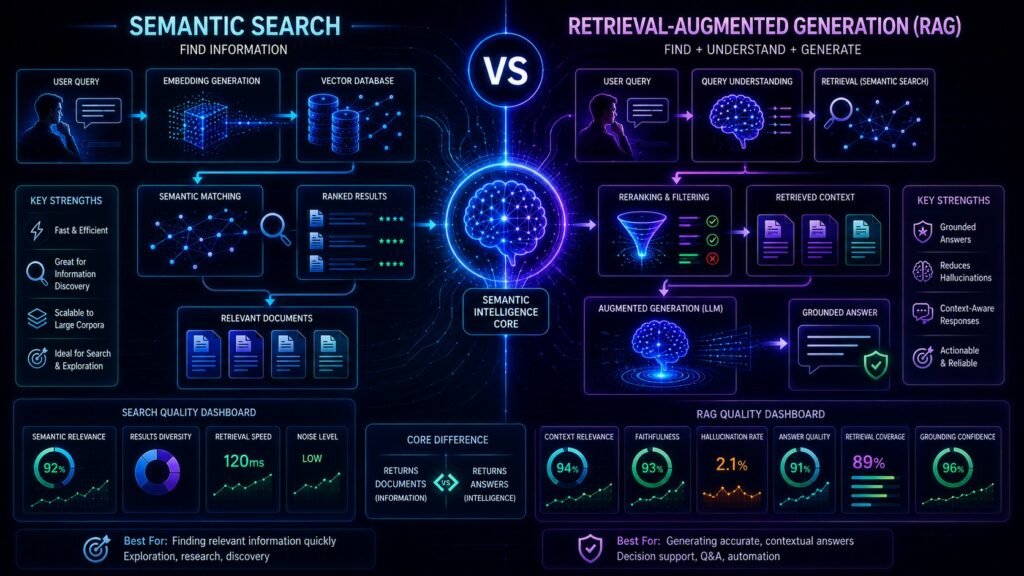
Semantic search is a retrieval technique.
RAG is a full AI generation architecture.
Understanding the distinction is essential for designing scalable enterprise AI systems.
Choosing the wrong architecture may create:
- hallucination risks
- weak grounding
- poor retrieval quality
- scalability issues
- infrastructure inefficiencies
- disappointing enterprise AI performance
Today, organizations increasingly combine semantic search and RAG together to build grounded AI systems capable of retrieving and generating reliable answers.
In this guide, you will learn the differences between semantic search and RAG, how each technology works, enterprise use cases, hallucination implications, infrastructure trade-offs, and why both systems are becoming foundational for modern AI architectures.
In Simple Terms
What Is Semantic Search?
Semantic search retrieves information based on meaning rather than exact keyword matching.
Instead of searching for exact words, semantic search systems understand contextual relationships between concepts.
For example, a semantic search engine understands that:
“refund process”
and
“how customers get their money back”
may refer to similar ideas.
What Is RAG?
Retrieval-Augmented Generation (RAG) combines retrieval systems with Large Language Models.
A RAG system first retrieves relevant information and then uses that information to generate grounded answers.
RAG does not simply retrieve documents.
It generates intelligent responses using retrieved context.
Easy Analogy
Imagine asking a librarian a question.
Semantic search works like the librarian finding relevant books or documents.
RAG works like the librarian reading those documents and then answering your question directly using the retrieved information.
This is the biggest difference.
Semantic search retrieves.
RAG retrieves and generates.
Why Enterprises Compare RAG and Semantic Search
Modern organizations increasingly need AI systems capable of:
- retrieving enterprise knowledge
- answering complex questions
- reducing hallucinations
- understanding context
- generating grounded responses
- scaling across large knowledge bases
Many companies initially adopt semantic search systems.
Later, they evolve toward RAG architectures to improve conversational AI capabilities.
This is why the comparison between RAG vs semantic search became increasingly important in enterprise AI strategy.
Understanding How Semantic Search Works
Semantic search systems use embeddings to represent meaning mathematically.
Instead of relying on keyword overlap, semantic retrieval systems compare semantic similarity between:
- user queries
- documents
- text chunks
- knowledge entries
This enables more context-aware retrieval.
Core Components of Semantic Search
| Component | Purpose |
| Embeddings | Represent semantic meaning |
| Vector Database | Stores searchable embeddings |
| Retriever | Finds semantically related content |
| Ranking System | Prioritizes relevant results |
Semantic search focuses entirely on retrieval quality.
Understanding How RAG Works
RAG systems extend semantic retrieval by adding generation capabilities.
A typical RAG pipeline includes:
- embeddings
- vector databases
- semantic retrieval systems
- reranking pipelines
- prompt assembly systems
- Large Language Models
The retrieved information becomes grounding context for AI generation.
Core Components of a RAG System
| Component | Purpose |
| Retriever | Finds relevant documents |
| Vector Database | Stores semantic embeddings |
| Reranker | Improves retrieval relevance |
| Prompt Builder | Creates grounded prompts |
| LLM | Generates final answer |
RAG systems combine retrieval and generation together.
Why Semantic Search Became Popular
Traditional keyword search systems struggle with contextual understanding.
For example, keyword systems may fail when:
- synonyms differ
- terminology changes
- phrasing varies
- users ask conversational questions
Semantic search solves many of these problems.
This made semantic retrieval foundational for modern enterprise AI systems.
Major Advantages of Semantic Search
Better Contextual Understanding
Semantic search understands meaning instead of exact wording.
Improved Search Experience
Users can ask more natural questions.
Strong Enterprise Search Capabilities
Semantic retrieval improves internal knowledge discovery.
Scalable Document Retrieval
Vector databases enable large-scale semantic retrieval.
Flexible Query Matching
Conceptually similar queries retrieve related content.
Major Limitations of Semantic Search
Despite its strengths, semantic search also has limitations.
No Native Answer Generation
Semantic search retrieves documents but does not generate grounded answers directly.
Users Must Interpret Results
Users often still need to read retrieved content manually.
Hallucination Reduction Is Limited
Semantic retrieval alone does not control generation quality.
Weak Conversational AI Support
Semantic search alone is insufficient for advanced AI assistants.
Retrieval Noise Problems
Weak retrieval pipelines may still return irrelevant information.
Why RAG Became So Important
RAG systems solve one of the biggest weaknesses of standalone Large Language Models:
lack of grounding
Traditional LLMs generate answers from internal pretrained knowledge only.
RAG improves factual grounding by retrieving external information dynamically.
Major Advantages of RAG
Grounded AI Generation
Retrieved context improves factual reliability.
Better Conversational Experiences
Users receive direct AI-generated answers.
Reduced Hallucinations
Grounding reduces unsupported generation.
Enterprise Knowledge Integration
RAG works well with enterprise documents and knowledge bases.
Dynamic Knowledge Updates
Organizations can update documents without retraining models.
Better Multi-Step Question Answering
RAG supports complex reasoning workflows.
Major Limitations of RAG
RAG also introduces challenges.
Infrastructure Complexity
RAG systems contain many moving components.
Higher Latency
Retrieval pipelines increase response time.
Retrieval Dependency
Weak retrieval reduces answer quality significantly.
Context Window Constraints
Large retrieved contexts may exceed token limits.
Monitoring Complexity
Production RAG systems require extensive evaluation and monitoring.
Semantic Search vs RAG: Key Differences
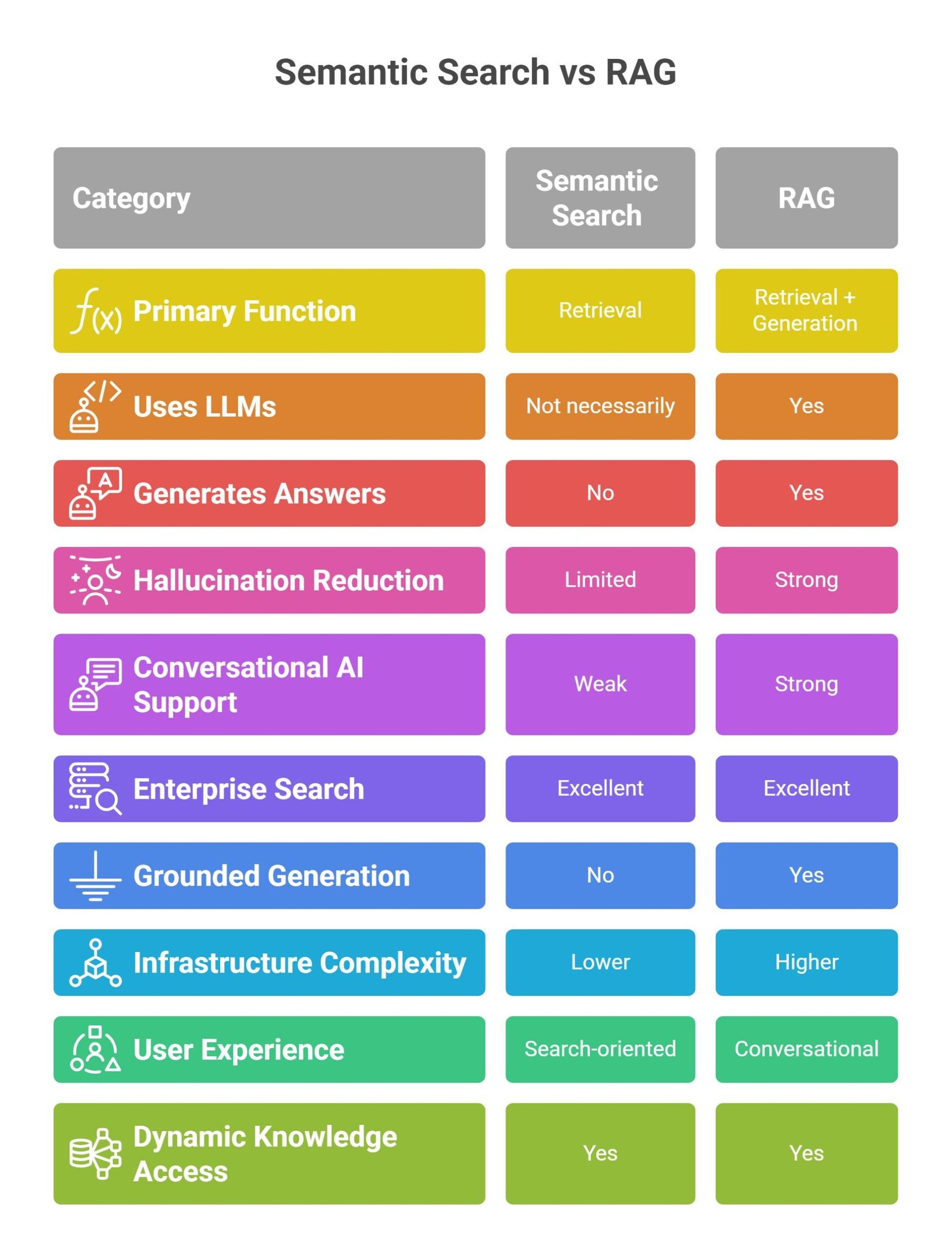
| Category | Semantic Search | RAG |
| Primary Function | Retrieval | Retrieval + Generation |
| Uses LLMs | Not necessarily | Yes |
| Generates Answers | No | Yes |
| Hallucination Reduction | Limited | Strong |
| Conversational AI Support | Weak | Strong |
| Enterprise Search | Excellent | Excellent |
| Grounded Generation | No | Yes |
| Infrastructure Complexity | Lower | Higher |
| User Experience | Search-oriented | Conversational |
| Dynamic Knowledge Access | Yes | Yes |
Why Semantic Search Is Often Part of RAG
One of the most important concepts to understand is this:
Most RAG systems already use semantic search internally.
The retrieval layer inside RAG often depends on:
- embeddings
- vector databases
- semantic similarity search
- contextual ranking systems
This means semantic search is frequently a building block of RAG architectures.
When to Use Semantic Search
Semantic search works best when organizations primarily need:
- enterprise document discovery
- intelligent search experiences
- semantic document matching
- internal knowledge retrieval
- recommendation systems
Best Semantic Search Use Cases
Enterprise Knowledge Search
Employees search internal documentation efficiently.
Ecommerce Product Discovery
Customers find products using natural language.
Research Search Systems
Researchers locate semantically related papers.
Content Recommendation Engines
Platforms suggest semantically relevant content.
Legal Document Retrieval
Law firms search legal databases efficiently.
When to Use RAG
RAG works best when organizations need:
- conversational AI systems
- grounded AI generation
- hallucination reduction
- enterprise AI assistants
- intelligent copilots
- contextual question answering
Best RAG Use Cases
Customer Support AI
Support copilots retrieve and explain troubleshooting guidance.
AI Chatbots
RAG improves conversational reliability significantly.
Healthcare AI Systems
Medical assistants retrieve grounded clinical information.
Legal AI Assistants
AI systems generate grounded legal summaries.
Enterprise AI Assistants
Employees receive direct contextual answers instead of raw documents.
Why RAG Usually Reduces Hallucinations Better
Semantic search retrieves information but does not control how language models generate answers.
RAG explicitly grounds generation using retrieved context.
This significantly reduces hallucination risk.
However, weak retrieval systems may still introduce hallucinations.
This is why retrieval quality remains critical.
Common Enterprise Mistakes
Many organizations misunderstand the relationship between semantic search and RAG.
Assuming Semantic Search Is a Full AI Assistant
Semantic retrieval alone cannot provide grounded conversational AI.
Ignoring Retrieval Quality
Weak retrieval pipelines reduce both semantic search and RAG performance.
Underestimating Infrastructure Complexity
RAG systems require monitoring, evaluation, and orchestration infrastructure.
Treating RAG as Only a Chatbot
RAG architectures support far more than conversational interfaces.
Why Evaluation Matters for Both Systems
Organizations increasingly benchmark:
- retrieval precision
- context recall
- answer faithfulness
- semantic relevance
- hallucination rates
- latency
Continuous evaluation improves enterprise reliability significantly.
Future of Semantic Search and RAG
Enterprise AI architectures are evolving rapidly.
Major trends include:
- multimodal retrieval systems
- agentic RAG pipelines
- reasoning-aware retrieval
- autonomous search orchestration
- hybrid retrieval systems
- retrieval-aware reasoning models
- adaptive semantic retrieval
Future enterprise AI systems will increasingly combine semantic retrieval with grounded AI generation.
Suggested
- What Is RAG in AI
- How RAG Works
- Semantic Search vs RAG
- Hybrid Search in RAG
- Vector Database for RAG
- Embeddings for RAG
- Reducing Hallucinations in RAG
- RAG Evaluation Metrics
FAQ: RAG vs Semantic Search
What is the difference between semantic search and RAG?
Semantic search retrieves relevant information. RAG retrieves information and generates grounded answers using Large Language Models.
Is semantic search part of RAG?
Yes. Many RAG systems use semantic search internally for retrieval.
Which is better for enterprise AI systems?
It depends on the use case. Semantic search is better for retrieval-focused systems. RAG is better for conversational grounded AI systems.
Can semantic search reduce hallucinations?
Not directly. Semantic retrieval improves retrieval quality, but grounded generation requires RAG architectures.
Why is RAG more complex than semantic search?
RAG combines retrieval systems, orchestration layers, and language model generation pipelines.
Final Takeaway
Understanding RAG vs semantic search is essential because retrieval architecture directly affects enterprise AI reliability, grounded generation quality, hallucination reduction, scalability, and user experience.
Semantic search excels at intelligent document retrieval and contextual search experiences, while RAG extends retrieval into grounded AI generation and conversational intelligence.
Organizations that understand how both systems work together can build more scalable, reliable, and production-ready enterprise AI platforms.
That capability is becoming foundational for enterprise AI assistants, semantic search systems, healthcare AI platforms, legal retrieval systems, customer support copilots, and intelligent enterprise knowledge architectures across industries.