
Reducing Hallucinations in RAG: How to Build More Reliable AI Systems
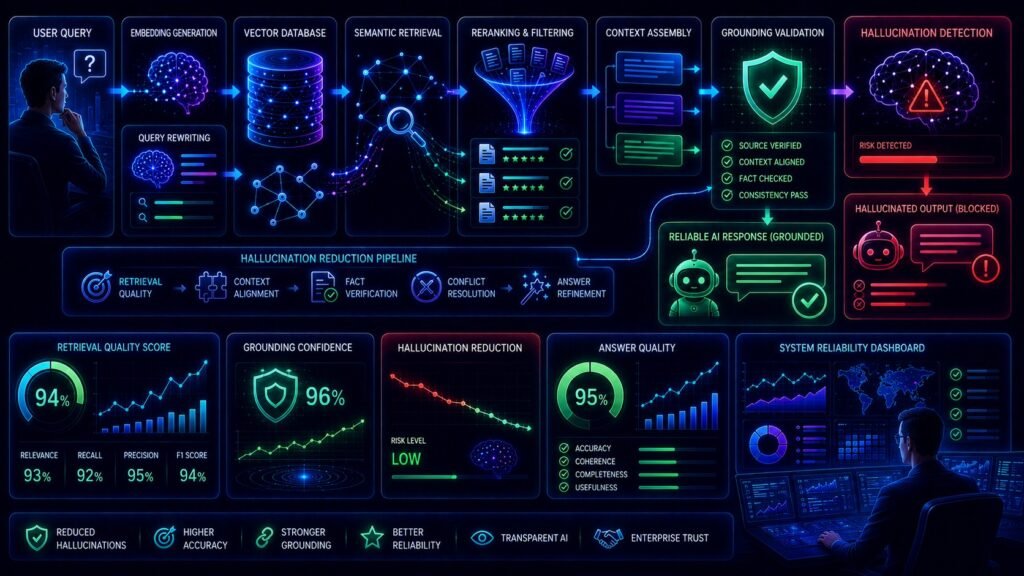
Retrieval-Augmented Generation (RAG) systems became popular because they significantly improved the reliability of Large Language Models.
Unlike standalone LLMs that rely mostly on pretrained model memory, RAG systems retrieve external information from:
- vector databases
- enterprise documents
- semantic search systems
- knowledge bases
- PDFs
- websites
- internal company repositories
before generating responses.
This retrieval layer helps AI systems produce more grounded and context-aware answers.
However, despite these advantages, modern RAG systems still produce hallucinations.
Organizations frequently encounter:
- fabricated answers
- unsupported claims
- irrelevant responses
- incomplete information
- incorrect reasoning
- misleading outputs
This creates one of the biggest challenges in enterprise AI today:
How do you reduce hallucinations in RAG systems?
Many people incorrectly assume that retrieval alone completely solves hallucination problems.
In reality, hallucinations can still happen because RAG systems contain multiple failure points across:
- retrieval pipelines
- embeddings
- chunking systems
- semantic search
- reranking models
- grounding layers
- generation models
Understanding these weaknesses is critical for building reliable enterprise AI systems.
Today, organizations increasingly deploy RAG systems across:
- enterprise AI assistants
- customer support copilots
- healthcare retrieval systems
- legal AI platforms
- ecommerce AI assistants
- research copilots
- intelligent document systems
This makes hallucination reduction one of the most important areas in modern AI engineering.
In this guide, you will learn why RAG systems hallucinate, the biggest causes of hallucinations, and the best techniques enterprises use to build more grounded and trustworthy AI systems.
In Simple Terms
What Is a Hallucination in RAG?
A hallucination happens when the AI generates information that is:
- unsupported
- fabricated
- misleading
- partially incorrect
- disconnected from retrieved evidence
Even if the answer sounds fluent and confident, it may still be wrong.
Why RAG Still Hallucinates
RAG improves AI grounding, but it does not completely eliminate hallucinations.
The AI still depends heavily on:
- retrieval quality
- semantic search accuracy
- chunking quality
- contextual grounding
- reasoning behavior
If any layer fails, hallucinations may still appear.
Easy Analogy
Imagine a research assistant answering questions using a library.
Even if the library contains correct information, problems still happen when:
- the wrong books are retrieved
- important pages are missing
- context is misunderstood
- the assistant invents missing details
That is exactly how hallucinations happen inside RAG systems.
Why Hallucinations Matter in Enterprise AI
Hallucinations are not just minor AI mistakes.
In enterprise environments, hallucinations can create serious risks including:
- compliance failures
- financial losses
- incorrect legal guidance
- healthcare risks
- customer trust issues
- operational disruptions
This is why hallucination reduction became foundational for enterprise AI infrastructure.
The Two Main Causes of RAG Hallucinations
Most hallucinations happen because of failures in two major areas.
| RAG Layer | Failure Type |
| Retrieval Layer | Wrong or missing information |
| Generation Layer | Unsupported or fabricated responses |
Understanding this distinction is critical for improving RAG reliability.
Retrieval Failures That Cause Hallucinations
Many hallucinations originate before generation even begins.
Poor Retrieval Quality
If the retrieval system finds weak or irrelevant documents, the AI receives poor grounding context.
Weak retrieval is one of the biggest causes of hallucinations.
Irrelevant Retrieval Results
Semantic search systems sometimes retrieve documents that are semantically related but contextually incorrect.
Example:
A query about:
“refund approval policy”
may retrieve:
- reimbursement workflows
- accounting reports
- payment disputes
instead of the exact refund policy.
This retrieval noise confuses the language model.
Missing Critical Context
Sometimes retrieval systems fail to retrieve important supporting information.
This often happens because of:
- weak chunking
- poor retrieval depth
- ambiguous queries
- weak embeddings
Incomplete retrieval frequently produces partially correct answers.
Weak Chunking Strategies
Chunking directly affects retrieval quality.
Poor chunking may:
- split workflows incorrectly
- isolate incomplete information
- break semantic continuity
- remove contextual meaning
Weak chunking creates weak grounding.
Incorrect Chunk Sizes
Very small chunks lose context.
Very large chunks introduce retrieval noise.
Finding the right chunk size is critical for hallucination reduction.
Weak Embedding Models
Embeddings represent semantic meaning numerically.
Weak embeddings reduce retrieval precision significantly.
This often happens when:
- general embedding models lack domain understanding
- enterprise terminology is inconsistent
- semantic similarity quality is weak
Better embeddings improve retrieval grounding.
Query Understanding Failures
Users often ask vague questions such as:
- “latest policy”
- “refund issue”
- “pricing workflow”
Weak query understanding reduces retrieval precision.
This increases hallucination risk.
Why Query Rewriting Helps
Modern RAG systems increasingly use query rewriting systems to improve semantic retrieval.
Query rewriting clarifies:
- user intent
- contextual meaning
- domain terminology
This significantly improves grounding quality.
Outdated Knowledge Sources
RAG systems can only retrieve indexed information.
If enterprise data is outdated:
- answers become outdated
- workflows become incorrect
- hallucination risks increase
Continuous data refresh is critical.
Reranking Failures
Many RAG systems use reranking models after retrieval.
Rerankers prioritize the most relevant chunks.
Weak reranking systems may prioritize irrelevant content.
This weakens contextual grounding.
Generation Failures That Cause Hallucinations
Even strong retrieval cannot fully prevent hallucinations.
Large Language Models still generate text probabilistically.
Unsupported Inference
The AI may infer conclusions not fully supported by retrieved evidence.
This creates subtle hallucinations.
Overconfident Generation
LLMs prioritize fluent language generation.
Sometimes the model sounds confident even when evidence is weak.
Weak Grounding Behavior
Grounding means staying connected to retrieved evidence.
Sometimes the model ignores retrieved context partially or completely.
Multi-Step Reasoning Failures
Complex reasoning tasks increase hallucination risk.
The model may:
- connect facts incorrectly
- misunderstand relationships
- combine unrelated information
This is especially dangerous in enterprise AI systems.
Why Enterprise RAG Systems Are Difficult
Enterprise AI environments are highly complex.
Organizations manage:
- large document repositories
- fragmented knowledge systems
- changing workflows
- inconsistent terminology
- multilingual datasets
This creates major retrieval and grounding challenges.
Enterprise Data Is Often Messy
Real enterprise documents frequently contain:
- duplicates
- outdated policies
- inconsistent formatting
- incomplete metadata
- conflicting information
RAG systems struggle when enterprise knowledge quality is weak.
Domain-Specific Terminology Challenges
Industries like:
- healthcare
- finance
- legal
- engineering
require highly specialized semantic understanding.
General embedding models often fail in these environments.
Best Techniques for Reducing Hallucinations in RAG
Modern enterprises increasingly use multiple optimization layers together.
Improve Retrieval Quality
Strong retrieval systems improve grounding significantly.
Organizations increasingly optimize:
- vector search
- semantic retrieval
- retrieval ranking
- contextual matching
Use Better Chunking Strategies
Semantic chunking improves retrieval precision.
Good chunking preserves contextual meaning.
Optimize Chunk Sizes
Balanced chunk sizes improve retrieval quality while preserving semantic continuity.
Use Hybrid Search
Hybrid retrieval combines:
- dense retrieval
- sparse retrieval
This improves precision and reduces retrieval failures.
Add Query Rewriting
Query rewriting improves semantic retrieval by clarifying user intent.
Improve Metadata Filtering
Metadata filtering narrows retrieval to:
- departments
- time periods
- document categories
- access permissions
This improves enterprise retrieval precision.
Use Reranking Models
Rerankers prioritize the most relevant retrieved chunks.
This improves grounding quality significantly.
Use Better Embedding Models
Domain-specific embeddings improve semantic understanding and retrieval accuracy.
Add Grounding Validation Layers
Modern enterprise systems increasingly verify whether generated answers are supported by retrieved evidence.
This reduces unsupported generation.
Use Hallucination Detection Systems
Organizations increasingly deploy AI observability and hallucination monitoring systems.
These systems continuously evaluate:
- faithfulness
- groundedness
- semantic accuracy
- retrieval quality
Human-in-the-Loop Review
Human oversight remains essential for high-risk AI systems.
Especially in:
- healthcare AI
- legal AI
- financial AI
human validation remains critical.
Why Continuous Evaluation Matters
Hallucination reduction is not a one-time optimization task.
Enterprise AI systems require continuous monitoring.
Organizations increasingly benchmark:
- retrieval precision
- groundedness
- faithfulness
- hallucination rates
- contextual relevance
This improves long-term AI reliability.
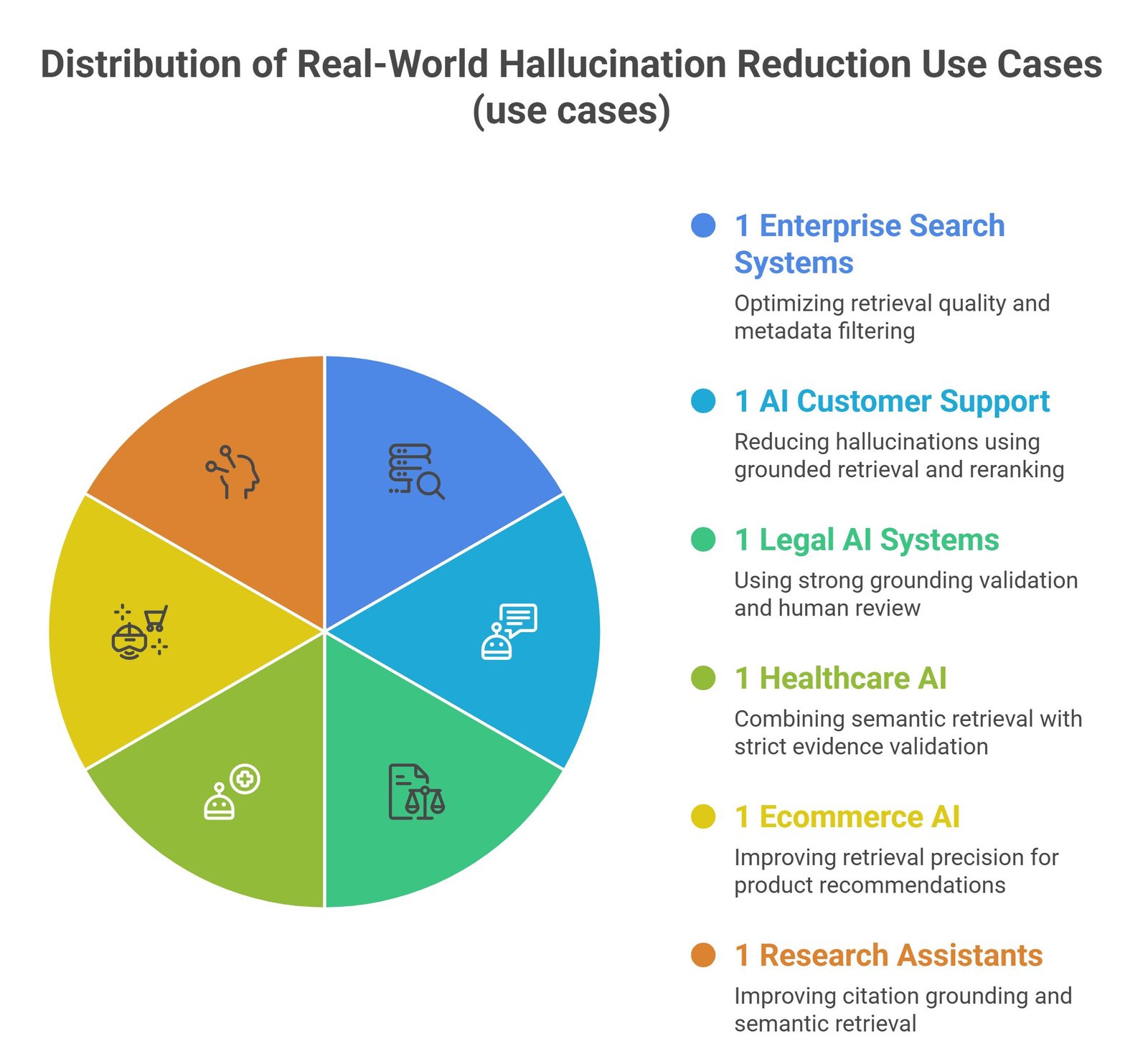
Reducing Hallucinations in RAG: Real-World Use Cases
Enterprise Search Systems
Organizations optimize retrieval quality and metadata filtering.
AI Customer Support
Support copilots reduce hallucinations using grounded retrieval and reranking.
Legal AI Systems
Legal assistants use strong grounding validation and human review.
Healthcare AI
Medical systems combine semantic retrieval with strict evidence validation.
Ecommerce AI
Shopping assistants improve retrieval precision for product recommendations.
Research Assistants
Scientific AI systems improve citation grounding and semantic retrieval.
Future of Hallucination Reduction in RAG
RAG architectures are evolving rapidly.
Major trends include:
- reasoning-aware retrieval
- agentic grounding systems
- autonomous retrieval optimization
- multimodal grounding
- real-time hallucination detection
- adaptive semantic orchestration
- retrieval-aware reasoning systems
Future enterprise AI systems will increasingly rely on intelligent grounding infrastructure and continuous observability.
Suggested Read:
- Why RAG Gives Wrong Answers
- How to Evaluate RAG
- RAG Evaluation Metrics
- Chunking Strategies for RAG
- Best Chunk Size for RAG
- Query Rewriting for RAG
- Hybrid Search in RAG
- Reranking in RAG
FAQ: Reducing Hallucinations in RAG
Why do RAG systems still hallucinate?
Hallucinations happen because retrieval or grounding quality may still fail.
Can RAG completely eliminate hallucinations?
No. RAG significantly reduces hallucinations but cannot eliminate them entirely.
What causes hallucinations in RAG?
Common causes include weak retrieval, poor chunking, weak embeddings, and unsupported generation.
How does chunking affect hallucinations?
Chunking affects retrieval precision and contextual grounding.
What is the best way to reduce hallucinations in RAG?
Organizations combine strong retrieval, query rewriting, reranking, grounding validation, and continuous evaluation.
Final Takeaway
Understanding reducing hallucinations in RAG is essential because hallucination control directly affects enterprise AI trustworthiness, grounded generation, semantic relevance, and production reliability.
Although Retrieval-Augmented Generation dramatically improves AI grounding, hallucinations still emerge when retrieval systems, chunking strategies, semantic search pipelines, reranking systems, or grounding mechanisms fail.
Organizations that optimize these layers together can build more reliable, scalable, and trustworthy enterprise AI systems.
That capability is becoming foundational for enterprise AI assistants, customer support copilots, semantic search systems, legal AI platforms, healthcare retrieval systems, and intelligent document intelligence architectures across industries.