
SLM vs LLM: Key Differences Explained Simply for Beginners
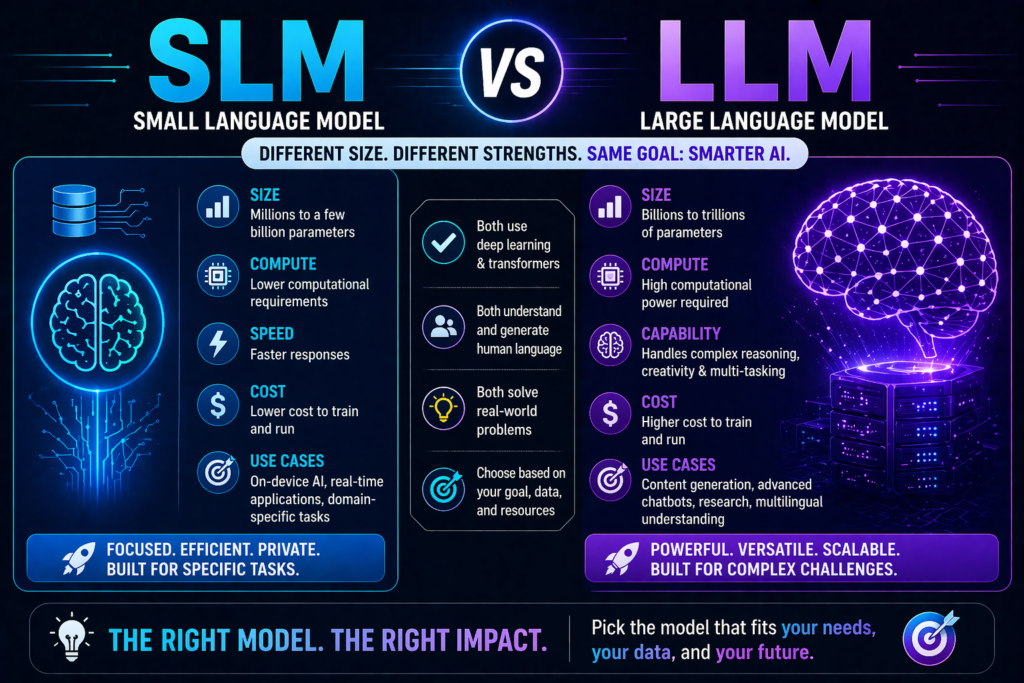
AI language models are evolving quickly. While most people know about Large Language Models (LLMs), another category is becoming more important: Small Language Models (SLMs).
Both can generate text, answer questions, summarize content, and assist workflows. But they are designed for different priorities.
This guide explains SLM vs LLM in simple language so you can understand which model type is better for your needs.
In simple terms
SLM
A Small Language Model is a lighter AI model designed for speed, lower cost, and efficient deployment.
LLM
A Large Language Model is a bigger AI model designed for broader capabilities, stronger reasoning, and higher-quality outputs.
Think of it like:
- SLM = compact efficient car
- LLM = powerful premium vehicle
Both are useful in different situations.
What is an SLM?
SLMs are smaller AI language models with fewer parameters and lower compute requirements.
They are often used for:
- on-device AI
- private deployments
- fast responses
- narrow business tasks
- low-cost automation
- edge computing
Examples may include compact models built by:
What is an LLM?
LLMs are larger models trained on huge datasets with stronger general language ability.
They are often used for:
- advanced chatbots
- reasoning tasks
- coding assistance
- research support
- creative generation
- enterprise copilots
Popular LLM providers include:
- OpenAI
- Anthropic
- Meta
SLM vs LLM: Main Differences
| Feature | SLM | LLM |
| Model Size | Smaller | Larger |
| Speed | Faster | Moderate |
| Cost | Lower | Higher |
| Hardware Need | Lower | Higher |
| Reasoning Depth | Moderate | Stronger |
| General Knowledge | Moderate | Broader |
| Privacy Options | Strong | Depends |
| Mobile Use | Excellent | Limited |
| Enterprise Scale Tasks | Good | Excellent |
Why SLMs are growing fast
Many companies do not need the biggest model for every task.
They need:
- fast customer replies
- internal classification
- summarization
- document tagging
- offline assistants
- private deployments
SLMs can solve these efficiently.
Why LLMs still matter
LLMs remain strong for tasks needing:
- complex reasoning
- broad world knowledge
- long-form writing
- advanced coding
- multi-step planning
- nuanced conversation
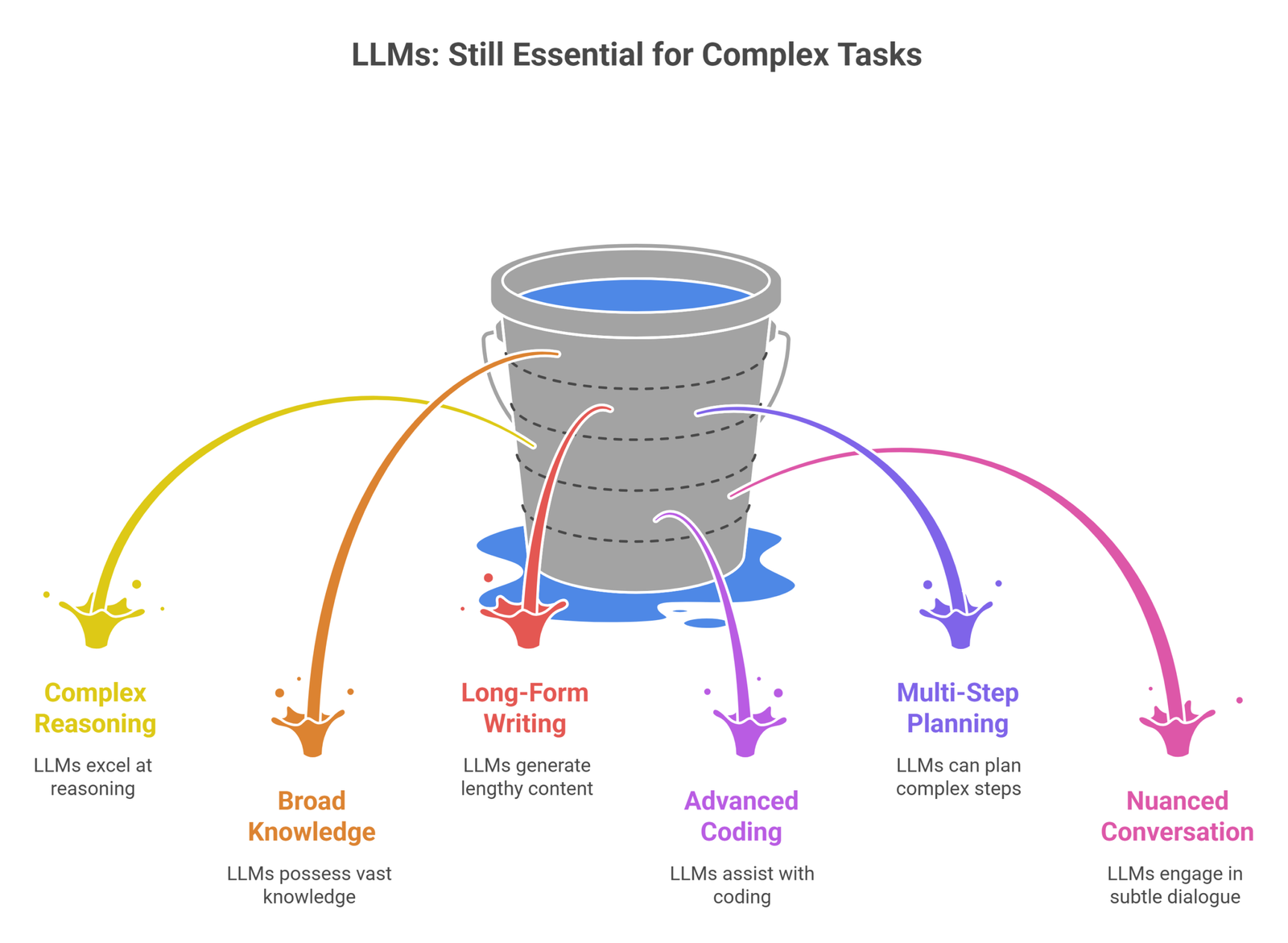
For high-complexity work, LLMs often perform better.
Real-world SLM use cases
1. On-device Assistants
Phones, laptops, offline tools.
2. Customer Support Routing
Ticket classification and triage.
3. Document Summaries
Internal quick summaries.
4. Smart Keyboards
Predictive writing and suggestions.
5. Private Enterprise AI
Local deployment for security needs.
Real-world LLM use cases
1. AI Chat Assistants
Rich conversations and research.
2. Coding Copilots
Generate and explain code.
3. Strategy Support
Analyze scenarios and write reports.
4. Creative Writing
Long-form content creation.
5. AI Agents
Multi-step reasoning with tools.
Which is cheaper?
SLM
Usually cheaper to run due to:
- lower compute
- fewer tokens processed internally
- lighter infrastructure
LLM
Usually more expensive because of:
- larger models
- stronger compute demand
- premium APIs or hosting costs
Which is better for privacy?
SLMs can be strong for privacy because many can run locally or in private environments.
That reduces sending data externally.
LLMs may also offer enterprise privacy options, but deployment model matters.
Which is better for startups?
Depends on the goal.
Choose SLM if you need:
- low cost
- speed
- focused tasks
- offline support
Choose LLM if you need:
- advanced outputs
- broad capability
- premium user experience
- reasoning-heavy workflows
Many startups use both.
Hybrid future: SLM + LLM together
A growing trend is:
- SLM handles simple requests
- LLM handles difficult tasks
This lowers cost while keeping quality high.
Example:
Support bot uses SLM for FAQs and LLM for escalations.
Common misconceptions
Bigger always means better
Not true. Overpowered models waste money for simple tasks.
Small means weak
Modern SLMs can be excellent for targeted workflows.
Only one model is needed
Many companies benefit from multi-model systems.
How to Choose Between SLM vs LLM
Ask:
- How complex is the task?
- What is the budget?
- Is privacy critical?
- Do you need mobile/offline use?
- Is reasoning quality essential?
Your answers guide the right choice.
Suggested Read:
- LLM for Beginners
- LLM Explained Simply
- How LLMs Work
- LLM Training vs Inference
- LLM Use Cases
- How AI Agents Work Explained
FAQ: SLM vs LLM
What is an SLM?
A Small Language Model designed for efficient AI tasks.
What is an LLM?
A Large Language Model built for broad advanced language tasks.
Is SLM faster than LLM?
Often yes, especially for lightweight deployments.
Is LLM smarter than SLM?
Often better on complex reasoning and broader knowledge tasks.
Will SLMs replace LLMs?
Likely no. Both will coexist.
Final takeaway
SLM vs LLM is not about one winner. It is about choosing the right tool for the job.
SLMs win on speed, cost, and efficiency. LLMs win on capability, depth, and complex reasoning. The future of AI will likely combine both.