
RAG vs Prompt Engineering: Which AI Optimization Method Works Better?
Large Language Models changed enterprise AI by enabling systems capable of:
- conversational AI
- enterprise search
- document summarization
- coding assistance
- customer support automation
- workflow orchestration
- research automation
- intelligent reasoning
However, organizations quickly realized something important:
raw LLM performance alone is often not enough for production-grade AI systems.
As enterprises attempted to deploy AI systems across healthcare, finance, legal workflows, customer support, and enterprise knowledge systems, two major optimization strategies became dominant:
Prompt Engineering
and
Retrieval-Augmented Generation (RAG)
Today, one of the biggest questions in enterprise AI architecture is:
Should you optimize AI systems using better prompts or retrieval systems?
This is the foundation of the:
RAG vs Prompt Engineering debate.
At first glance, both approaches appear similar because they improve AI outputs.
But in reality:
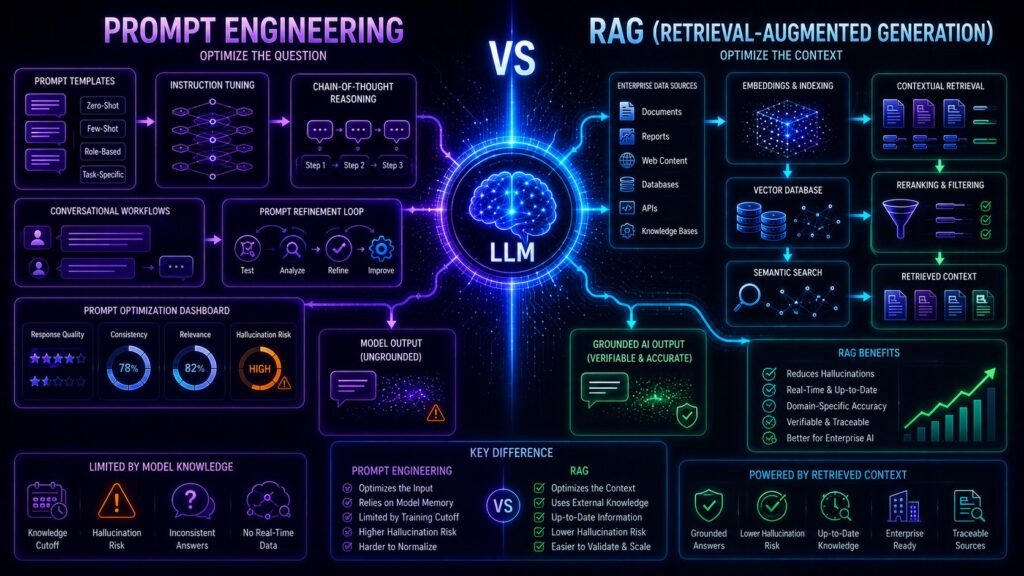
- prompt engineering optimizes how instructions are given to models
- RAG optimizes how external knowledge is retrieved and grounded
These are fundamentally different AI architecture strategies.
Understanding the differences between RAG and prompt engineering is critical because choosing the wrong optimization method may lead to:
- hallucinations
- poor enterprise search quality
- weak contextual grounding
- scalability limitations
- expensive AI infrastructure problems
- unreliable enterprise AI systems
Modern organizations increasingly combine both approaches together.
But knowing when to use each strategy remains extremely important.
In this guide, you will learn how prompt engineering and RAG work, their strengths and weaknesses, enterprise use cases, hallucination implications, scalability trade-offs, infrastructure complexity, and why retrieval-grounded AI systems are rapidly becoming foundational for enterprise AI architectures.
In Simple Terms
What Is Prompt Engineering?
Prompt engineering improves AI outputs by carefully designing instructions for Large Language Models.
This includes techniques such as:
- instruction prompts
- role prompting
- few-shot prompting
- chain-of-thought prompting
- structured templates
- system prompts
The goal is to guide model behavior more effectively.
What Is RAG?
Retrieval-Augmented Generation improves AI systems by retrieving relevant external information before generating responses.
RAG systems use:
- embeddings
- vector databases
- semantic retrieval
- contextual search
- enterprise knowledge retrieval
to ground AI outputs using real information.
Easy Analogy
Imagine asking two employees to solve a problem.
Prompt engineering is like giving better instructions to the employee.
RAG is like giving the employee access to a searchable company knowledge base before answering.
Both improve outcomes, but they solve different problems.
Why Enterprises Compare RAG and Prompt Engineering
Modern enterprise AI systems increasingly require:
- grounded reasoning
- factual reliability
- enterprise knowledge access
- contextual understanding
- hallucination reduction
- scalable AI orchestration
Prompt engineering improves model behavior, but it cannot fundamentally solve missing knowledge problems.
This is why retrieval systems became increasingly important.
Understanding How Prompt Engineering Works
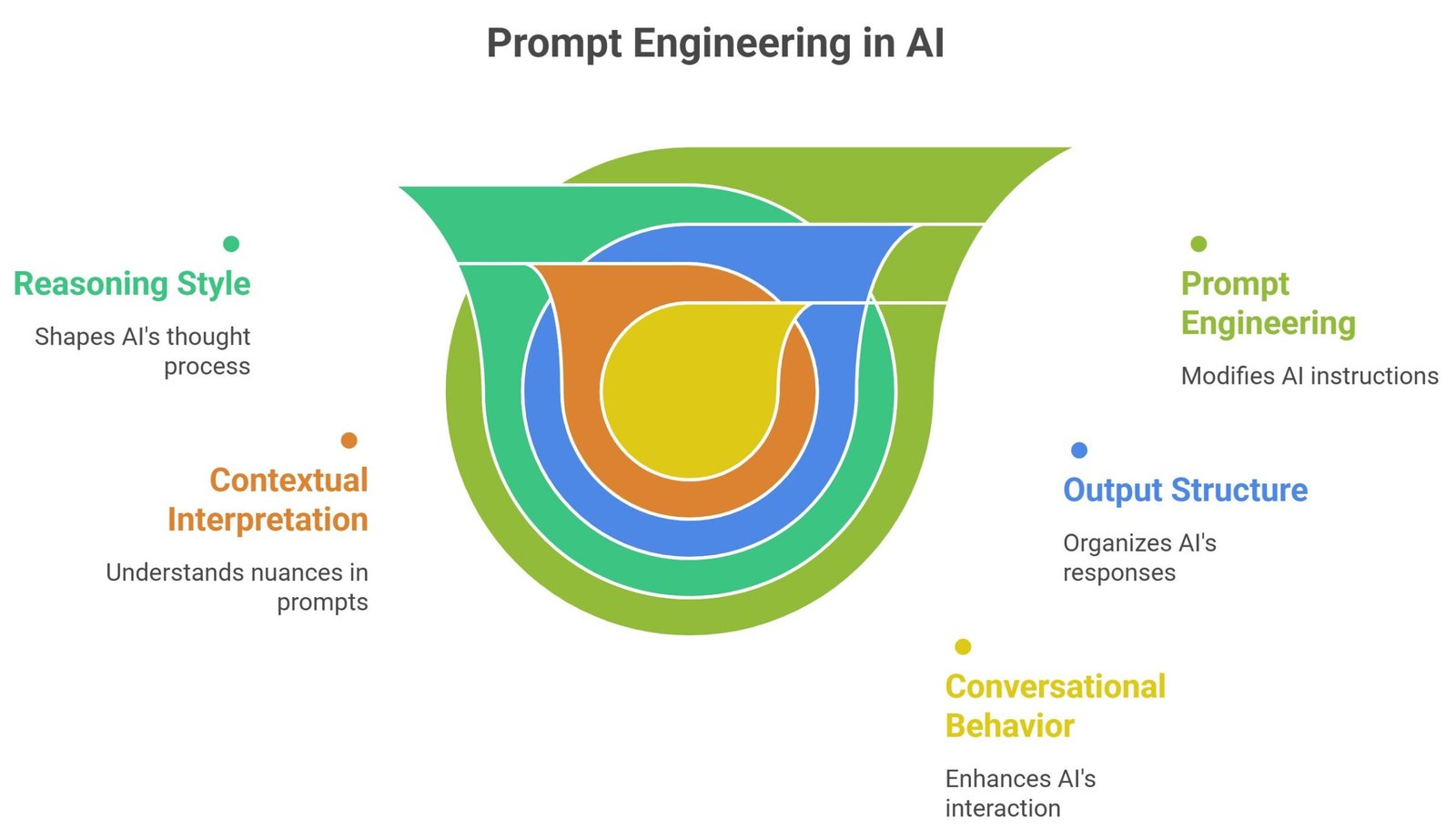
Prompt engineering modifies how AI models receive instructions.
The underlying model remains unchanged.
Instead, prompts shape:
- reasoning style
- output structure
- contextual interpretation
- conversational behavior
- task decomposition
This approach is lightweight and fast to deploy.
Common Prompt Engineering Techniques
| Technique | Purpose |
| Zero-Shot Prompting | Direct instructions |
| Few-Shot Prompting | Examples improve outputs |
| Chain-of-Thought | Step-by-step reasoning |
| Role Prompting | Assigns AI personas |
| Structured Prompting | Controls formatting |
These methods improve response quality significantly.
Understanding How RAG Works
RAG fundamentally changes how AI systems access information.
Instead of relying only on pretrained memory, RAG retrieves external information dynamically.
A modern RAG architecture usually includes:
- embeddings
- vector databases
- retrievers
- rerankers
- orchestration layers
- enterprise document systems
Retrieved context becomes grounding information for the LLM.
Core Components of a RAG System
| Component | Purpose |
| Embeddings | Represent semantic meaning |
| Vector Database | Stores searchable embeddings |
| Retriever | Finds contextual information |
| Reranker | Improves relevance quality |
| LLM | Generates grounded responses |
RAG focuses heavily on semantic retrieval.
Why Prompt Engineering Became So Popular
Prompt engineering became widely adopted because it is:
- simple
- low cost
- fast to implement
- model agnostic
- highly flexible
Organizations could improve AI outputs without retraining models or deploying additional infrastructure.
Major Advantages of Prompt Engineering
Lower Infrastructure Complexity
No retrieval systems are required.
Faster Deployment
Prompt optimization can be implemented quickly.
Lower Operational Costs
Prompt engineering avoids retrieval infrastructure expenses.
Better Behavioral Control
Prompts shape model personality and reasoning style.
Strong Creative Optimization
Prompting improves storytelling and creative generation tasks.
Flexible Experimentation
Teams can iterate rapidly without changing infrastructure.
Major Limitations of Prompt Engineering
Despite its strengths, prompt engineering has major limitations.
No Real-Time Knowledge Access
Prompts cannot give models updated information automatically.
Weak Enterprise Grounding
Prompting alone cannot access enterprise documents dynamically.
Hallucinations Still Exist
Better prompts reduce hallucinations slightly but do not eliminate them.
Limited Context Windows
Prompting depends heavily on context size limitations.
Scaling Problems
Large enterprise knowledge systems become difficult to manage using prompts alone.
Why RAG Became Important
RAG solved several major limitations of prompt-only architectures.
Modern enterprise AI systems increasingly require:
- grounded retrieval
- semantic search
- enterprise document access
- contextual reasoning
- dynamic knowledge updates
- hallucination reduction
RAG enables these capabilities effectively.
Major Advantages of RAG
Grounded AI Generation
Retrieved evidence improves factual reliability.
Better Hallucination Reduction
External context improves answer grounding.
Dynamic Knowledge Updates
Organizations can update knowledge without retraining models.
Better Enterprise Search
RAG improves semantic retrieval dramatically.
Real-Time Information Access
Systems retrieve updated information dynamically.
Better Explainability
Retrieved evidence improves transparency.
Major Limitations of RAG
RAG systems also introduce operational complexity.
Higher Infrastructure Complexity
RAG requires multiple infrastructure layers.
Retrieval Dependency
Poor retrieval weakens grounded generation.
Increased Latency
Retrieval pipelines increase response time.
Monitoring Complexity
Production RAG systems require evaluation infrastructure.
Retrieval Noise Problems
Irrelevant retrieval may reduce answer quality.
RAG vs Prompt Engineering: Key Differences
| Category | Prompt Engineering | RAG |
| Optimization Method | Instruction Design | External Retrieval |
| Knowledge Source | Model Memory | External Documents |
| Real-Time Knowledge | Weak | Strong |
| Hallucination Reduction | Moderate | Strong |
| Enterprise Search | Weak | Excellent |
| Infrastructure Complexity | Lower | Higher |
| Dynamic Updates | Weak | Strong |
| Semantic Retrieval | None | Excellent |
| Explainability | Moderate | Strong |
| Enterprise Scalability | Limited | Excellent |
Why Prompt Engineering Alone Cannot Solve Enterprise AI Problems
One of the biggest misconceptions in enterprise AI is:
“Better prompts eliminate hallucinations.”
This is not entirely true.
Prompt engineering improves response structure and reasoning style, but it does not fundamentally solve:
- outdated knowledge
- missing enterprise context
- semantic retrieval problems
- real-time information access
RAG addresses these challenges directly.
Why RAG Does Not Replace Prompt Engineering
RAG also has limitations.
Retrieval systems still depend heavily on effective prompting.
Prompt engineering remains essential for:
- response formatting
- reasoning guidance
- workflow orchestration
- conversational behavior
- instruction control
Modern enterprise AI systems usually combine both strategies together.
Why Hybrid Architectures Are Becoming Standard
Most enterprise AI systems now combine:
- prompt engineering
- retrieval pipelines
- vector databases
- semantic search systems
- orchestration frameworks
- grounded generation systems
This creates scalable AI architectures.
Example Hybrid Enterprise AI Workflow
| Layer | Purpose |
| Prompt Layer | Controls reasoning behavior |
| Retriever | Finds contextual information |
| Vector Database | Stores embeddings |
| RAG Pipeline | Grounds responses |
| LLM | Generates final answers |
This architecture is becoming increasingly common.
Why RAG Improves Enterprise Search Better
Prompt engineering improves how models answer questions.
RAG improves how models access knowledge.
Enterprise users often ask questions such as:
- “What changed in our refund policy?”
- “Which suppliers are affected by new regulations?”
- “Show compliance rules for this workflow.”
These tasks require semantic retrieval.
Prompt engineering alone cannot solve them reliably.
Why Prompt Engineering Still Matters
Even advanced RAG systems rely heavily on prompts.
Prompt engineering controls:
- retrieval instructions
- reasoning behavior
- summarization quality
- response formatting
- chain-of-thought workflows
This means prompting remains foundational in enterprise AI systems.
Enterprise Use Cases for Prompt Engineering
AI Writing Systems
Prompt templates improve content generation quality.
Conversational Chatbots
Prompting controls AI personality and tone.
Coding Assistants
Structured prompts improve code generation reliability.
Marketing AI Tools
Prompt frameworks improve campaign generation.
Creative AI Systems
Prompting enhances storytelling workflows.
Enterprise Use Cases for RAG
Enterprise AI Assistants
Employees retrieve internal knowledge dynamically.
Customer Support AI
Support systems retrieve troubleshooting documents semantically.
Legal AI Platforms
AI systems retrieve grounded contracts and regulations.
Healthcare AI Systems
Medical assistants retrieve updated clinical information.
Research Intelligence Systems
AI systems retrieve semantically related research documents.
Why RAG Usually Reduces Hallucinations Better
Prompt engineering helps guide reasoning but does not inherently verify information.
RAG improves hallucination reduction because external evidence grounds generation.
However, weak retrieval pipelines may still produce incorrect outputs.
This is why retrieval quality remains essential.
Common Enterprise Mistakes
Many organizations misunderstand how prompting and retrieval should work together.
Treating Prompt Engineering as a Hallucination Cure
Prompting alone cannot fully solve grounding problems.
Ignoring Retrieval Quality
Weak retrieval weakens grounded generation.
Assuming RAG Eliminates Prompting
RAG systems still require strong prompts.
Overengineering Infrastructure Early
Not every workflow requires advanced retrieval architectures immediately.
Why Evaluation Matters for Both Approaches
Organizations increasingly benchmark:
- hallucination rates
- answer faithfulness
- retrieval precision
- semantic relevance
- groundedness
- latency
- contextual accuracy
Continuous evaluation improves enterprise AI reliability significantly.
Future of Prompt Engineering and RAG
Enterprise AI architectures are evolving rapidly.
Major trends include:
- agentic RAG systems
- GraphRAG architectures
- multimodal retrieval systems
- retrieval-aware reasoning
- adaptive prompting systems
- autonomous AI agents
- grounded enterprise copilots
Future enterprise AI systems will increasingly combine:
- prompt orchestration
- semantic retrieval
- grounded generation
- contextual reasoning
- autonomous workflows
into unified AI architectures.
Suggested Read:
- What Is RAG in AI
- How RAG Works
- Reducing Hallucinations in RAG
- Query Rewriting for RAG
- RAG vs Fine Tuning
- LLM Plus RAG vs Standalone LLM
- RAG Evaluation Metrics
- RAG Monitoring
FAQ: RAG vs Prompt Engineering
What is the difference between RAG and prompt engineering?
Prompt engineering improves model instructions, while RAG improves external knowledge retrieval and grounding.
Can prompt engineering replace RAG?
No. Prompt engineering cannot dynamically retrieve updated enterprise knowledge.
Does RAG reduce hallucinations better than prompts?
Yes. RAG grounds responses using retrieved evidence, improving factual reliability significantly.
When should enterprises use RAG instead of prompt engineering?
Organizations should use RAG when AI systems require semantic retrieval, enterprise search, dynamic knowledge access, or grounded responses.
Can prompt engineering improve AI accuracy?
Yes. Better prompts improve reasoning quality and response structure, but they do not replace retrieval systems.
Final Takeaway
Understanding RAG vs prompt engineering is essential because enterprise AI optimization increasingly depends on balancing reasoning quality, semantic retrieval, grounded generation, hallucination reduction, and scalable knowledge access.
Prompt engineering improves how AI systems think and respond, while RAG improves how AI systems access and ground information.
Organizations that understand how both approaches complement each other can build more scalable, reliable, explainable, and production-ready enterprise AI systems.
That capability is becoming foundational for enterprise AI assistants, semantic search systems, healthcare AI platforms, customer support copilots, legal intelligence systems, and next-generation grounded AI architectures.