
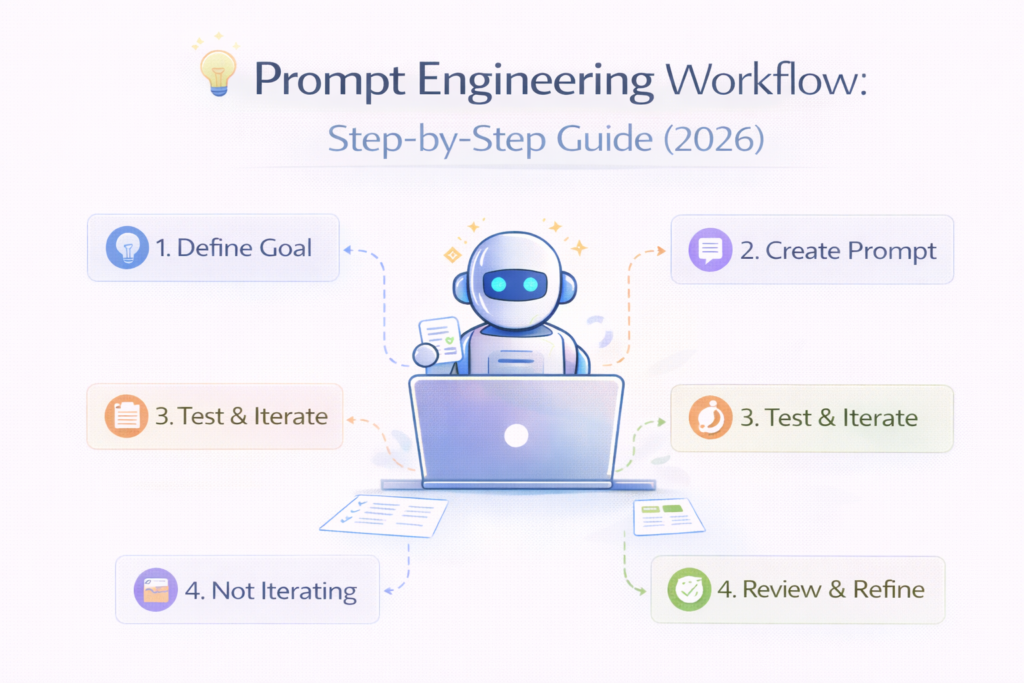
Prompt Engineering Workflow: Step-by-Step Guide
Prompt engineering is not a one-step task—it is a process. Writing a single prompt and expecting perfect results rarely works. Instead, effective prompt engineering follows a structured workflow that helps you design, test, and refine prompts for consistent results.
A well-defined prompt engineering workflow turns AI from unpredictable to reliable.
In simple terms
A prompt engineering workflow is a repeatable process:
Define → Write → Test → Improve → Use
This helps you move from random prompting to controlled outputs.
Why you need a workflow
From analyzing top-ranking guides and real-world usage, most users struggle because they:
- write prompts randomly
- do not test outputs
- do not refine prompts
A workflow solves this by making prompt engineering systematic.
The 6-Step Prompt Engineering Workflow
Step 1: Define the task clearly
Before writing any prompt, define:
- what you want
- who the audience is
- what the output should look like
Example
Task:
“Write a beginner-friendly blog introduction about AI tools”
Without this clarity, prompts become vague.
Step 2: Add context
Context improves relevance.
Include:
- audience
- purpose
- background information
Example
“This is for beginners who have no technical background”
Step 3: Write the initial prompt
Now combine task + context into a prompt.
Example
“Write a beginner-friendly introduction about AI tools for non-technical users”
This is your starting point—not the final version.
Step 4: Specify output format
Define structure for consistency.
Example
“Write in 3 short paragraphs with simple language”
Step 5: Test the prompt
Run the prompt and evaluate:
- clarity
- relevance
- accuracy
Ask:
- is the output usable?
- does it match expectations?
Step 6: Refine and iterate
Improve the prompt based on results.
Example refinement
Add:
- constraints
- examples
- better structure
Iteration is the most important step.
Visual workflow summary
Task → Context → Prompt → Format → Test → Refine
This cycle repeats until results are consistent.
Prompt Engineering Workflow: Real-world example
Step 1: Task
Write a professional email
Step 2: Context
Business communication
Step 3: Prompt
“Write a professional email”
Step 4: Add format + constraints
“Write a professional email declining a meeting request politely. Keep it under 150 words.”
Step 5: Test output
Check:
- tone
- clarity
- usefulness
Step 6: Refine
Adjust wording if needed.
Final result
- clear
- structured
- ready to use
Prompt workflow template
Use this reusable structure:
Task: [What you want]
Context: [Background]
Constraints:
– [Rule 1]
– [Rule 2]
Output format:
– [Structure]
Test → Evaluate → Refine
Prompt Engineering workflow Advanced techniques
Break tasks into multiple prompts
Instead of one complex prompt:
- step 1: summarize
- step 2: analyze
- step 3: generate output
Use system prompts for consistency
For applications, define:
- role
- behavior
- rules
This ensures consistent outputs across sessions.
Combine prompting with context engineering
Add:
- retrieved data (RAG)
- memory
- user inputs
This improves accuracy.
Build prompt libraries
Save effective prompts as templates:
- reusable
- scalable
- consistent
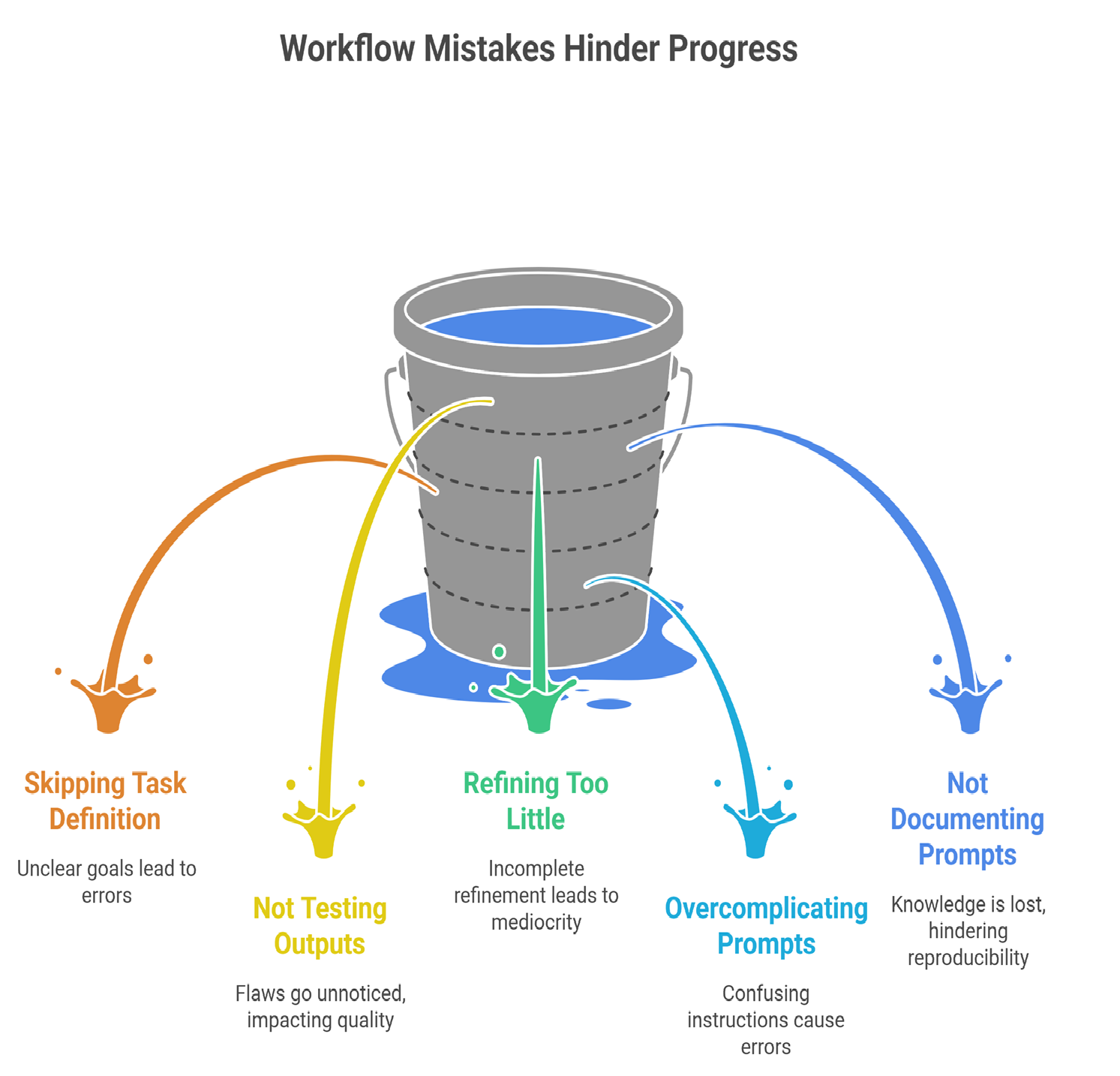
Common mistakes in workflow
- skipping task definition
- not testing outputs
- refining too little
- overcomplicating prompts
- not documenting prompts
When to use a prompt workflow
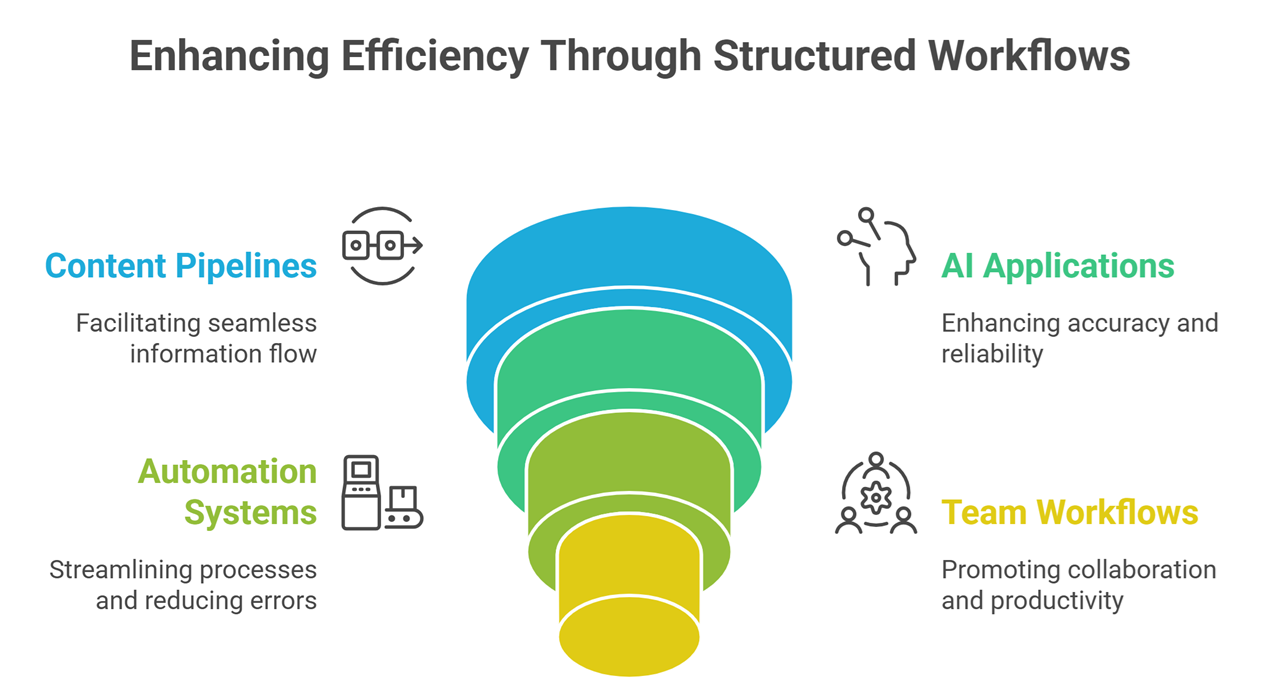
A structured workflow is essential for:
- content pipelines
- AI applications
- automation systems
- team workflows
For simple tasks, basic prompts may work—but workflows are needed for consistency.
Suggested Read:
- What Is Prompt Engineering? A Simple Guide for Beginners
- Prompt Engineering Best Practices You Should Follow
- Prompt Engineering Examples (Beginner to Advanced)
- Common Prompt Engineering Mistakes (And How to Fix Them)
- How to Write Better System Prompts
- Context Engineering vs Prompt Engineering: What Changed?
FAQ: Prompt Engineering Workflow
What is a prompt engineering workflow?
A step-by-step process for designing and improving prompts.
Why is iteration important?
Because the first prompt is rarely perfect.
Can I skip steps?
Skipping steps usually leads to poor results.
How long should the workflow take?
It depends on complexity, but iteration is key.
Final takeaway
Prompt engineering is not about writing perfect prompts—it is about building a process that consistently improves results.
If you follow a structured workflow, you can turn AI into a reliable tool instead of an unpredictable one.