
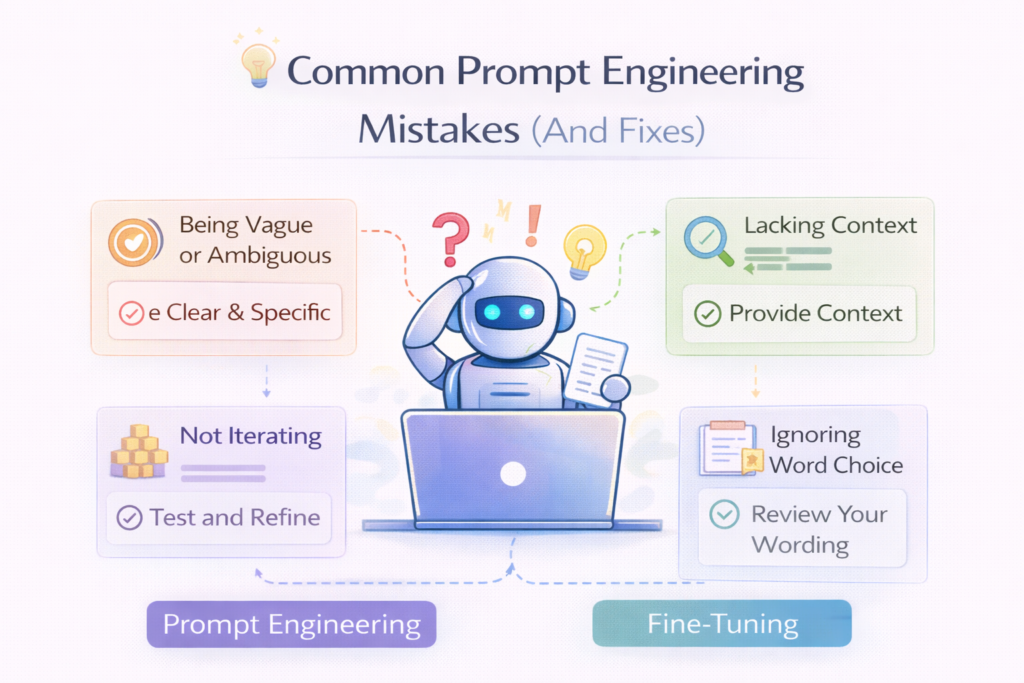
Common Prompt Engineering Mistakes (And How to Fix Them)
Prompt engineering is powerful—but small mistakes can completely ruin your results. Many users blame the AI when outputs are poor, but in most cases, the problem lies in the prompt itself.
Understanding common prompt engineering mistakes can help you improve output quality, consistency, and efficiency without changing the model.
In simple terms
Most prompt failures come from:
- unclear instructions
- missing context
- poor structure
Fixing these issues can dramatically improve results.
Why prompt mistakes matter
From analyzing high-ranking content and real-world usage, poor prompts lead to:
- vague or irrelevant outputs
- inconsistent responses
- more editing and retries
- wasted time and cost
Prompt engineering is not just about writing prompts—it is about avoiding mistakes.
10 Common Prompt Engineering Mistakes
Being too vague
Bad prompt
“Explain AI”
Problem
- no audience
- no depth
- unclear goal
Fix
“Explain AI in simple terms for beginners with 3 real-world examples”
Missing context
Bad prompt
“Write a blog intro”
Problem
- no topic
- no audience
- generic output
Fix
“Write a blog intro about remote work for small business owners in a friendly tone”
Not specifying output format
Bad prompt
“Summarize this article”
Problem
- unpredictable structure
Fix
“Summarize this article in 5 bullet points with headings”
Overloading the prompt
Bad prompt
Too many instructions in one request
Problem
- confusion
- inconsistent output
Fix
Break tasks into steps:
- summarize first
- then analyze
Ignoring constraints
Bad prompt
“Write about marketing”
Problem
- too broad
- irrelevant details
Fix
“Write a 200-word summary of digital marketing strategies for startups”
Not using examples
Bad prompt
“Translate this sentence”
Problem
- unclear pattern
Fix
Provide examples:
“Hello → Hola
Thank you → ?”
Expecting perfect output in one try
Problem
- AI rarely gives perfect results immediately
Fix
- iterate
- refine prompts
- improve step by step
Ignoring role prompting
Bad prompt
“Write a report”
Problem
- generic tone
Fix
“You are a business analyst. Write a structured report…”
Mixing multiple goals
Bad prompt
“Explain AI, compare tools, and write a blog”
Problem
- unclear objective
Fix
Split into separate prompts:
- explain
- compare
- write
Not testing prompts
Problem
- inconsistent results
Fix
- test variations
- refine structure
- evaluate outputs
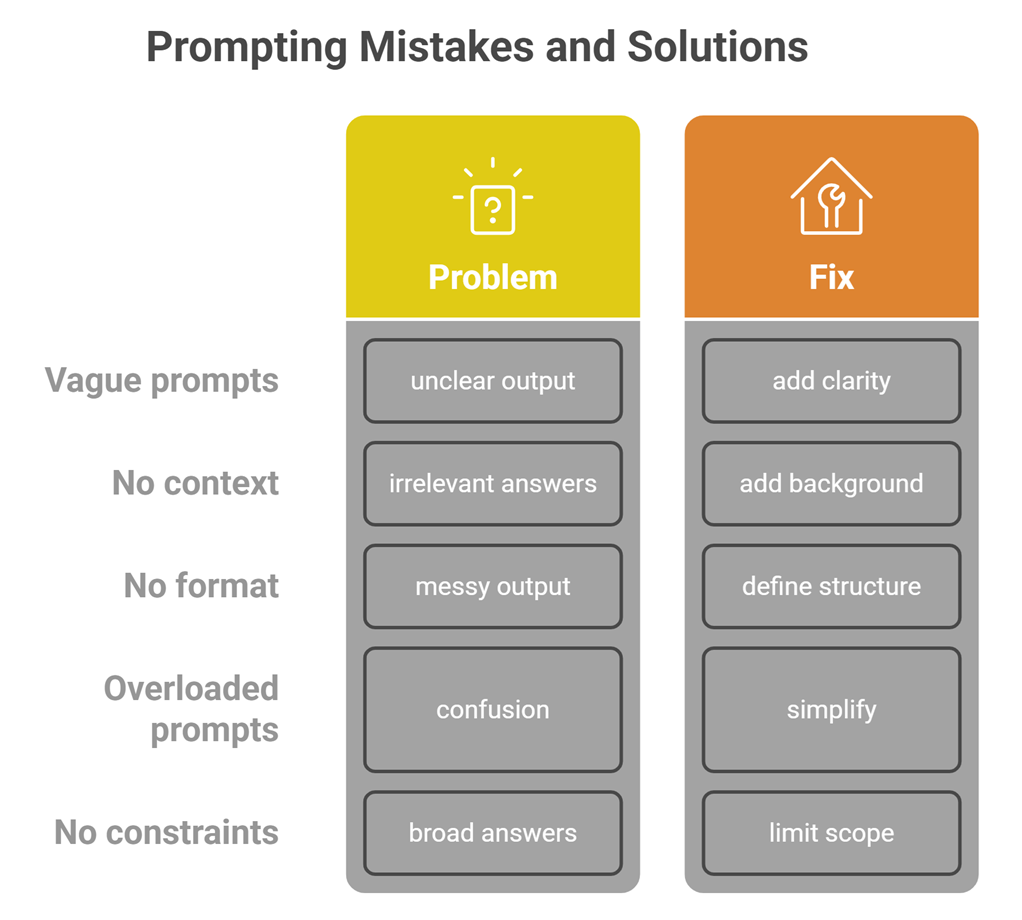
Common Prompt Engineering Mistakes
| Mistake | Problem | Fix |
| Vague prompts | unclear output | add clarity |
| No context | irrelevant answers | add background |
| No format | messy output | define structure |
| Overloaded prompts | confusion | simplify |
| No constraints | broad answers | limit scope |
Real-world example
Weak prompt
“Write an email”
Problem
- no context
- no tone
- no purpose
Improved prompt
“Write a professional email declining a meeting request politely. Keep it under 150 words.”
Result
- clear
- structured
- usable output
How to avoid these mistakes
Follow this simple formula:
Task + Context + Constraints + Format
Example:
“Write a 150-word blog intro (task) about AI tools (context) for beginners (audience) in bullet points (format).”
Advanced tip: Build reusable prompts
Instead of rewriting prompts:
- create templates
- reuse structures
- standardize outputs
This improves consistency and saves time.
Common misconceptions
“Long prompts are better”
Not always—clarity matters more.
“AI should understand automatically”
AI needs clear instructions.
“One prompt is enough”
Prompting is iterative.
Suggested Read:
- What Is Prompt Engineering? A Simple Guide for Beginners
- Prompt Engineering Best Practices You Should Follow
- Prompt Engineering Examples (Beginner to Advanced)
- How to Write Better System Prompts
- Why Prompt Engineering Matters in AI
- 25 Prompt Engineering Techniques With Examples
FAQ: Common Prompt Engineering Mistakes
What is the most common mistake?
Being too vague.
How do I fix bad prompts?
Add clarity, context, and structure.
Do prompts need to be long?
No, just clear.
Can mistakes be avoided completely?
No, but they can be minimized with practice.
Final takeaway
Most AI output problems are not model problems—they are prompt problems. By avoiding common mistakes and using structured prompts, you can dramatically improve results.
The key is simple:
Better prompts = fewer mistakes = better outputs