
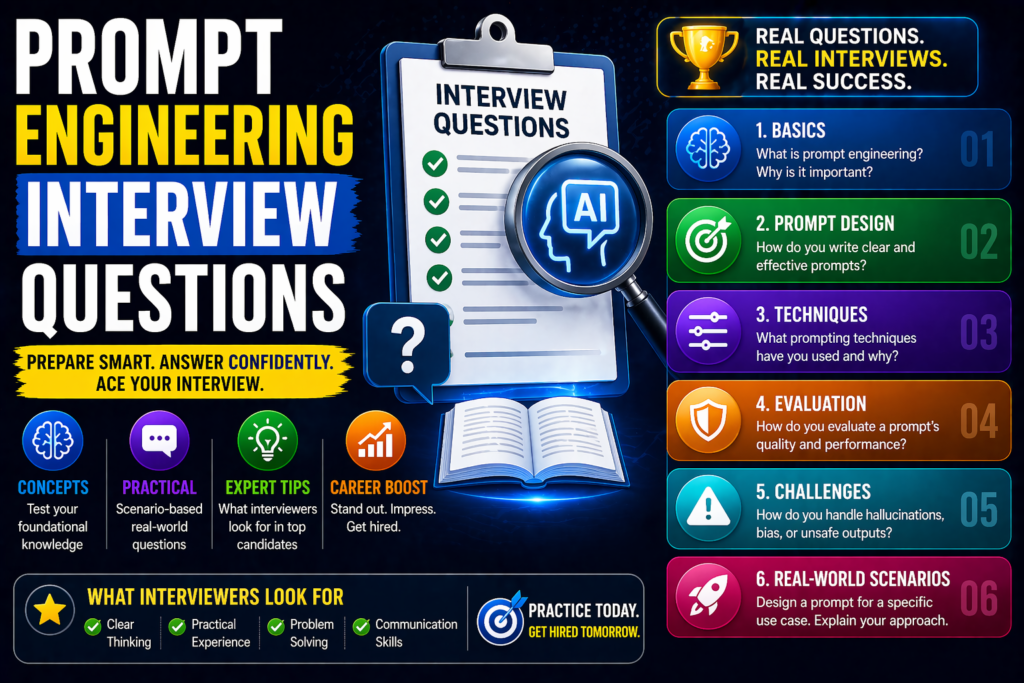
Prompt Engineering Interview Questions: 35 Questions and Answers to Prepare Fast
Prompt engineering roles are growing across AI startups, SaaS companies, consulting firms, and enterprise teams. Employers want people who can design prompts, evaluate outputs, improve workflows, and reduce hallucinations.
If you are preparing for interviews, this guide covers the most common prompt engineering interview questions with practical answers.
In simple terms
Interviewers usually test three things:
Can you write prompts, improve outputs, and solve business problems using AI?
They care less about theory alone and more about applied skills.
What recruiters look for
Most companies assess:
- prompt design skills
- LLM understanding
- structured thinking
- testing ability
- AI safety awareness
- business use case thinking
- communication skills
35 Prompt Engineering Interview Questions
Beginner Questions
1.What is Prompt Engineering?
Prompt engineering is the process of designing inputs that guide AI models toward better outputs.
2.Why does Prompt Wording Matter?
Small wording changes can affect clarity, structure, tone, and accuracy.
3.What is Zero-Shot Prompting?
Giving instructions without examples.
4.What is Few-Shot Prompting?
Providing a few examples before the task.
5.What is Chain-of-Thought Prompting?
Encouraging stepwise reasoning for complex tasks.
6.What is Role Prompting?
Assigning the model a role like analyst, teacher, or recruiter.
7.What is Temperature?
A setting that influences randomness and creativity.
8.What is Token Limit?
The maximum amount of text processed in context.
9.What is Hallucination?
When the model generates false or unsupported information.
10.How do you Reduce Hallucinations?
Use clear prompts, ask for uncertainty, use retrieval, and verify outputs.
Practical Questions
11.How would you improve a Weak Prompt?
Add context, constraints, examples, and output format.
12.How do you Prompt for Summaries?
Specify audience, length, tone, and required key points.
13.How do you Prompt for Structured Output?
Request JSON, tables, lists, or schema-based responses.
14.How do you test Prompts?
Use datasets, A/B tests, scorecards, and human review.
15.How do you optimize Prompts for Cost?
Reduce unnecessary tokens and simplify instructions.
16.How do you handle Vague User Input?
Ask clarifying questions first.
17.How do you Prompt for Coding Tasks?
Include language, framework, constraints, and expected output.
18.How do you Prompt for Customer Support?
Use tone rules, policy boundaries, and escalation logic.
19.How do you maintain Brand Voice?
Provide style guides and examples.
20.How do you compare Prompt Versions?
Run identical inputs and measure results.
Advanced Questions
21.What is Prompt Injection?
An attempt to override trusted instructions with malicious prompts.
22.How do you defend against Prompt Injection?
Separate instructions from data, validate actions, limit access.
23.What is RAG?
Retrieval-Augmented Generation uses external data sources for answers.
24.Why use RAG instead of only Prompts?
Because prompts alone cannot reliably provide private or fresh data.
25.What is Context Window Management?
Using available context efficiently within model limits.
26.What is Self-Consistency Prompting?
Generating multiple reasoning paths and selecting stronger answers.
27.How do you Evaluate Prompt Quality?
Measure accuracy, relevance, consistency, cost, and user satisfaction.
28.How do you reduce Bias in Prompts?
Use neutral wording, balanced examples, and audits.
29.How do you build Prompts for Agents?
Use tool rules, permissions, memory logic, and fallback handling.
30.How do you monitor Production Prompts?
Track failures, latency, costs, edits, and user feedback.
Scenario Questions
31.A Chatbot gives wrong answers. What do you do?
Audit prompts, add retrieval, tighten instructions, and test outputs.
32.Outputs are too Verbose. Fix it.
Add word limits and concise formatting instructions.
33.Model ignores format rules. Fix it.
Use stronger schemas, examples, and validation checks.
34.Costs are rising. What do you do?
Shorten prompts, cache outputs, optimize model choice.
35.User asks unsafe requests. What do you do?
Apply safety rules, refuse harmful actions, redirect safely.
Sample interview answers framework
Use this structure:
Situation → Prompt Approach → Testing → Result
Example:
“We needed better support replies. I redesigned prompts with policy rules and tone examples, tested three versions, and reduced manual edits by 40%.”
Common mistakes in interviews
- speaking only theory
- no real examples
- ignoring metrics
- not discussing testing
- weak communication
- no safety awareness
How to stand out as a candidate
Build a portfolio
Show prompts and workflows.
Learn Evaluation
Most candidates skip testing.
Understand business outcomes
Talk ROI, efficiency, accuracy.
Practice live Prompting
Many interviews include practical tasks.
Suggested Read:
- What Is Prompt Engineering? Complete Beginner Guide
- Prompt Evaluation Methods
- Testing Prompts Systematically
- Prompt Safety Best Practices
- Few Shot Prompting Explained
- Best Prompts for ChatGPT
FAQ: Prompt Engineering Interview Questions
Are prompt engineering jobs real?
Yes, often under titles like AI Specialist, LLM Engineer, AI Content Ops, or Automation Engineer.
Do I need coding skills?
Helpful, but some roles focus more on workflow and content systems.
What tools should I know?
ChatGPT, Claude, Gemini, API basics, spreadsheets, and evaluation tools.
Is prompt engineering enough alone?
Best paired with domain expertise, analytics, or technical skills.
Final takeaway
Prompt engineering interviews test practical problem-solving more than memorized definitions. Learn prompting methods, evaluation systems, safety basics, and business use cases.
Prepare with these questions, practice live scenarios, and show measurable thinking to stand out.