
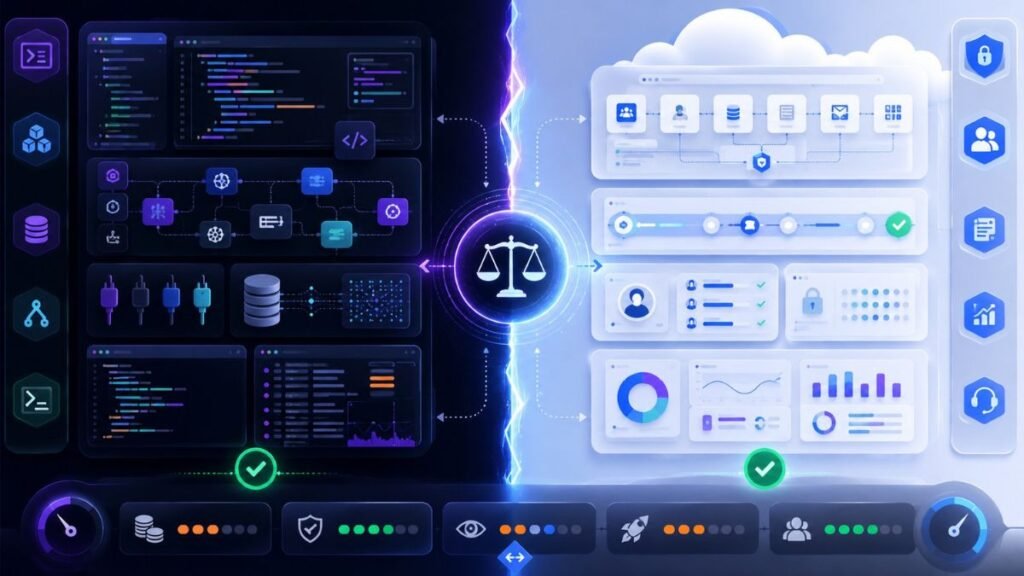
Open source vs managed platforms for agentic AI comes down to control versus convenience. Open source frameworks give developers flexibility, self-hosting, customization, and lower platform lock-in. Managed platforms offer faster deployment, built-in integrations, security features, monitoring, support, and enterprise governance. The better choice depends on your team, risk level, budget, and production requirements.
In Simple Terms
Open source agentic AI platforms are like building your own agent stack with more control. You choose the framework, model, tools, vector database, memory store, deployment method, and observability layer.
Managed AI agent platforms are more like buying an integrated workspace. The platform handles more of the building, deployment, monitoring, security, and connector experience.
Neither option is always better. The right choice depends on what you are building and who will maintain it.
What Are Open Source Agentic AI Platforms?
Open source agentic AI platforms or frameworks let developers build AI agents using code they can inspect, modify, self-host, and extend.
Examples include LangGraph, CrewAI, LlamaIndex, Haystack, and many open-source agent development kits. These tools are useful when teams need custom workflows, flexible model choice, self-hosting, specialized tool adapters, or deeper control over orchestration.
LangGraph, for example, focuses on capabilities important for agent orchestration, including durable execution, streaming, and human-in-the-loop support. LangGraph’s durable execution documentation also explains that preserving completed work lets a workflow resume without reprocessing previous steps, even after a significant delay.
What Are Managed AI Agent Platforms?
Managed AI agent platforms provide a hosted or enterprise-ready environment for building, deploying, monitoring, and governing AI agents.
Examples include Microsoft Copilot Studio, Salesforce Agentforce, Amazon Bedrock Agents, OpenAI’s agent tooling, Google Cloud agent platforms, and other commercial AI agent builders.
Microsoft says Copilot Studio lets users design, test, and publish agents using natural language or a graphical interface, including standalone agents or agents published to Microsoft 365 Copilot. Google ADK is open source, but its official site also highlights deploy-anywhere flexibility and native deployment to Google Cloud with managed infrastructure, authentication, Cloud Trace observability, and enterprise-grade security.
Open Source vs Managed Platforms: Quick Comparison
| Criteria | Open Source Agentic AI Platforms | Managed AI Agent Platforms |
| Control | Higher control over code, models, tools, hosting | Higher platform convenience |
| Setup speed | Slower if infrastructure is needed | Faster for common workflows |
| Customization | Strong for custom architecture | Depends on platform limits |
| Security | You own implementation and controls | Built-in identity, admin, and governance features |
| Observability | Must assemble or configure | Often built into platform |
| Cost | Lower license cost, higher engineering cost | Higher platform cost, lower setup burden |
| Vendor lock-in | Lower if architecture is portable | Higher if tied to ecosystem |
| Best for | Developers, startups, custom systems | Enterprises, business teams, governed workflows |
A commercial decision should include total cost, not just software pricing.
When Open Source Is the Better Choice
Choose open source when your team needs maximum control.
Open source is often better if you need to self-host agents, swap models, customize orchestration, inspect execution logic, connect unusual APIs, use private infrastructure, or avoid deep platform lock-in.
It is also useful for teams that want to experiment quickly at the architecture level. For example, a developer team may choose LangGraph for stateful orchestration, LlamaIndex for document-heavy RAG agents, or Haystack for transparent retrieval pipelines.
Open source is strongest when your team has engineers who can own deployment, security, logging, scaling, and maintenance.
When Managed Platforms Are the Better Choice
Choose managed platforms when speed, governance, integrations, and admin controls matter more than full customization.
Managed platforms are often better for enterprises that already use Microsoft 365, Salesforce, AWS, Google Cloud, or another major business platform. These systems can provide connectors, access control, workflow tooling, monitoring, admin settings, and support.
OpenAI’s Agents SDK is developer-oriented, but its documentation shows the managed-agent direction clearly: agents can be configured with instructions, tools, handoffs, guardrails, and structured outputs. OpenAI’s tracing documentation also says the SDK records LLM generations, tool calls, handoffs, guardrails, and custom events during agent runs.
Managed platforms make sense when the main question is not “Can we customize everything?” but “Can we deploy safely and maintain it with less infrastructure work?”
Cost Comparison: License Price Is Not the Whole Cost
Open source may look cheaper because the software itself can be free. But production cost includes engineering time, hosting, monitoring, security, evaluation, incident response, and maintenance.
Managed platforms may look more expensive because of seats, usage, premium connectors, token costs, or enterprise licensing. But they may reduce engineering burden.
| Cost Area | Open Source | Managed |
| Software license | Often free or low | Usually paid |
| Engineering setup | Higher | Lower |
| Hosting | Self-managed | Included or cloud-managed |
| Observability | Build or integrate | Often included |
| Security review | Team-owned | Platform-assisted |
| Maintenance | Team-owned | Vendor-assisted |
| Lock-in cost | Usually lower | Often higher |
The real comparison is total cost of ownership.
Security and Governance Trade-Offs
Security is not automatically better in either model.
Open source gives teams visibility and control, but the team must configure access, secrets, tool permissions, logs, sandboxing, and data controls correctly. Managed platforms often include identity, permissions, admin controls, audit logs, and enterprise policies, but they may also move more dependency into one vendor ecosystem.
LangChain’s human-in-the-loop middleware can pause execution when a proposed tool action needs review, such as file writing or SQL execution. Microsoft’s Copilot Studio documentation describes generative orchestration across agents, topics, tools, and knowledge sources, which is powerful but also requires careful governance.
For high-risk workflows, teams should check identity, access control, audit logs, data residency, tool permissions, human approval, prompt-injection defenses, and incident response.
Observability and Evaluation
Agentic AI failures often happen inside the workflow, not only in the final answer. Teams need traces, tool-call records, retrieved context, memory events, approvals, latency, cost, and user feedback.
Open source stacks can provide strong observability, but developers may need to connect LangSmith, OpenTelemetry, custom dashboards, or cloud logs. Managed platforms often include dashboards, traces, analytics, or admin reporting, but depth varies.
Google’s ADK blog says ADK provides precise control over agent behavior and orchestration, a tool ecosystem, integrated build/debug experience, and an evaluation framework for reliable agents. A 2026 preprint evaluating 51 Python agent development kits found no single framework dominated across all benchmark settings, reinforcing that platform choice should depend on task type and workflow needs rather than brand alone.
Developer Control vs Business Accessibility
Open source platforms usually serve developers first. They are better when your team wants to write code, create custom tools, version workflows, inspect traces, and manage deployments.
Managed platforms often serve business and enterprise users better. Low-code builders can let operations, support, sales, and IT teams participate in agent design without writing every component from scratch.
Microsoft Copilot Studio’s value is partly that business users can design and publish agents through a graphical environment. Open source frameworks are usually stronger when developer control is the priority.
Hybrid Approach: Often the Best Practical Choice
Many teams do not need a pure open source or pure managed strategy.
A hybrid architecture might use an open source framework for the core agent workflow, a managed model API for inference, a managed vector database for retrieval, cloud monitoring for observability, and a low-code platform for business-facing agent surfaces.
Google ADK is a good example of this middle ground because it is open source but also supports managed deployment to Google Cloud infrastructure. This type of hybrid approach can reduce lock-in while still giving teams production infrastructure.
Decision Table: Which Should You Choose?
| Team Need | Better Fit |
| Maximum customization | Open source |
| Fast enterprise deployment | Managed |
| Strong self-hosting requirement | Open source |
| Low-code business user access | Managed |
| Strict vendor independence | Open source |
| Built-in admin/governance | Managed |
| Custom tools and unusual APIs | Open source or hybrid |
| Microsoft/Salesforce/AWS/Google-native workflows | Managed |
| Experimental architecture work | Open source |
| Small team with limited DevOps | Managed |
Common Mistakes to Avoid
The first mistake is choosing open source only because it looks free. Engineering time is expensive.
The second mistake is choosing managed platforms only because they are convenient. Platform limits and lock-in can matter later.
The third mistake is ignoring observability. If the team cannot inspect tool calls, handoffs, context, and failures, the agent is hard to trust.
The fourth mistake is giving agents write access before approval flows are ready. Start with read-only tools, then draft actions, then supervised writes.
Suggested Read:
- What Is an AI Agent? A Simple Explanation With Examples
- Best Platforms for Building Agentic AI Applications
- Best Agentic AI Frameworks for Developers in 2026
- How to Choose the Right Agentic AI Framework
- LangGraph vs CrewAI vs Microsoft Agent Framework
- Tool Use in Agentic AI: Function Calling, APIs, and External Actions
- Observability for Agentic AI: What Teams Need to Track
- Agentic AI Governance: Risks, Controls, and Accountability
FAQ: open source vs managed platforms for agentic AI
What is the difference between open source and managed platforms for agentic AI?
Open source platforms give more control, customization, and portability. Managed platforms provide hosted infrastructure, connectors, admin controls, monitoring, support, and easier deployment.
Are open source agentic AI platforms better than managed platforms?
Not always. Open source is better for control and customization. Managed platforms are better for speed, enterprise governance, and lower infrastructure burden.
When should developers choose open source AI agent frameworks?
Choose open source when you need custom orchestration, self-hosting, model flexibility, unusual tools, lower lock-in, or deep developer control.
When should enterprises choose managed AI agent platforms?
Choose managed platforms when you need fast deployment, admin controls, enterprise connectors, compliance support, business-user access, and vendor support.
Which is better for AI agent security: open source or managed?
Neither is automatically better. Open source gives control but requires strong implementation. Managed platforms offer built-in controls but create vendor dependency and must still be configured carefully.
How do costs compare between open source and managed agentic AI platforms?
Open source often has lower software cost but higher engineering and maintenance cost. Managed platforms usually have higher platform cost but lower setup and operations burden.
Final Takeaway
Open source vs managed platforms for agentic AI is a control-versus-convenience decision. Choose open source when customization, portability, and engineering control matter most. Choose managed platforms when deployment speed, governance, integrations, and operational support matter most. For many teams, a hybrid approach is the most practical path.
To continue learning, read Best Platforms for Building Agentic AI Applications, How to Choose the Right Agentic AI Framework, and Agentic AI Governance next.