
Chain of Thought Prompting Explained: How It Works With Examples
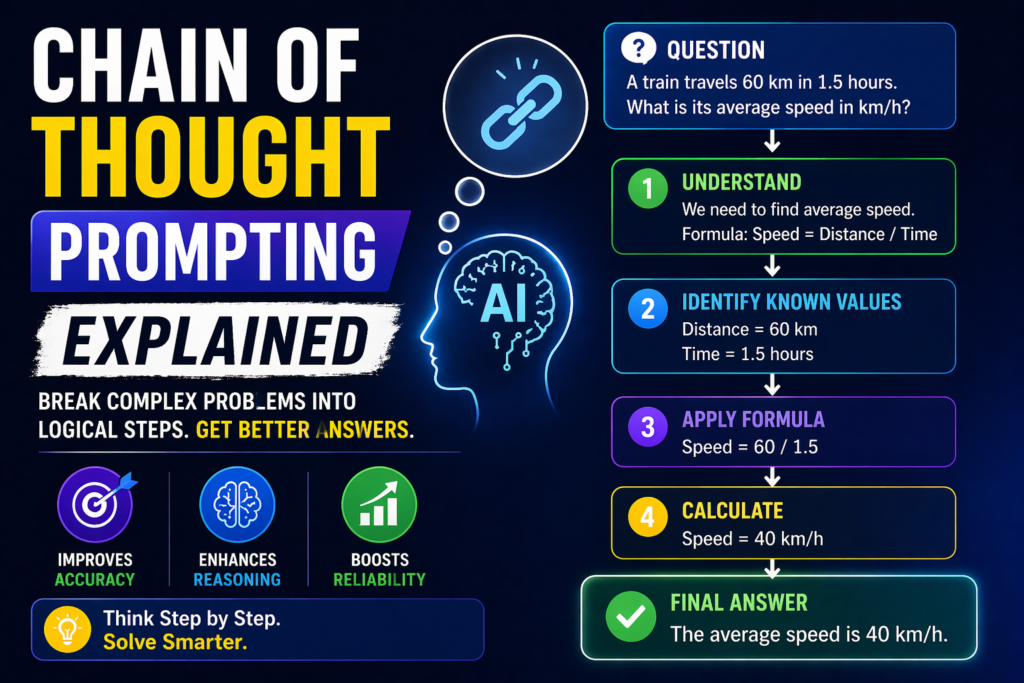
Chain of thought prompting is a powerful AI prompting method that encourages models to reason step by step before giving a final answer.
Instead of jumping directly to a response, the model works through intermediate thinking steps. This often improves logic, accuracy, and problem-solving performance.
In this guide, you’ll learn what chain of thought prompting is, how it works, where to use it, and how to write better reasoning prompts.
In simple terms
Chain of thought prompting means:
Ask the AI to think through the problem step by step.
Instead of:
“What is 27 × 14?”
Use:
“Solve 27 × 14 step by step, then give the final answer.”
This structure helps the model reason more carefully.
What is Chain of Thought Prompting?
Chain of thought prompting is a prompt engineering technique where the model is encouraged to generate intermediate reasoning steps before producing the final answer.
It is commonly used for:
- logic problems
- math tasks
- planning
- analysis
- multi-step decisions
By breaking the problem into parts, the model often performs better on complex tasks.
Why Chain of Thought Prompting Works
Large language models can solve many tasks, but difficult questions may require multiple reasoning steps.
Chain of thought prompting helps by:
- slowing down rushed answers
- improving logical consistency
- breaking tasks into smaller steps
- reducing simple mistakes
- making answers easier to review
It is especially useful when a task cannot be solved in one quick response.
Simple Chain of Thought Prompting Examples
Example 1: Math
Prompt:
“A store sells pencils in packs of 6. If I need 24 pencils, how many packs do I need? Solve step by step.”
Example 2: Decision Making
Prompt:
“I need a laptop for coding and travel. Compare battery life, weight, and performance step by step, then recommend one.”
Example 3: Logic
Prompt:
“If all cats are animals and some animals are pets, can we conclude all cats are pets? Explain step by step.”
Example 4: Planning
Prompt:
“Create a 30-day fitness plan for beginners. Think step by step about time, recovery, and progression.”
Best use cases for Chain of Thought Prompting
This method works best for:
1.Math and calculations
Multi-step arithmetic and formulas.
2.Logical reasoning
Cause-effect, deductions, comparisons.
3.Problem solving
Breaking complex issues into manageable parts.
4.Strategy and planning
Roadmaps, schedules, prioritization.
5.Analysis tasks
Evaluating pros, cons, trade-offs.
Chain of Thought vs Zero Shot vs Few Shot
| Method | How It Works | Best For |
| Zero Shot | Instructions only | Simple tasks |
| Few Shot | Uses examples | Formatting + patterns |
| Chain of Thought | Step-by-step reasoning | Complex tasks |
If a direct prompt fails, chain of thought can often improve results.
How to write better Chain of Thought Prompts
1.Ask for steps clearly
Use phrases like:
- think step by step
- explain reasoning
- break this into parts
2.Define the goal
Tell the model what success looks like.
Example:
“Find the best option based on cost and quality.”
3.Use structured outputs
Example:
- Understand problem
- Analyze factors
- Recommend answer
4.Add constraints
Example:
- keep it concise
- use only given data
- compare top 3 options
5.Verify final answer
Ask the model to check its own result.
Common mistakes
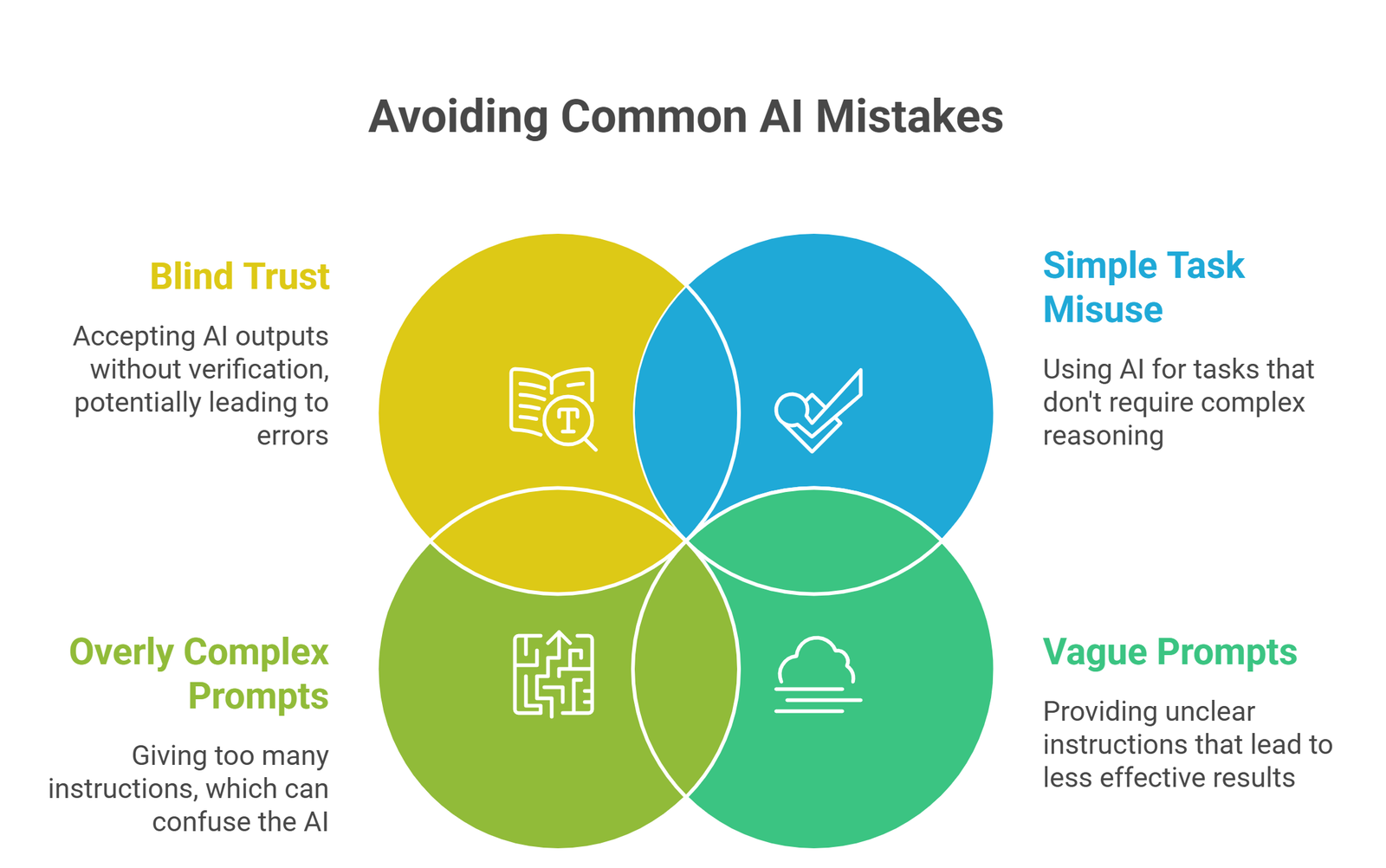
Using it for simple tasks
Not every question needs step-by-step reasoning.
Overly vague prompts
“Think about this” is weaker than specific instructions.
Too many instructions
Complex prompts can confuse the model.
Trusting reasoning blindly
Always verify important outputs.
Copy-paste Chain of Thought Prompt Templates
Problem Solving
“Solve this problem step by step, then give the final answer: [problem]”
Comparison
“Compare these options step by step using [criteria], then recommend one: [options]”
Planning
“Think step by step and build a plan for [goal] within [constraints].”
Analysis
“Break this issue into causes, impacts, and solutions step by step: [topic]”
When not to use Chain of Thought Prompting
It may be unnecessary for:
- simple summaries
- quick rewrites
- translations
- one-line factual answers
- basic formatting tasks
Use simpler prompts when reasoning is not needed.
Suggested Read:
- What Is Prompt Engineering? Complete Beginner Guide
- Zero Shot Prompting Explained
- Few Shot Prompting Explained
- Tree of Thought Prompting Explained
- Prompt Engineering Best Practices
- ChatGPT Prompting Guide
FAQ: Chain of Thought Prompting
What is chain of thought prompting?
A prompting method where AI reasons step by step before answering.
Does it improve accuracy?
Often yes, especially for complex tasks.
Is it useful for ChatGPT?
Yes, especially for logic, planning, and analysis.
Is it always needed?
No. Use it mainly for multi-step problems.
Final takeaway
Chain of thought prompting helps AI models reason more carefully by working through steps before giving a final answer.
For logic, math, planning, and decision-making, it can significantly improve output quality.
If your normal prompts feel shallow or error-prone, ask the model to think step by step.