Blog

Your blog category

Multimodal AI in Retail: Use Cases and Benefits

Multimodal AI in retail visual showing product images, voice search, customer data, shelf cameras, smart stores, visual search, and AI shopping assistants

Multimodal AI in Retail: How AI Combines Images, Text, Voice, and Customer Data Multimodal AI in retail combines product images, text searches, voice requests, customer behavior, inventory data, shelf visuals, reviews, receipts, and support messages to create smarter shopping experiences. Retailers use it for visual search, AI shopping assistants, personalization, inventory monitoring, customer support, fraud […]

Multimodal AI in Retail: Use Cases and Benefits Read More »

Multimodal AI in Healthcare: Use Cases and Risks

Multimodal AI in healthcare visual showing medical scans, clinical notes, lab results, voice data, patient records, and AI decision support

Multimodal AI in Healthcare: How AI Combines Medical Images, Records, Voice, and Patient Data Multimodal AI in healthcare uses multiple types of clinical data together, such as medical images, doctor notes, lab results, patient history, voice recordings, and sensor data. The goal is not to replace clinicians, but to help healthcare teams connect scattered information

Multimodal AI in Healthcare: Use Cases and Risks Read More »

RAG Security Risks: Threats, Attacks, and Protection Guide

RAG security risks architecture showing prompt injection attacks, vector database threats, semantic retrieval vulnerabilities, and enterprise AI protection

RAG Security Risks: Hidden Threats in Retrieval-Augmented Generation Systems Retrieval-Augmented Generation (RAG) has rapidly become one of the most important architectures in modern AI systems. Organizations increasingly use RAG for: enterprise search AI copilots customer support assistants healthcare retrieval financial intelligence legal AI systems document intelligence operational knowledge systems AI analytics assistants RAG improves Large

RAG Security Risks: Threats, Attacks, and Protection Guide Read More »

RAG Cost Optimization: Reduce Production AI Costs

RAG cost optimization visual showing vector database tuning, caching, LLM inference savings, and enterprise AI infrastructure

RAG Cost Optimization: How to Reduce AI Retrieval Costs Without Losing Quality Retrieval-Augmented Generation is powerful, but production RAG systems can become expensive quickly. Costs come from embeddings, vector databases, reranking, storage, retrieval calls, context tokens, LLM inference, monitoring, and cloud infrastructure. RAG cost optimization helps teams reduce waste while keeping retrieval quality, answer faithfulness,

RAG Cost Optimization: Reduce Production AI Costs Read More »

Agentic AI Governance: Risks and Controls

Agentic AI Governance : Agentic AI governance dashboard showing AI agent risks, controls, permissions, human approval, audit logs, monitoring, and accountability checks

Agentic AI Governance: Risks, Controls, and Accountability Agentic AI governance is the set of policies, controls, approvals, monitoring practices, and accountability rules used to manage AI agents safely. It matters because agentic AI systems can plan, use tools, access data, call APIs, update workflows, and take actions that may affect users, customers, systems, or business

Agentic AI Governance: Risks and Controls Read More »

Common Failure Modes in Agentic AI Systems

Common Failure Modes in Agentic AI Systems: Agentic AI failure modes dashboard showing planning errors, tool misuse, stale memory, bad retrieval, prompt injection, latency, and human review

Common Failure Modes in Agentic AI Systems: Planning, Tools, Memory, Security, and Production Risks  Common failure modes in agentic AI systems include misunderstood goals, poor planning, wrong tool calls, stale memory, bad retrieval, unsafe autonomy, prompt injection, multi-agent coordination errors, hidden cost growth, and weak observability. These failures matter because agentic AI systems do not

Common Failure Modes in Agentic AI Systems Read More »

Multimodal Evaluation: Metrics and Testing Guide

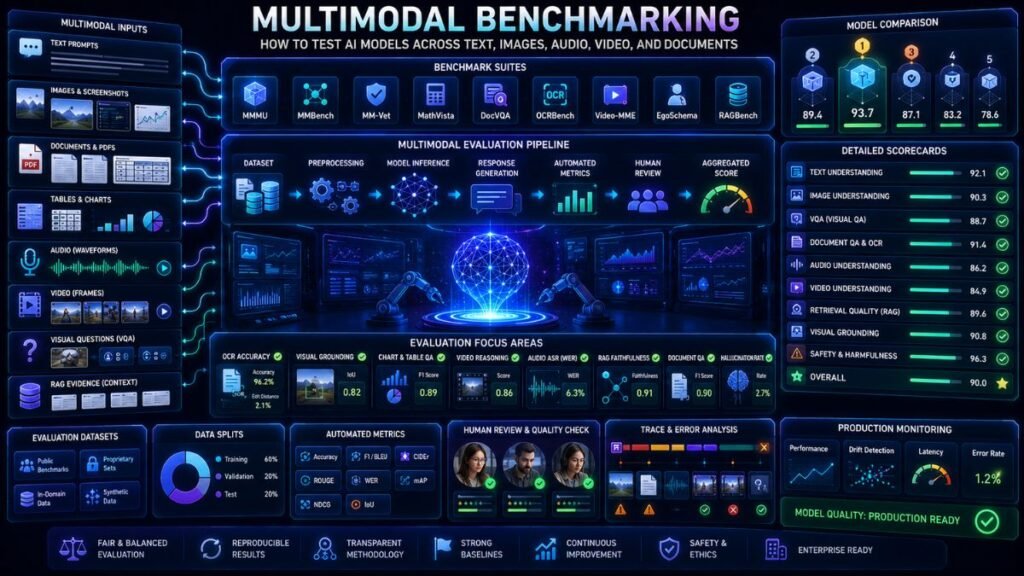
Multimodal evaluation dashboard showing text, images, audio, video, documents, benchmarks, scorecards, tracing, and AI quality checks

Multimodal Evaluation Explained: How to Test AI That Handles Text, Images, Audio, and Video Multimodal evaluation is the process of testing AI systems that work with more than text, including images, audio, video, screenshots, PDFs, charts, and documents. It measures whether the system understands the right inputs, reasons correctly, avoids unsupported claims, and produces useful

Multimodal Evaluation: Metrics and Testing Guide Read More »

RAG Latency Optimization: Complete Guide to Faster AI Retrieval

RAG latency optimization architecture showing vector databases, semantic retrieval acceleration, caching systems, and AI inference optimization

RAG Latency Optimization: How to Build Faster AI Retrieval Systems Retrieval-Augmented Generation (RAG) systems are rapidly becoming the foundation of enterprise AI applications. Organizations increasingly deploy RAG for: enterprise search AI copilots customer support assistants legal AI systems healthcare retrieval financial intelligence analytics assistants document intelligence platforms operational AI systems RAG dramatically improves Large Language

RAG Latency Optimization: Complete Guide to Faster AI Retrieval Read More »

RAG Deployment Basics: Complete Guide to Production AI Systems

RAG deployment Basics architecture showing vector databases, semantic retrieval pipelines, cloud infrastructure, and AI monitoring systems

RAG Deployment Basics: How to Deploy Production-Ready AI Systems Retrieval-Augmented Generation (RAG) has rapidly become one of the most important architectures in modern enterprise AI. Organizations increasingly use RAG systems for: enterprise search AI copilots customer support assistants legal AI systems healthcare knowledge retrieval financial intelligence platforms document intelligence conversational analytics research automation RAG dramatically

RAG Deployment Basics: Complete Guide to Production AI Systems Read More »

Scroll to Top