The Core Building Blocks of an Agentic AI System

core building blocks of an agentic AI system: Agentic AI system architecture showing goals, context, memory, planning, tools, action, feedback, observability, safety, and human approval

The core building blocks of an agentic AI system include a goal layer, input or perception layer, context engine, memory, planning module, reasoning model, tool router, action executor, feedback loop, evaluation, observability, and safety controls. Together, these components help AI agents move from passive responses to goal-driven workflows. In Simple Terms An agentic AI system […]

The Core Building Blocks of an Agentic AI System Read More »


Multimodal AI for Automation: Use Cases and Benefits

Multimodal AI for automation visual showing documents, screenshots, voice, video, forms, workflow tools, AI agents, approvals, and enterprise automation

Multimodal AI for automation uses text, images, voice, video, documents, forms, screenshots, and business data together to automate workflows. Instead of automating only structured clicks or typed inputs, multimodal AI can understand messy real-world information and help route tasks, extract data, trigger actions, and support human review. In Simple Terms Multimodal AI for automation means

Multimodal AI for Automation: Use Cases and Benefits Read More »

Multimodal AI for Research: Use Cases and Benefits

Multimodal AI for research visual showing scientific papers, microscopy images, charts, datasets, lab notes, embeddings, and AI-assisted discovery workflows

Multimodal AI for research helps researchers analyze different types of evidence together, including papers, PDFs, figures, charts, microscopy images, lab notes, code, datasets, audio notes, and experiment logs. Its strongest role is not replacing researchers, but reducing friction in discovery, literature review, data interpretation, and research synthesis. In Simple Terms Multimodal AI for research means

Multimodal AI for Research: Use Cases and Benefits Read More »

Top RAG Interview Questions and Answers for AI Engineers

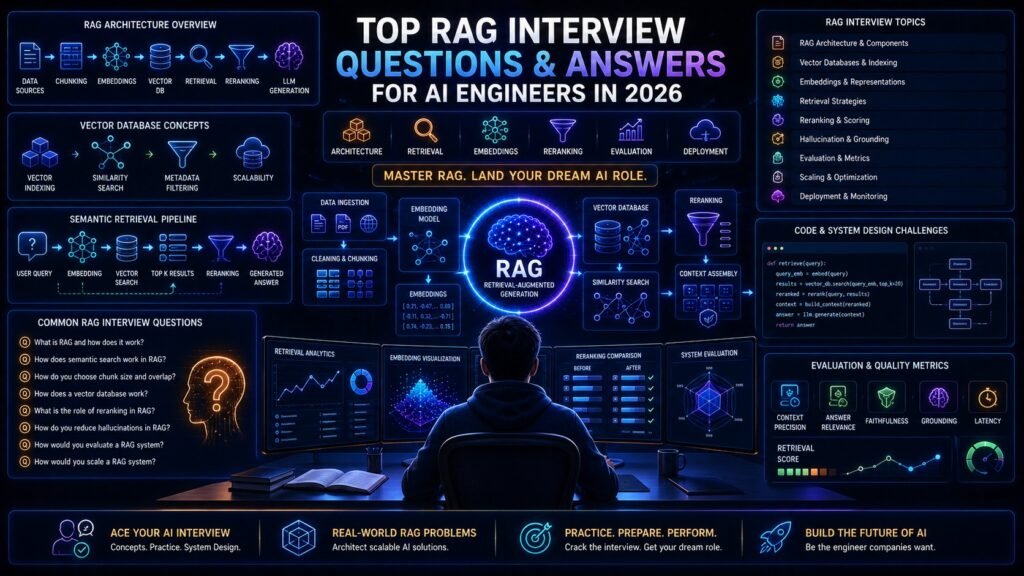
RAG interview questions visual showing vector databases, retrieval pipelines, embeddings, semantic search, and AI engineering interview preparation

Retrieval-Augmented Generation (RAG) has become one of the most important skills in modern AI engineering. Companies building AI copilots, enterprise search systems, AI agents, customer support assistants, and document intelligence platforms increasingly expect engineers to understand: semantic search embeddings vector databases retrieval pipelines reranking hallucination reduction chunking evaluation observability deployment optimization As a result,: RAG

Top RAG Interview Questions and Answers for AI Engineers Read More »

Best Prompts for Gemini: 50 Useful Gemini Prompts for Studying, Writing, Research, and Work

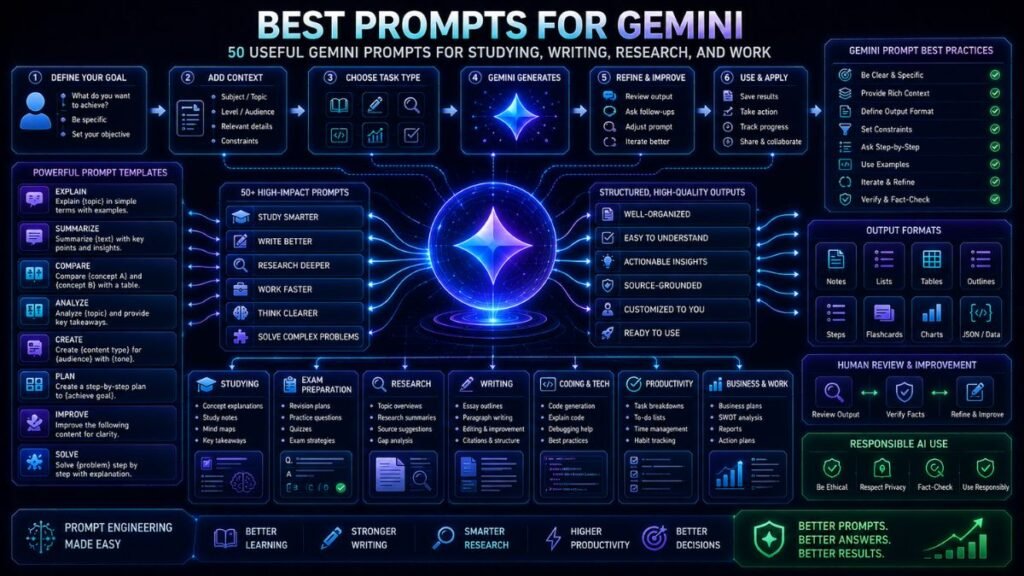
Best Prompts for Gemini: AI workflow dashboard showing Gemini prompts for studying, writing, research, coding, productivity, and exam preparation.

The best prompts for Gemini are specific, context-rich, and written around a clear goal. Instead of asking Gemini broad questions, strong prompts define the task, audience, format, and constraints. Use these Gemini prompt examples for studying, exam preparation, writing, research, coding, productivity, and daily work. In simple terms A Gemini prompt is the instruction you

Best Prompts for Gemini: 50 Useful Gemini Prompts for Studying, Writing, Research, and Work Read More »

Prompt Engineering Templates for Summarization: 12 Research and Article Summary Templates

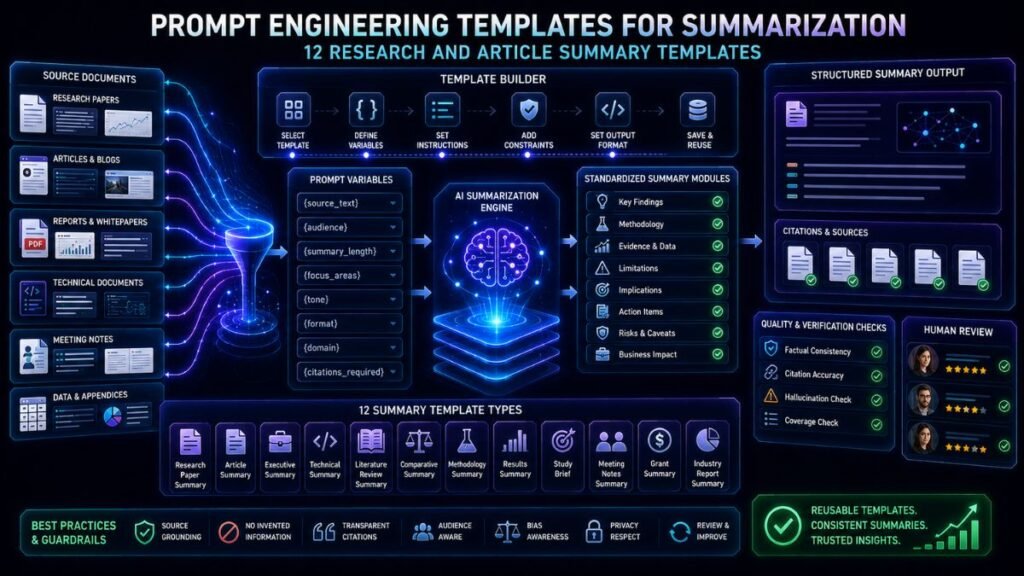
Prompt Engineering Templates for Summarization: AI summarization template dashboard showing reusable prompts for research papers, articles, reports, and technical documents.

Prompt engineering templates for summarization help you turn messy, inconsistent AI outputs into repeatable summaries. Instead of asking “summarize this,” a reusable template defines the source, audience, format, length, focus, and verification rules. Use these templates for research papers, articles, business reports, technical documents, meetings, and study notes. In simple terms A summarization prompt is

Prompt Engineering Templates for Summarization: 12 Research and Article Summary Templates Read More »

Multimodal AI for Accessibility: Use Cases and Benefits

Multimodal AI for accessibility visual showing voice input, captions, image descriptions, screen readers, documents, wearable cameras, and assistive AI tools

Multimodal AI for accessibility uses text, images, audio, video, voice, documents, captions, and assistive devices together to help more people access digital and physical information. It can support image descriptions, speech-to-text, text-to-speech, document reading, visual navigation, captions, learning support, and more inclusive interfaces. In Simple Terms Multimodal AI for accessibility means AI that can understand

Multimodal AI for Accessibility: Use Cases and Benefits Read More »

Prompt Engineering Best Practices: 15 Practical Rules for Better AI Outputs

prompt engineering best practices: AI prompt optimization dashboard showing prompt engineering best practices, structured prompts, testing, and output review.

Prompt engineering best practices help you write clearer instructions so AI tools produce more useful, accurate, and consistent outputs. The most effective prompts define the task, add context, specify the output format, include examples when needed, and make room for testing and revision. Good prompting is less about tricks and more about communication. In simple

Prompt Engineering Best Practices: 15 Practical Rules for Better AI Outputs Read More »

Scroll to Top