
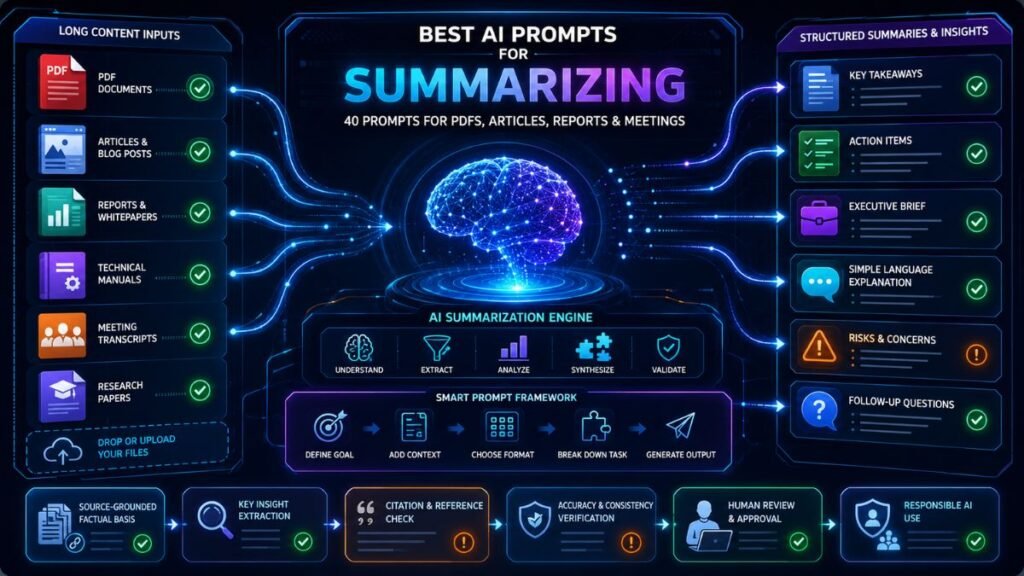
Best AI Prompts for Summarizing: 40 Prompts for PDFs, Articles, Reports, and Meetings
The best AI prompts for summarizing do more than say “summarize this.” They tell the AI what type of document it is reading, who the summary is for, what format to use, and what details must not be missed. Use these summary prompts for PDFs, articles, reports, meetings, research papers, and dense technical documents.
In simple terms
A summarization prompt is an instruction that tells an AI tool how to shorten or explain a piece of content. A weak prompt gives a vague command. A strong AI summary prompt defines the source, goal, audience, length, format, and level of detail.
For example, “Summarize this PDF” may produce a short generic overview. A better prompt says, “Summarize this PDF for a busy manager. Include key findings, risks, action items, deadlines, and unanswered questions.”
What Makes a Good Summarization Prompt?
A good prompt for summarization usually includes five parts.
| Prompt element | What it does | Example |
| Source type | Tells AI what it is summarizing | PDF, article, report, transcript |
| Audience | Adjusts depth and language | Student, manager, beginner, expert |
| Format | Controls output structure | Bullets, table, brief, checklist |
| Focus | Tells AI what matters most | Risks, actions, findings, examples |
| Constraint | Reduces unsupported output | Use only the provided text |
A simple formula is:
Summarize [content type] for [audience]. Focus on [priority]. Format the summary as [format]. Use only the provided text. Mark anything unclear or missing.
This structure helps the AI produce a useful summary instead of a shallow rewrite.
Best AI prompts for summarizing articles
1. Quick article summary
“Summarize this article in 5 bullet points. Focus on the main argument, supporting evidence, and final takeaway: [paste article].”
2. One-sentence summary
“Summarize the following passage in one clear sentence without losing the central idea: [paste text].”
3. Beginner-friendly article summary
“Summarize this article for a beginner. Explain the main idea in simple language and define any technical terms: [paste article].”
4. Critical article summary
“Summarize this article and separate facts, opinions, assumptions, and claims that need verification: [paste article].”
5. Key takeaway prompt
“Extract the 10 most important takeaways from this article. For each takeaway, explain why it matters: [paste article].”
Best prompt for summarizing PDF documents
6. PDF overview prompt
“Summarize this PDF by section. Include the purpose, main points, important details, and final conclusion: [paste or upload PDF text].”
7. PDF chapter summary prompt
“Summarize each chapter or section of this PDF separately. For each section, include key ideas, examples, and practical takeaways.”
8. PDF action brief prompt
“Create an action-focused summary of this PDF. Include decisions, deadlines, responsibilities, risks, and follow-up questions.”
9. PDF study notes prompt
“Turn this PDF into study notes with headings, definitions, examples, flashcard questions, and a final revision checklist.”
10. Long PDF compression prompt
“Summarize this long PDF into a 300-word executive summary, then provide a detailed bullet summary by section.”
Best prompts for AI to summarize technical documents in simple language
11. Technical simplification prompt
“Summarize this dense technical document in simple language for a non-technical reader. Keep the meaning accurate and define key terms: [paste text].”
12. Technical document structure prompt
“Break this technical document into problem, method, system components, workflow, limitations, and practical use cases.”
13. Jargon explanation prompt
“Summarize this technical text and create a glossary of important terms with simple explanations.”
14. Engineer-to-manager prompt
“Summarize this technical document for a product manager. Focus on what it does, why it matters, risks, dependencies, and next steps.”
15. Technical risk prompt
“Summarize this document and identify assumptions, implementation risks, missing information, and areas that need expert review.”
AI prompts for summarizing reports
16. Report summary prompt
“Summarize this report into background, key findings, evidence, recommendations, risks, and conclusion: [paste report].”
17. Executive summary prompt
“Write a concise executive summary of this report for senior leadership. Focus on decisions, numbers, risks, and recommended actions.”
18. Report findings prompt
“Extract the main findings from this report and organize them in a table with evidence, impact, and suggested action.”
19. Business report prompt
“Summarize this business report for a team meeting. Include key updates, blockers, opportunities, and decisions needed.”
20. Policy report prompt
“Summarize this policy report in plain English. Include the main issue, proposed solution, stakeholders affected, and possible trade-offs.”
AI prompts for meeting summaries
21. Meeting notes prompt
“Turn these meeting notes into a summary with decisions, action items, owners, deadlines, risks, and open questions: [paste notes].”
22. Transcript summary prompt
“Summarize this meeting transcript. Group the summary by agenda item and include who is responsible for each next step.”
23. Client meeting prompt
“Summarize this client meeting for an internal team. Include client goals, concerns, requests, commitments, and follow-up tasks.”
24. Standup summary prompt
“Summarize this standup update into completed work, current work, blockers, dependencies, and next actions.”
25. Decision log prompt
“Extract all decisions from this meeting transcript. Include decision, reason, owner, deadline, and unresolved concerns.”
AI prompts for research paper summaries
26. Research paper summary prompt
“Summarize this research paper with sections for research problem, method, dataset, findings, limitations, and practical relevance.”
27. Abstract explanation prompt
“Explain this abstract in simple language. Identify the research question, method, result, and why it matters: [paste abstract].”
28. Literature review prompt
“Summarize these paper notes into themes, agreements, disagreements, gaps, and future research directions: [paste notes].”
29. Methodology summary prompt
“Summarize the methodology section of this paper. Explain what the researchers did, why, and what limitations the method has.”
30. Research limitation prompt
“Summarize this paper and highlight limitations, assumptions, unanswered questions, and claims that need careful interpretation.”
Summary prompts for different output formats
31. Bullet summary prompt
“Summarize this content in 7 bullets. Each bullet should contain one important idea and one supporting detail.”
32. Table summary prompt
“Summarize this text in a table with columns for topic, key point, evidence, importance, and action needed.”
33. Checklist summary prompt
“Turn this content into a practical checklist. Include steps, warnings, and success criteria.”
34. Comparison summary prompt
“Summarize the differences between the main options discussed in this text. Use a comparison table.”
35. Question-answer prompt
“Summarize this document as an FAQ. Include the most important questions a reader would ask and answer them clearly.”
Prompts for better, deeper summaries
36. Missing details prompt
“After summarizing this text, list what information is missing, unclear, or needs verification.”
37. Insight extraction prompt
“Do not only summarize. Extract the non-obvious insights, contradictions, risks, and practical implications from this text.”
38. Audience rewrite prompt
“Create three versions of the summary: one for a beginner, one for a manager, and one for a technical expert.”
39. Follow-up questions prompt
“Summarize this document and suggest 10 smart follow-up questions I should ask before making a decision.”
40.Accuracy check prompt
“Check whether this summary accurately reflects the original text. Identify missing points, distorted meaning, or unsupported claims: [paste original and summary].”
Common summarization mistakes to avoid
The biggest mistake is asking AI to summarize without context. A vague prompt often misses the details that matter most to your use case.
Another mistake is trusting a summary without checking the original document. AI summaries can omit caveats, simplify technical details too much, or miss context from tables, charts, footnotes, and appendices.
Also avoid asking for very short summaries of very complex documents when accuracy matters. For dense PDFs, technical documents, and research papers, ask for both a short overview and a section-by-section summary.
Suggested Read:
- Prompt Engineering for Beginners: A Practical Guide
- Best Prompt Templates for Summarization and Research
- 25 Prompt Engineering Techniques With Examples
- How to Write Better System Prompts
- What Is Prompt Injection? Examples and Risks
FAQ: Best AI prompts for summarizing
What is an example of a prompt designed for text summarization?
A good example is: “Summarize the following passage in one sentence, keeping the main idea and removing minor details: [paste text].” This is clearly a summarization prompt because it asks AI to compress text while preserving meaning.
What is the best prompt for summarizing a PDF?
The best prompt for summarization a PDF asks for a section-by-section summary, key takeaways, action items, risks, and missing information. For long PDFs, ask for both an executive summary and a detailed breakdown.
What prompts get AI to summarize dense technical documents into simple language?
Use a prompt that says: “Summarize this technical document in simple language for a non-technical reader. Define key terms, preserve accuracy, and list assumptions or risks.”
Can AI summarize meeting notes?
Yes. AI can summarize meeting notes into decisions, action items, owners, deadlines, risks, and open questions. Always review the output for speaker attribution and missed commitments.
How do I make AI summaries more accurate?
Tell the AI to use only the provided text, preserve important caveats, mark unclear areas, and identify claims that need verification. For important work, compare the summary against the source.
Final takeaway
The best AI prompts for summarizing are specific, structured, and purpose-driven. Instead of asking AI to “summarize this,” tell it the document type, audience, format, focus, and accuracy rules. Use these prompts for PDFs, articles, reports, meetings, research papers, and technical documents, then review the output before using it in real decisions.
For stronger results, continue with prompt engineering techniques and learn how to structure prompts for clearer, safer, and more useful AI outputs.