
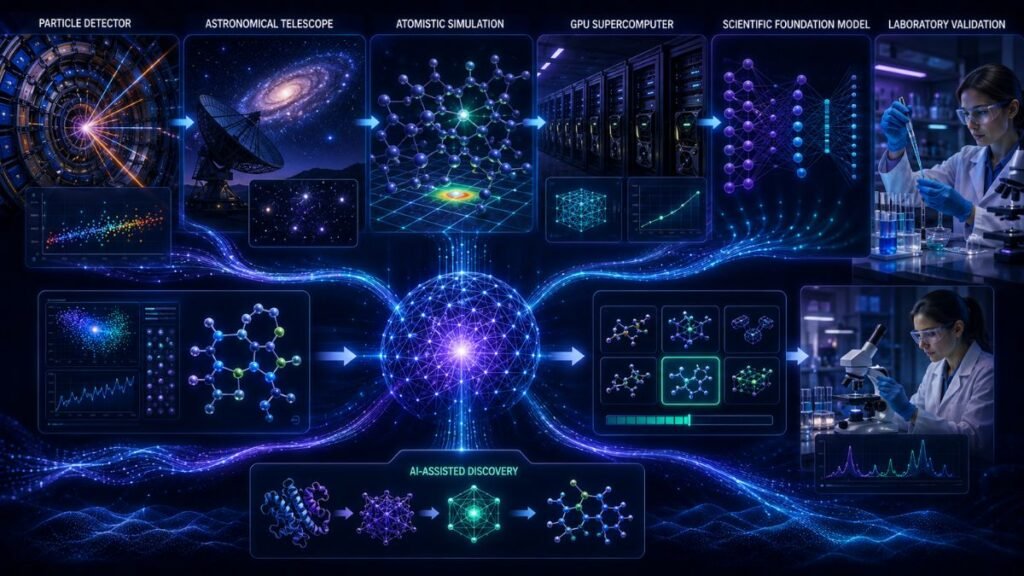
NVIDIA introduced a new collection of scientific-computing software at the ISC conference on June 22, 2026, covering experimental instruments, materials simulation, astronomy, scientific AI models, and GPU-accelerated data analysis.
The NVIDIA AI for science software portfolio includes the newly available DAQIRI data-streaming library, downloadable ALCHEMI tools and simulation microservices, and cuPhoton reference code planned for later in summer 2026. NVIDIA positions them as part of CUDA-X, its wider collection of GPU-optimized libraries for AI and high-performance computing.
The most striking reported result comes from astronomy. NVIDIA says an early-access cuPhoton pipeline accelerated the loading and reading of selected Rubin Observatory FITS images by as much as 14,900×, while signal processing and analysis reached up to 8,400× on 32 Grace Blackwell superchips. These are NVIDIA-reported figures tied to particular hardware, data, and implementation choices.
What NVIDIA Actually Announced
The announcement covers three distinct software categories.
DAQIRI: instrument data streaming
DAQIRI stands for Data Acquisition for Integrated Real-time Instruments.
It is a high-performance networking library intended to move data from fast scientific detectors and sensors directly into GPU-accelerated software. The goal is to analyze data as it arrives rather than writing everything to storage first and processing it later. DAQIRI is available now through an open-source repository.
ALCHEMI: chemistry and materials simulations
ALCHEMI combines domain-specific NIM microservices with Python toolkits for high-throughput atomistic simulation.
Its available services include batched geometry relaxation and batched molecular dynamics. These processes help researchers identify stable structures and simulate how atoms or molecules move over time. The ALCHEMI Toolkit and Toolkit-Ops are available through GitHub and PyPI, while released NIM services can be downloaded through NVIDIA’s NGC catalog.
cuPhoton: a coming astronomy reference implementation
cuPhoton is planned as reference code for loading, processing, analyzing, and visualizing very large multidimensional scientific datasets.
Its first highlighted application is astronomy, especially FITS data produced by observatories and sky surveys. It is not generally available at the time of the announcement; NVIDIA says it is expected during summer 2026.
Availability: Released, Early Access or Planned?
| Component | Purpose | Status on June 22, 2026 |
| NVIDIA DAQIRI | Streams detector and sensor data into GPU pipelines | Available on GitHub |
| ALCHEMI Toolkit | Builds custom atomistic simulation workflows | Available on GitHub and PyPI |
| ALCHEMI Toolkit-Ops | Optimized operations for simulation workflows | Available on GitHub and PyPI |
| ALCHEMI BGR NIM | Batched geometry relaxation | Available through NGC |
| ALCHEMI BMD NIM | Batched molecular dynamics | Available through NGC |
| ALCHEMI VASP NIM | Higher-throughput VASP simulations | Early access; expected later in summer |
| NVIDIA cuPhoton | Astronomy and multidimensional-data reference code | Expected in summer 2026 |
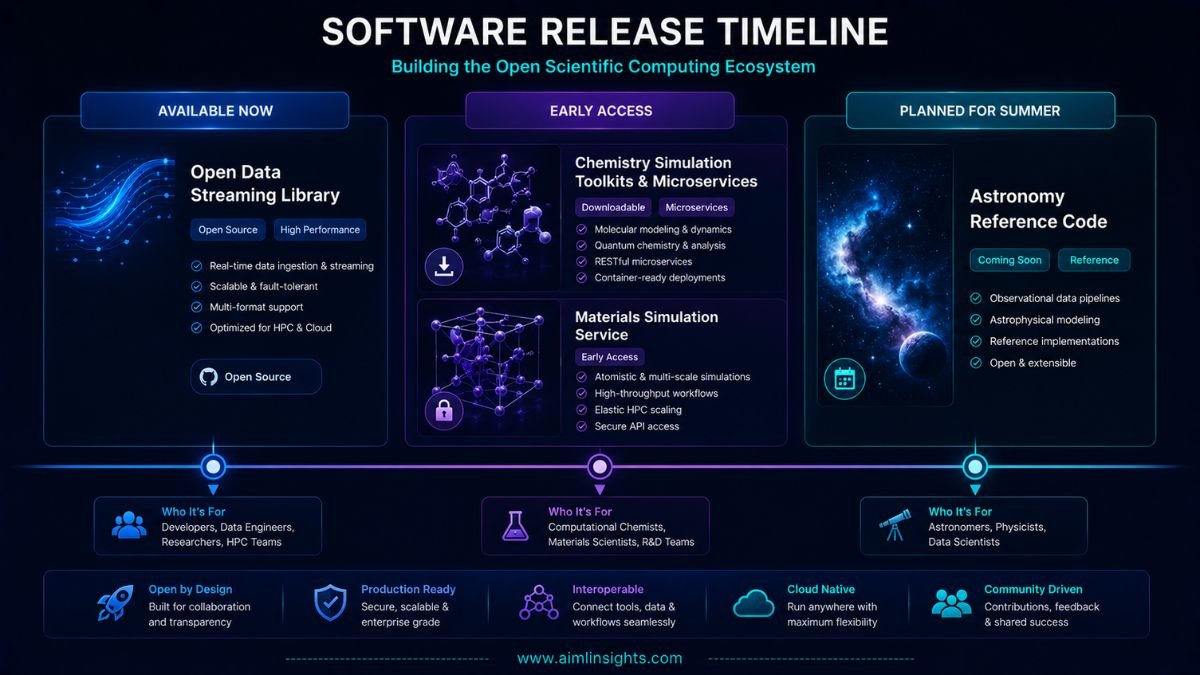
This distinction matters. A downloadable library can be evaluated today. An early-access service may change before release. A demonstrated reference implementation may still require significant engineering before production deployment.
How the Scientific Workflow Fits Together
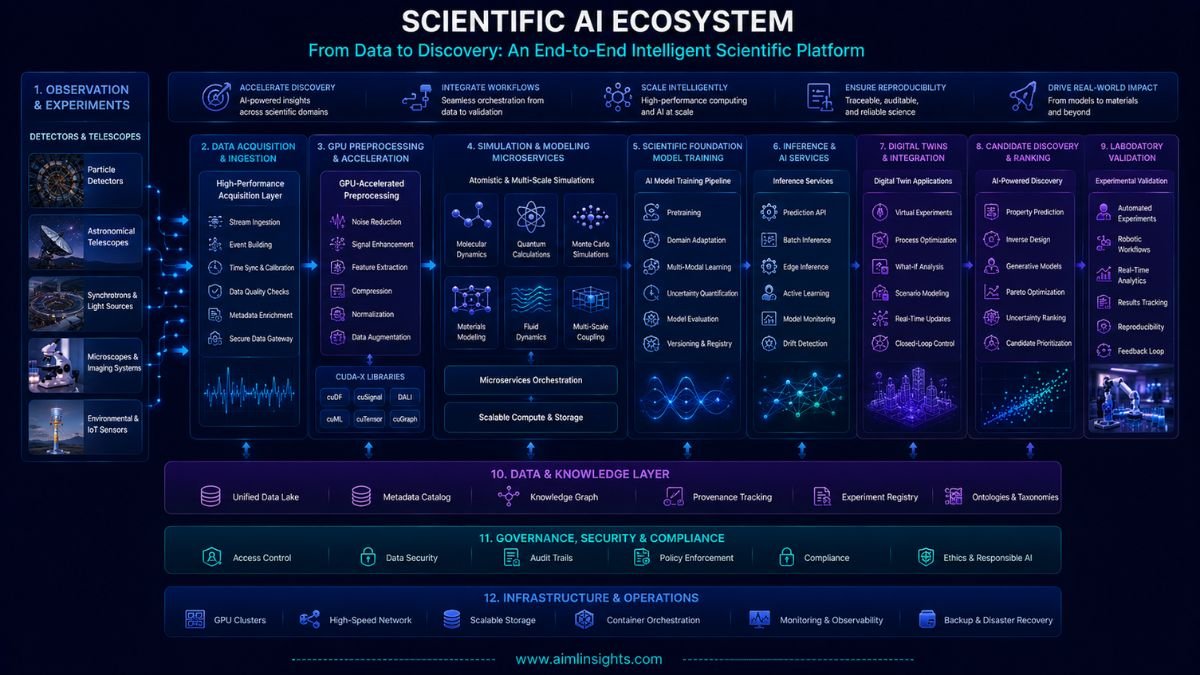
NVIDIA’s announcement is best understood as a layered architecture rather than one product.
Scientific instrument or generated structure
↓
DAQIRI or scientific data loader
↓
GPU preprocessing and CUDA-X libraries
↓
Physical simulation or ALCHEMI microservice
↓
Training data for scientific AI models
↓
Foundation model or surrogate-model training
↓
NIM or Triton inference service
↓
Candidate ranking, digital twin or experiment
↓
Laboratory or observational validation
DAQIRI addresses the input bottleneck. ALCHEMI addresses simulation throughput. Megatron-LM, Nemotron, BioNeMo, and related frameworks can train or run models using the resulting data. Triton and NIM provide inference-serving layers, while Omniverse can support visualization or digital-twin workflows. NVIDIA describes this broader stack in its Lila Sciences example.
DAQIRI and Real-Time Experimental Science
Modern instruments can generate information faster than traditional systems can save it.
DAQIRI attempts to keep the data moving into accelerated processing pipelines rather than forcing every signal through a storage-first workflow.
NVIDIA highlights A-GHOST, a research project involving CERN, the University of Chicago, University College London, and CERN openlab. It uses DAQIRI to apply AI to ATLAS collision data in real time. NVIDIA says the project can analyze data that would otherwise be rejected because ATLAS cannot store more than a small fraction of everything its detectors produce.
The practical value is not simply faster file transfer. Real-time analysis may help an experiment decide what information deserves to be retained while the event is still available.
The risk is equally important: an imperfect filtering model could suppress scientifically valuable events. Real-time AI should therefore supplement carefully validated trigger and retention systems rather than become an unreviewed authority.
cuPhoton and Astronomy’s Data Problem
Astronomy is moving into a data-volume era in which reading and preprocessing images can become as challenging as the scientific analysis itself.
cuPhoton is intended to work with multidimensional data from telescopes, X-ray systems, and laser experiments. NVIDIA says it can be combined with other CUDA-X technologies to build an accelerated pipeline for loading, processing, analysis, and visualization. Princeton collaborated on its development, while Princeton and Harvard researchers plan to use it with observatory and dark-energy-survey data.
The underlying CUDA-X ecosystem already includes scientific imaging tools such as cuCIM, which supports GPU-accelerated multidimensional image processing and offers APIs designed to resemble familiar scientific Python interfaces.
However, cuPhoton’s headline speedups require context. The published announcement does not provide a complete independent benchmark covering CPU model, storage system, precision, preprocessing stages, energy use, software versions, or equivalent-cost configurations.
How ALCHEMI Accelerates Materials Simulation
ALCHEMI targets a different scientific bottleneck: the cost of simulating large numbers of molecules and materials.
The batched geometry-relaxation service searches for stable atomic arrangements. Batched molecular dynamics models how those structures evolve over time. Instead of processing one system at a time, the services can batch many structures and make more effective use of GPU memory.
ALCHEMI can also work with machine-learning interatomic potentials. These are surrogate models trained to approximate expensive quantum-mechanical calculations. They can generate energies and forces faster than traditional first-principles methods, although their reliability depends on the training distribution and validation strategy.
NVIDIA’s earlier technical documentation describes services for conformer search and molecular dynamics using models such as AIMNet2, MACE-MPA-0, and TensorNet.
The VASP Microservice
VASP is widely used for electronic-structure and materials calculations.
NVIDIA says an upcoming ALCHEMI VASP NIM can run multiple VASP calculations on one GPU using NVIDIA Multi-Process Service. The company reports a 3× geometry-optimization speedup in its selected test. The service remains early access and is expected later in summer 2026.
This is not a replacement for VASP’s scientific methods. It is a deployment and throughput layer intended to schedule calculations more efficiently on NVIDIA hardware.
Licensing, input preparation, convergence settings, numerical equivalence, and workflow validation remain the researcher’s responsibility.
Scientific Foundation-Model Workflows
The announcement also shows how accelerated simulation can feed scientific AI.
In the Lila Sciences example, ALCHEMI generates physical-science data. Megatron-LM and Nemotron are used in model-training workflows, BioNeMo supports molecular generation, Triton and NIM serve inference, and Omniverse contributes to digital-twin applications.
The useful distinction is:
- Simulation software generates or evaluates physical data.
- Scientific foundation models learn patterns from data and propose candidates.
- Inference services make those models available to applications or agents.
- Digital twins connect predictions with simulated systems.
- Experiments determine whether the predicted result is physically valid.
A model can prioritize a promising catalyst or magnet. It cannot prove synthesizability, safety, stability, or commercial performance without testing.
Benchmark Audit
| Claim | Reported result | Baseline or setup | Owner | Independently verified? |
| cuPhoton FITS loading and reading | Up to 14,900× faster | Early-access LSST data workflow on GB200 NVL72 | NVIDIA | No |
| cuPhoton signal processing | Up to 8,400× faster | 32 Grace Blackwell superchips | NVIDIA | No |
| ALCHEMI VASP geometry optimization | 3× faster | Multiple VASP jobs on one GPU | NVIDIA | No |
| Lila materials screening | 50× acceleration | ALCHEMI BGR workflow | NVIDIA and Lila Sciences | No independent reproduction cited |
| Magnetic-property calculation | 30% faster | Early-access VASP microservice | NVIDIA and Lila Sciences | No |
| TensorNet kernels | 6× training/inference speedup; 3× lower memory | Lila Sciences workflow | NVIDIA and Lila Sciences | No |
The figures demonstrate potential on selected workloads. They should not be combined into one universal “science acceleration” score because the datasets, systems, algorithms, hardware, and baselines differ.
Practical Use Cases
The software may be useful for:
- Real-time particle-physics filtering
- Telescope and sky-survey preprocessing
- Dark-matter and dark-energy searches
- Battery and catalyst screening
- OLED and coating materials
- Magnetic-material simulation
- High-throughput molecular dynamics
- Scientific surrogate-model training
- Autonomous laboratory pipelines
- Multidimensional imaging from X-ray or laser experiments
The best-suited users are research groups already running GPU or HPC infrastructure and dealing with high data rates, expensive simulations, or repeated computational workflows.
Smaller laboratories may face substantial setup costs. The tools require compatible NVIDIA GPUs, CUDA expertise, data pipelines, workflow validation, and researchers who understand both the domain science and numerical-computing assumptions.
Critical Limitations
NVIDIA’s release contains important software, but several caveats remain.
First, performance claims are company-reported. Independent teams must reproduce them under equivalent hardware and numerical settings.
Second, faster computation does not guarantee better science. A simulation can run quickly and still use an unsuitable physical model, inaccurate potential, poor boundary conditions, or insufficient sampling.
Third, AI surrogate models can fail outside their training distribution.
Fourth, early-access or future software may change in functionality, licensing, performance, or availability.
Finally, the stack increases dependency on NVIDIA hardware and CUDA-X. Research institutions should consider portability, long-term maintenance, reproducibility, energy use, and the ability to rerun important workflows on alternative systems.
Why This Matters
The most important shift is the attempt to close the gap between experimental instruments, HPC simulations, and AI models.
Scientific computing has traditionally involved separate stages: capture data, store it, process it, simulate alternatives, train a model, and return to the laboratory.
NVIDIA wants more of those stages to happen in accelerated pipelines, potentially allowing researchers to steer an experiment or choose the next simulation while work is still running.
That could shorten discovery cycles. It also makes software validation, provenance, uncertainty tracking, and human scientific judgment more important.
Simple Explanation for Beginners
Think of scientific research as a factory.
DAQIRI moves raw information from instruments onto the factory line.
cuPhoton is designed to process extremely large scientific images.
ALCHEMI runs many virtual chemistry or materials experiments.
Scientific AI models study the results and suggest promising candidates.
Real scientists must still check whether those candidates work in the physical world.
Conclusion: NVIDIA AI for Science Software
The NVIDIA AI for science software announcement extends CUDA-X across experimental data, materials simulation, astronomy, AI-model training, inference, and digital twins.
DAQIRI and several ALCHEMI components are available now. The VASP microservice and cuPhoton remain future or early-access offerings.
The reported acceleration figures are substantial, but they come from selected NVIDIA and partner tests rather than broad independent evaluations.
The real test will be whether these tools help researchers produce reproducible discoveries—not only faster GPU benchmarks.
Final Takeaways
- NVIDIA announced the software portfolio on June 22, 2026.
- DAQIRI streams high-rate scientific data into GPU pipelines.
- DAQIRI is available now as open-source software.
- ALCHEMI offers simulation toolkits and downloadable NIM microservices.
- BGR and BMD services are available through NGC.
- The VASP microservice remains early access.
- cuPhoton is reference code planned for summer 2026.
- NVIDIA reports up to 14,900× acceleration in one astronomy data-loading test.
- Scientific AI models complement rather than replace simulations and experiments.
- All major performance figures are provider- or partner-reported.
Suggested Read:
- NVIDIA ALCHEMI Explained
- Agentic Coding Benchmark Tests Real Software Tool Use
- NVIDIA CUDA-X Guide
- LoRA Alternatives PEFT Benchmark: Which Methods Perform Better?
- Latest NVIDIA AI News
FAQ: NVIDIA AI for Science Software
What is NVIDIA AI for science software?
It is a collection of GPU-accelerated libraries, microservices, toolkits, and reference implementations for scientific data processing, simulation, AI-model workflows, and visualization.
What does NVIDIA DAQIRI do?
DAQIRI streams information from high-rate scientific detectors and sensors into GPU software so analysis can happen while the data arrives.
Is NVIDIA cuPhoton available now?
No. NVIDIA describes cuPhoton as forthcoming reference code and says it is expected in summer 2026.
How does NVIDIA ALCHEMI accelerate materials discovery?
It batches atomistic simulations, supports machine-learning interatomic potentials, and provides microservices for geometry relaxation and molecular dynamics.
What is a scientific NIM microservice?
It is a packaged, GPU-optimized service that exposes a scientific model or computation through a standardized deployment interface.
Can AI replace scientific simulation and experiments?
No. AI can approximate calculations, prioritize candidates, or guide experiments, but physical assumptions and predicted discoveries still require numerical and experimental validation.
References: