

The best AI tool for blogging is not always the tool that writes the longest draft. The best choice helps you improve the weakest part of your content workflow: topic research, SEO planning, drafting, editing, visuals, internal linking, publishing, or content updates. For most bloggers, the right answer is a small AI stack, not one magic app.
In Simple Terms
AI blogging tools help you create better blog content faster.
Some tools help you find topics. Some create outlines. Some write first drafts. Some improve SEO. Some edit grammar. Some create images. The strongest blogging workflow uses AI for speed, but keeps human judgment in charge of originality, accuracy, examples, and final publishing.
Best AI Tool for Blogging: Quick Comparison
| Tool | Best For | Blogging Use Case | Main Limit |
| ChatGPT | Flexible planning and drafting | Ideas, outlines, FAQs, rewrites, content repurposing | Needs fact-checking |
| Claude | Long-form editing | Flow, clarity, structure, tone improvement | Not a dedicated SEO platform |
| Surfer | SEO optimization | Content scoring, SERP guidance, AI search visibility | Can lead to over-optimization |
| Semrush Content Toolkit | SEO-led content workflow | Research, briefs, writing, optimization, repurposing | More advanced than some beginners need |
| RankIQ | Bloggers and niche sites | Low-competition keyword ideas, content optimization | Less broad than enterprise SEO suites |
| KoalaWriter | SEO blog drafts | SERP-based AI articles, internal links, WordPress publishing | Still needs human review |
| Jasper | Brand-focused content | Marketing blogs, brand voice, campaigns | Better for teams than casual bloggers |
| Writesonic | AI writing and SEO workflow | Blog drafts, AI search visibility, content creation | Output quality depends on inputs |
| Grammarly | Editing and polish | Grammar, clarity, tone, readability | Not a research or SEO tool |
| Canva AI | Blog visuals | Featured images, social graphics, diagrams | Not a writing tool |
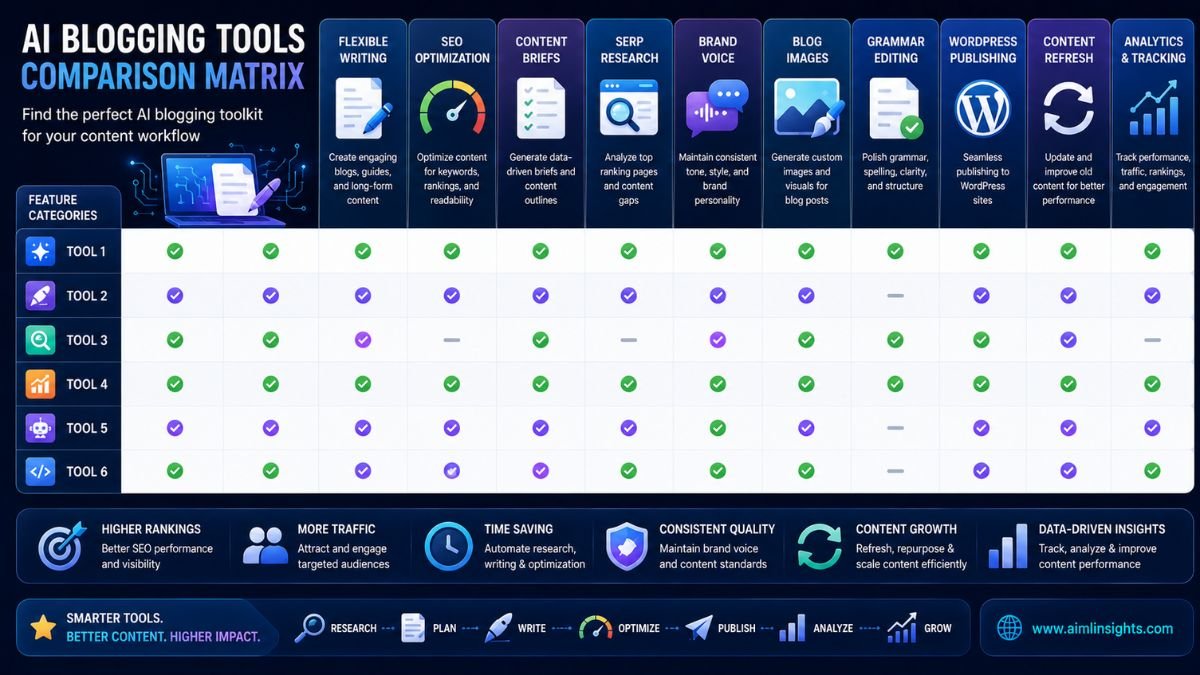
ChatGPT: Best Flexible AI Tool for Blogging Ideas
ChatGPT is useful for bloggers who want one flexible assistant for planning, outlining, rewriting, and repurposing. It can generate blog title angles, search-intent notes, FAQ ideas, meta descriptions, social snippets, and draft sections.
The best way to use ChatGPT for blogging is not to ask for a complete article and publish it directly. Use it to pressure-test your outline, simplify hard sections, create alternative introductions, and turn one blog post into newsletter or LinkedIn content.
Best for: ideation, outlining, rewriting, summaries, FAQs, repurposing.
Use carefully for: recent facts, tool features, pricing, statistics, and source-based claims.
Claude: Best for Long-Form Blog Editing
Claude is strong for editing longer blog drafts. Bloggers can use it to improve structure, reduce repetition, sharpen explanations, and check whether a post flows logically from problem to solution.
This makes Claude useful after you already have a draft. Instead of letting it create generic content from scratch, use it as a second-pass editor. Ask it to identify weak headings, unclear examples, missing reader questions, and sections that feel thin.
Best for: long-form editing, clarity, structure, tone, content review.
Use carefully for: SEO scoring and current product research.
Surfer: Best AI SEO Tool for Blogging
Surfer is one of the strongest AI SEO tools for blogging when search visibility is the goal. Surfer positions itself as an AI search visibility platform that helps users track and improve visibility across Google and AI search engines, with content scoring and optimization guidance.
Bloggers can use Surfer to analyze top-ranking pages, identify topic gaps, improve heading coverage, and optimize drafts before publishing. The risk is treating the score as the goal. A post can be optimized and still feel generic if it lacks original examples or useful judgment.
Best for: SEO content optimization, SERP alignment, topical coverage.
Use carefully for: maintaining natural writing and editorial voice.
Semrush Content Toolkit: Best for SEO-Led Blogging Workflows
Semrush Content Toolkit is useful for bloggers who want AI writing connected to real SEO data. Semrush says the toolkit combines AI writing capabilities with Semrush’s real-time SEO data, and its knowledge base describes support for creating, optimizing, and repurposing content for Google, social media, and AI search platforms.
This is useful if blogging is part of a serious traffic strategy. You can use it for topic ideas, content briefs, competitive research, optimization, and repurposing. It may be more than a beginner blogger needs, but it fits content teams and SEO-focused niche sites well.
Best for: SEO research, briefs, optimization, content repurposing.
Use carefully for: cost and platform complexity.
RankIQ: Best AI Blogging Tool for Niche Bloggers
RankIQ is designed specifically for bloggers. Its official site describes it as an SEO toolset tailored for bloggers, while independent 2026 coverage describes it as useful for bloggers who want a guided workflow for reports, outlines, optimization, and title analysis.
RankIQ is especially relevant for niche bloggers who want lower-competition keyword ideas and a simpler optimization process than full enterprise SEO platforms. It is a good fit for food blogs, travel blogs, lifestyle sites, hobby blogs, and affiliate content sites.
Best for: niche blogging, keyword ideas, guided optimization, beginner-friendly SEO.
Use carefully for: advanced technical SEO or large-scale competitor research.
KoalaWriter: Best for Fast SEO Blog Drafts
KoalaWriter is built for SEO blog post generation. Its official page highlights AI-powered SEO optimization, automatic internal and external linking, real-time data, and support for modern AI models. Another Koala page describes real-time SERP analysis, auto internal linking, and one-click WordPress publishing.
This makes KoalaWriter useful for bloggers who publish many posts and want a faster draft-to-publish workflow. The important step is editing. Fast AI drafts still need fact-checking, examples, internal links, screenshots, and brand voice.
Best for: SEO draft generation, affiliate blogs, content velocity, WordPress workflows.
Use carefully for: originality, accuracy, and thin AI-style content.
Jasper: Best for Brand-Controlled Blogging
Jasper is better suited to marketing blogs and teams that care about consistent brand voice. Its official pages position Jasper around marketing workflows, AI writing, campaigns, and brand-controlled content generation.
For bloggers, Jasper is useful when content needs to match a defined tone across blog posts, emails, landing pages, and ads. It is less necessary for a solo beginner who only needs basic writing help.
Best for: brand voice, marketing blogs, content teams, campaign writing.
Use carefully for: personal blogs where voice should feel more individual.
Writesonic: Best for AI Writing Plus Search Visibility
Writesonic is useful for bloggers who want AI writing plus SEO and AI-search positioning. Recent ranking coverage highlights Writesonic as a good fit for smaller content teams that want writing and SEO research in one subscription, while its own positioning emphasizes AI search growth and content workflows.
Use it for outlines, drafts, landing pages, and SEO-aware content workflows. Like other AI writing tools, it works best with a strong brief and human editing.
Best for: blog drafts, SEO-aware writing, content teams, AI visibility workflows.
Use carefully for: highly expert content that needs original field experience.
Grammarly: Best for Editing and Readability
Grammarly is not the best AI tool for blogging strategy, but it is valuable for final polish. It helps with grammar, clarity, tone, and readability. For bloggers, that matters because a useful post can still lose trust if it feels sloppy or unclear.
Use Grammarly near the end of the workflow, after the structure and facts are already strong.
Best for: editing, tone, grammar, readability, final polish.
Use carefully for: keeping your natural voice.
Canva AI: Best for Blog Images and Social Promotion
Blogging is not only writing. Featured images, diagrams, Pinterest pins, LinkedIn graphics, and social cards can improve click-through and distribution. Canva AI is useful for turning one article into visual assets that support Google Discover, social sharing, and newsletter promotion.
Use it for featured images, simple diagrams, quote cards, comparison visuals, and post thumbnails. Avoid generic AI art that does not explain the article.
Best for: blog visuals, featured images, social graphics, content repurposing.
Use carefully for: brand consistency and visual originality.
How to Choose the Best AI Tool for Blogging
Start with your bottleneck.
If you struggle with ideas, use ChatGPT, Perplexity, Semrush, or RankIQ. If your drafts are messy, use Claude or Grammarly. If traffic is the problem, use Surfer, Semrush, RankIQ, or KoalaWriter. If visuals slow you down, use Canva AI. If you publish at scale, combine an SEO tool, an AI writer, an editor, and a visual tool.
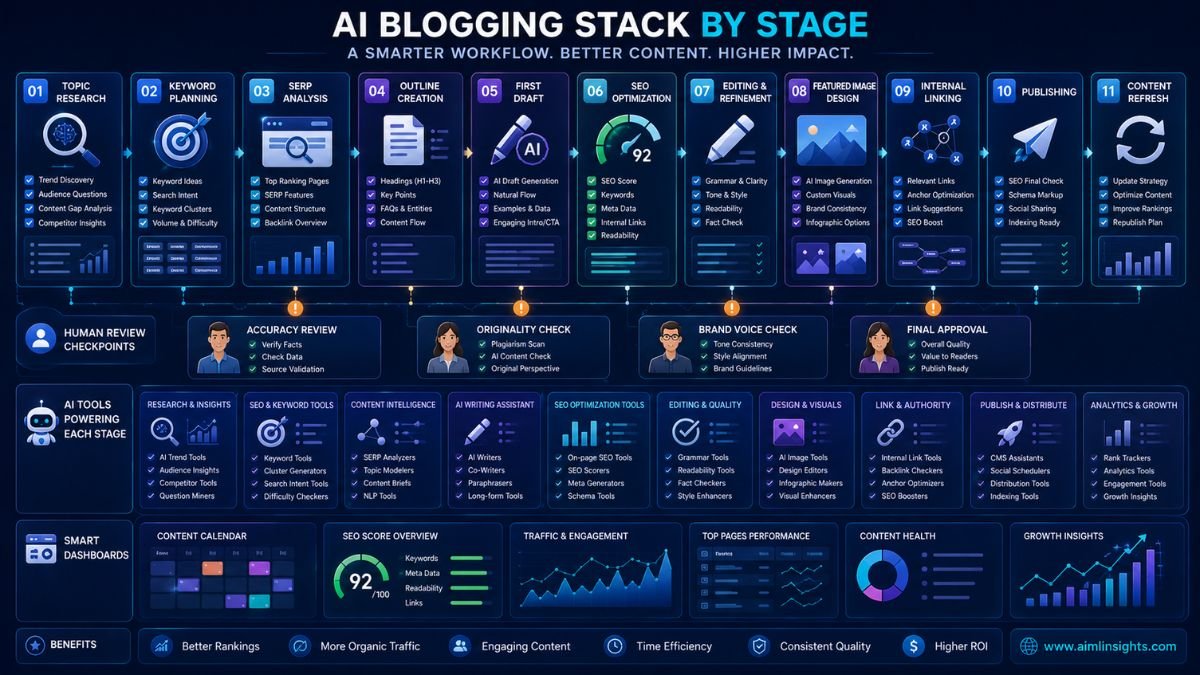
A good beginner blogging stack could be ChatGPT, RankIQ or Surfer, Grammarly, and Canva. A stronger SEO-focused stack could be Semrush Content Toolkit, Surfer, Claude, KoalaWriter, and Canva.
Common Mistakes Bloggers Should Avoid
The first mistake is publishing AI output without adding original insight. Google and readers both reward usefulness, not recycled summaries.
The second mistake is using AI SEO tools as if they guarantee rankings. They help with structure and coverage, but they do not replace topical expertise, backlinks, site speed, internal links, or trust.
The third mistake is ignoring updates. AI tool features, pricing, and model quality change often, so tool comparison posts should be refreshed regularly.
The fourth mistake is letting every article sound the same. Good blogging still needs examples, opinions, screenshots, testing notes, and a clear editorial angle.
Suggested Read:
- Best AI Tools for Beginners in 2026
- Best AI Tools for Bloggers and Content Writers
- AI Tools With Free Plans Worth Using in 2026
- Best AI Workflow Automation Tools for Teams
- ChatGPT vs Perplexity vs Claude for Research Tasks
- Best Prompt Templates for Summarization and Research
- Prompt Engineering for Beginners: A Practical Guide
- Why LLMs Hallucinate and How to Reduce It
FAQ: Best AI Tool for Blogging in 2026
What is the best AI tool for blogging?
The best AI tool for blogging depends on the task. ChatGPT is best for flexible planning, Surfer for SEO optimization, Semrush for SEO-led workflows, RankIQ for niche bloggers, KoalaWriter for fast SEO drafts, Grammarly for editing, and Canva AI for visuals.
Which AI tool is best for writing blog posts?
ChatGPT, Claude, Jasper, Writesonic, and KoalaWriter are strong options for writing blog posts. The best choice depends on whether you need flexibility, brand voice, SEO drafts, or long-form editing.
Can AI tools help blogs rank on Google?
Yes, AI tools can help with keyword research, content briefs, outlines, optimization, FAQs, internal links, and content refreshes. They do not guarantee rankings. The article still needs originality, accuracy, useful examples, and strong search-intent match.
Are AI blogging tools worth it?
AI blogging tools are worth it when they save time and improve quality. They are not worth it if they produce generic articles that require heavy rewriting or damage your brand voice.
Can AI write blog posts automatically?
AI can generate blog drafts automatically, but bloggers should not publish them without review. Every post needs fact-checking, editing, internal links, examples, visuals, and a human final pass.
What AI tools do beginner bloggers need first?
Beginner bloggers should start with one flexible writing assistant, one SEO planning tool, one editing tool, and one visual design tool. That usually covers most blogging needs without too many subscriptions.
Final Takeaway
The best AI tool for blogging is the one that improves your weakest workflow stage. For most bloggers, ChatGPT or Claude helps with planning and editing, Surfer or RankIQ helps with SEO, KoalaWriter or Writesonic helps with drafts, Grammarly improves polish, and Canva AI supports visuals.
The winning strategy is not to automate the whole blog. It is to use AI for speed while keeping human judgment, accuracy, originality, and reader value at the center.