
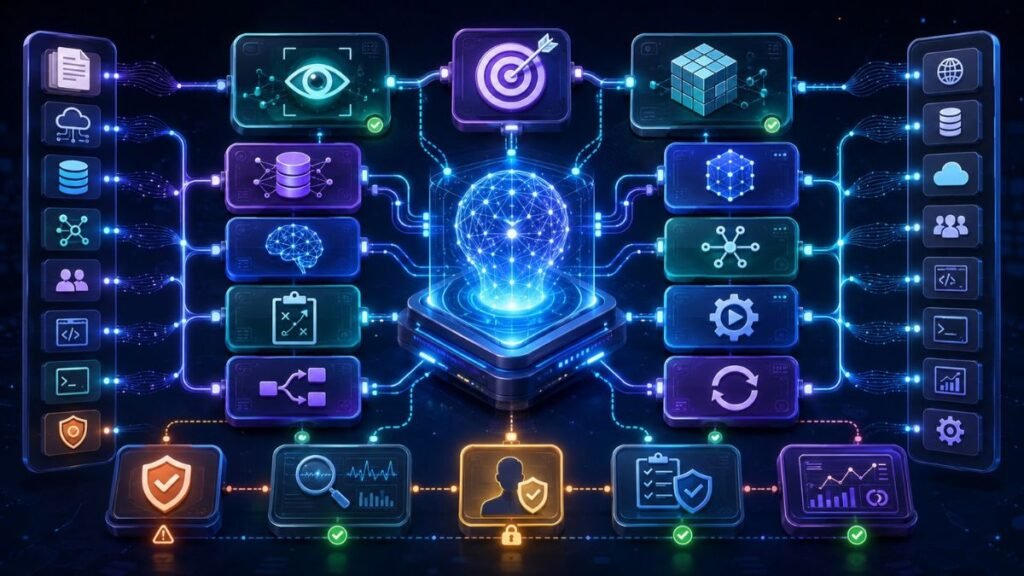
The core building blocks of an agentic AI system include a goal layer, input or perception layer, context engine, memory, planning module, reasoning model, tool router, action executor, feedback loop, evaluation, observability, and safety controls. Together, these components help AI agents move from passive responses to goal-driven workflows.
In Simple Terms
An agentic AI system is not just one AI model. It is a workflow architecture built around a model.
A basic chatbot may answer a question. An agentic AI system can receive a goal, gather context, plan steps, use tools, take action, check results, and ask a human for approval when the risk is high.
Think of it like a digital worker with a task list, memory, tools, rules, and a supervisor.
What Is an Agentic AI System?
An agentic AI system is an AI-powered system designed to pursue a goal through planning, tool use, action, and feedback. IBM defines AI agents as systems that autonomously perform tasks by designing workflows with available tools. Google Cloud describes AI agents as software systems that pursue goals and complete tasks on behalf of users, showing reasoning, planning, memory, and some autonomy.
The important point is that the model alone is not the system. The system includes the surrounding architecture: tools, memory, context, controls, monitoring, and human review.
Quick Overview: Agentic AI System Building Blocks
| Building Block | Main Role | Example |
| Goal layer | Defines success | “Resolve this support ticket” |
| Perception layer | Receives inputs | Text, files, screenshots, logs |
| Context engine | Selects useful information | Policies, user history, tool results |
| Memory | Stores task state | Prior actions and decisions |
| Planner | Breaks work into steps | Check account, retrieve policy |
| Reasoning model | Interprets and decides | LLM or multimodal model |
| Tool router | Selects tools | CRM, database, search, code runner |
| Action executor | Performs or drafts action | Update ticket or draft reply |
| Feedback loop | Checks progress | Retry, stop, or escalate |
| Observability | Records behavior | Traces, logs, tool calls |
| Safety controls | Limits risk | Permissions, approvals, rollback |
These blocks can be simple or advanced depending on the use case.
1) Goal Layer: The System Needs a Clear Objective
The first building block is the goal. Without a clear goal, the system may produce helpful-looking but misaligned output.
A weak goal is: “Help the customer.”
A stronger goal is: “Classify the customer issue, retrieve the relevant policy, draft a response, and escalate if refund approval is required.”
The goal layer gives the agent a success condition. It helps the system decide what actions are relevant and when the task is complete.
2) Perception Layer: The System Receives Inputs
The perception layer handles what the agent can see or read. Inputs may include user messages, documents, emails, logs, images, screenshots, audio, database records, or API results.
For a support agent, perception might include a ticket, customer message, screenshot, and account history. For a coding agent, it might include a GitHub issue, repository files, stack trace, and test output.
A 2026 survey describes agentic AI systems as moving from passive text generators to autonomous entities that can perceive, reason, plan, and act. It groups agent components into areas such as perception, brain, planning, action, tool use, and collaboration.
3) Context Engine: The Agent Gets the Right Information
Context engineering is one of the most important building blocks of an agentic AI system. It decides what information should enter the model at each step.
The context engine may include retrieved documents, user history, task instructions, policy rules, tool results, examples, constraints, and memory summaries.
Good context reduces guessing. Poor context creates hallucinations, irrelevant tool calls, and wrong actions.
For example, a billing agent should receive the customer’s payment records, refund policy, and current ticket. It should not receive unrelated customer data or outdated policy notes.
4) Memory: The System Tracks State Over Time
Memory helps the agent remember what has happened.
Short-term memory tracks the current task: what the user asked, which tools were called, and what results came back. Long-term memory may store preferences, prior interactions, or reusable workflow knowledge.
Memory is useful, but it must be controlled. Agents should not store sensitive information without clear rules. They should also avoid stale memory that can cause wrong future decisions.
A practical rule: memory should support continuity, not become a dumping ground.
5) Planner: The Agent Breaks Work Into Steps
Planning is the component that turns a goal into an action sequence. IBM defines AI agent planning as the process where an agent determines a sequence of actions to achieve a specific goal.
For example, a research agent may plan to search sources, filter results, extract evidence, compare findings, and summarize the answer. A coding agent may plan to reproduce a bug, inspect files, edit code, run tests, and prepare a pull request.
Planning can be fixed, dynamic, or hybrid. Fixed planning is safer for predictable workflows. Dynamic planning is useful for complex tasks, but it needs stronger evaluation and guardrails.
6) Reasoning Model: The Brain of the Agent
The reasoning model is usually a large language model or multimodal model. It interprets the task, processes context, makes decisions, and generates outputs.
But the model is not the whole agentic system. It is one component inside a larger architecture.
A good architecture separates reasoning from execution. The model may decide what tool to call, but the system should validate whether that tool call is allowed. This separation helps reduce unsafe actions.
7) Tool Router: Choosing the Right Tool
Tools let the agent interact with real systems. A tool can be a search function, vector database, CRM, calendar, email system, SQL database, code runner, browser, document parser, or internal API.
The tool router decides which tool to use and with what arguments. This layer is critical because wrong tool calls can create real operational problems.
Examples:
- A support agent calls the order lookup tool.
- A coding agent runs a test command.
- A sales agent checks CRM history.
- An operations agent retrieves system logs.
Tool schemas should be narrow, typed, validated, and permissioned.
8) Action Executor: Turning Decisions Into Work
The action executor performs the step selected by the agent. It may retrieve data, update a field, draft an email, run code, create a ticket, or prepare a recommendation.
Not every action should be automatic. High-risk actions should pause for human approval.
Google Cloud’s agentic AI design guidance describes a human-in-the-loop pattern where an agent pauses at a checkpoint and waits for a person to approve, correct, or provide input before continuing.
This is essential for payments, legal actions, healthcare, account changes, production code, and customer-impacting decisions.
9) Feedback Loop: The Agent Checks Results
A feedback loop lets the system inspect what happened after an action. Did the tool return the right data? Did the task progress? Did the agent need to retry, stop, or escalate?
Without feedback, the agent becomes a one-shot automation script. With feedback, it can adapt.
For example, if a customer lookup fails, the agent should not invent customer details. It should ask for more information or escalate.
Feedback is also where termination conditions matter. The agent should know when to stop.
10) Observability: Teams Need to See What Happened
Observability records the agent’s behavior. It should capture user input, model calls, retrieved context, memory access, tool calls, tool arguments, errors, approvals, latency, cost, and final output.
This matters because agent failures often happen inside the workflow, not only in the final answer.
Research on agentic architecture argues that reliability is largely architectural, supported by components such as goal managers, planners, tool routers, executors, memory, verifiers, safety monitors, and telemetry.
In production, if teams cannot inspect the trace, they cannot reliably debug the agent.
11) Evaluation and Safety Controls
Evaluation checks whether the agent works. Safety controls limit what it can do.
Evaluation should test goal completion, planning quality, tool-use accuracy, retrieval relevance, memory behavior, latency, cost, and escalation quality.
Safety controls include:
- Least-privilege permissions.
- Human approval for risky actions.
- Prompt-injection defenses.
- Tool validation.
- Audit logs.
- Budget limits.
- Rollback paths.
- Data-access controls.
NVIDIA describes autonomous agents as systems that reason, plan, and execute multi-step tasks based on goals while using security, privacy, and policy controls to make them safer to develop and deploy.
Example: How the Building Blocks Work Together
Imagine a user asks, “Why was my order delayed?”
- The goal layer defines the task: investigate the order delay.
- The perception layer reads the message and order ID.
- The context engine retrieves policy and shipping rules.
- Memory recalls prior customer interactions.
- The planner decides to check order status and shipping history.
- The tool router calls the order database.
- The action executor retrieves shipment data.
- The feedback loop checks whether the answer is complete.
- The system drafts a response.
- If compensation is needed, human approval is requested.
- Observability records the trace.
This is an agentic AI system because it works through a goal with tools, context, action, and controls.
Common Mistakes to Avoid
The first mistake is treating the LLM as the whole system. The model matters, but architecture decides reliability.
The second mistake is giving tools too much access. Start with read-only tools, then allow draft actions, then supervised writes.
The third mistake is skipping observability. If the agent fails, you need to know whether the problem came from planning, retrieval, memory, tools, or execution.
The fourth mistake is allowing endless loops. Every agent should have step limits, timeout rules, cost budgets, and stopping conditions.
Suggested Read:
- What Is Agentic AI? A Practical Guide for Beginners
- How Agentic AI Works: Planning, Memory, Tools, and Action
- Agentic AI Architecture Explained Simply
- What Is Context Engineering in Agentic AI?
- How to Evaluate Agentic AI Systems
- Observability for Agentic AI: What Teams Need to Track
- Common Failure Modes in Agentic AI Systems
- Agentic AI Security Risks You Should Understand
FAQ: The Core Building Blocks of an Agentic AI System
What are the core building blocks of an agentic AI system?
The core building blocks are goals, perception, context, memory, planning, reasoning, tools, action execution, feedback, observability, evaluation, and safety controls.
What components does an AI agent need?
A useful AI agent needs a goal, model, context, memory or state, tools, action logic, feedback loop, permissions, and monitoring.
How is an agentic AI system built?
It is built by connecting a reasoning model to context, memory, tools, workflows, evaluation, observability, and human oversight.
Why do AI agents need planning and memory?
Planning helps agents break goals into steps. Memory helps agents track previous actions, tool results, and task state across the workflow.
How do AI agents use tools?
AI agents use tools to search data, call APIs, query databases, update systems, run code, create tickets, or retrieve documents.
What controls are needed in an agentic AI system?
Key controls include access permissions, tool validation, human approval, audit logs, prompt-injection defenses, budget limits, and rollback paths.
Final Takeaway
The core building blocks of an agentic AI system turn a model into a controlled workflow system. Goals, context, memory, planning, tools, execution, feedback, observability, evaluation, and safety controls all work together to help AI agents complete tasks reliably.
To continue learning, read Agentic AI Architecture Explained, How Agentic AI Works, and How to Evaluate Agentic AI Systems next.