
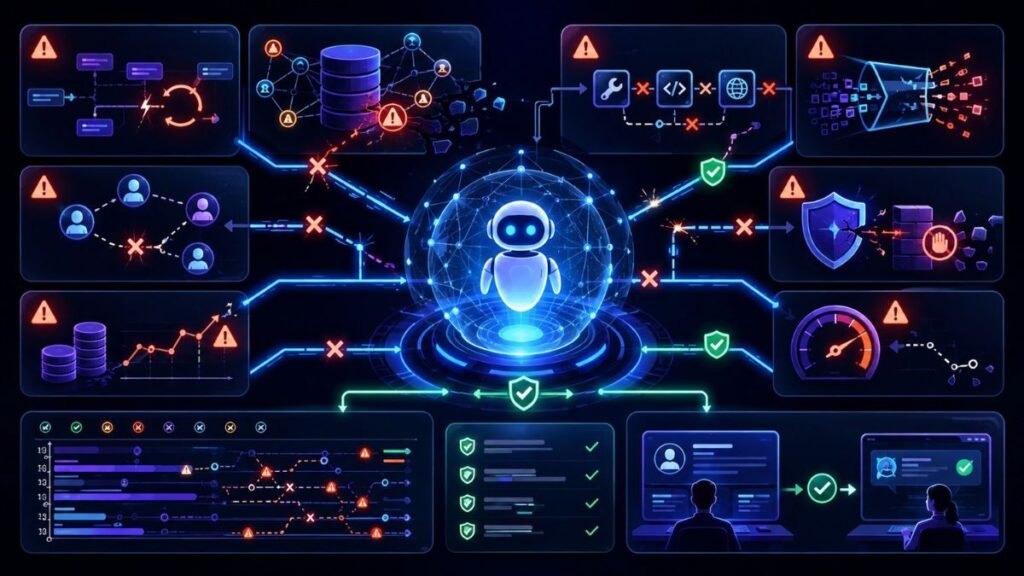
Common failure modes in agentic AI systems include misunderstood goals, poor planning, wrong tool calls, stale memory, bad retrieval, unsafe autonomy, prompt injection, multi-agent coordination errors, hidden cost growth, and weak observability. These failures matter because agentic AI systems do not only generate answers; they can take actions inside real workflows.
In Simple Terms
Agentic AI systems fail differently from normal chatbots.
A chatbot may give a wrong answer. An AI agent may give a wrong answer, call the wrong tool, retrieve the wrong document, update the wrong record, or keep looping through unnecessary steps.
That is why teams need to evaluate not only the final output, but the full path the agent followed.
Why Agentic AI Failure Modes Matter
Agentic AI systems combine models, prompts, tools, memory, retrieval, APIs, permissions, and sometimes multiple agents. That makes them more like distributed software systems than simple prompt-response tools.
A 2026 survey describes AI agents as systems that combine foundation models with reasoning, planning, memory, and tool use, and highlights evaluation challenges such as non-determinism, long-horizon credit assignment, tool variability, retries, context growth, and hidden costs.
The practical lesson is simple: when an agent fails, the cause may not be “the model is bad.” The failure may come from planning, context, memory, tools, permissions, or monitoring.
Goal Misinterpretation
The first failure mode happens at the start: the agent misunderstands the user’s goal.
For example, a user says, “Fix this billing issue,” but the agent assumes the goal is to draft a support response instead of investigating the payment history. Another agent may treat “summarize this contract” as “extract every clause,” producing a long and unhelpful output.
Detection signals: irrelevant actions, early wrong tool calls, outputs that answer a different task, repeated clarification failures.
Mitigation: use clear goal classification, ask clarifying questions for vague requests, and define task boundaries before tool use.
Planning Failures
Planning failure occurs when the agent chooses the wrong sequence of steps. It may skip validation, call tools too early, repeat steps, or create a plan that cannot complete the task.
A support agent might suggest a refund before checking policy. A coding agent might edit files before reproducing the bug. A research agent might summarize sources before verifying whether they are relevant.
Recent work on AI agent systems identifies planning and control as central design areas, from reactive policies to hierarchical and multi-step planners. Poor planning creates downstream failures because later steps depend on earlier choices.
Mitigation: test agent trajectories, require step-by-step plans for high-risk tasks, and use approval gates before irreversible actions.
Tool Selection Errors
Tool-use failure is one of the most common agentic AI failure modes. The agent may choose the wrong tool, pass bad arguments, misread tool outputs, or use a tool when it should not.
For example, an agent might search a public knowledge base when it should query the internal CRM. It might call a payment API with the wrong customer ID. It might misinterpret an error response as success.
OWASP’s Agentic AI security guidance notes that agentic systems introduce new failure modes including tool misuse, prompt injection, and data leakage.
Mitigation: use narrow tool schemas, strong permissions, typed arguments, validation layers, tool-call logging, and human review for high-impact actions.
Retrieval and Context Failures
Many agents use RAG or file search. Retrieval failure happens when the agent gets the wrong documents, incomplete context, outdated policies, or irrelevant chunks.
This can make the final answer look confident but unsupported. A legal agent may cite the wrong clause. A support agent may use an outdated refund policy. A document agent may miss a table or chart because chunking was poor.
Detection signals: low retrieval relevance, missing citations, contradictory context, answers based on unsupported claims.
Mitigation: improve chunking, metadata, reranking, source freshness, citation checks, and retrieval evaluation.
Memory Failures
Memory helps agents maintain continuity, but it can fail in dangerous ways. The agent may remember stale preferences, store sensitive data unnecessarily, confuse two users, or over-trust old task context.
For example, a sales agent may remember that a customer rejected a plan last month, but that may no longer be true. A support agent may recall a prior case and apply it incorrectly to a new issue.
Research on agent failures has proposed taxonomies covering memory, reflection, planning, action, and system-level operations, which reflects how memory can become a core source of agent errors.
Mitigation: add memory expiration, user-level isolation, consent rules, access controls, and memory relevance checks.
Prompt Injection and Instruction Confusion
Prompt injection happens when malicious or untrusted content manipulates the model’s behavior. In agentic AI, the risk increases because agents may use tools and act on instructions hidden in documents, emails, web pages, or screenshots.
OWASP defines prompt injection as manipulating model responses through specific inputs to alter behavior, including bypassing safety measures. OWASP’s prompt-injection examples also warn that if a model processes instructions blindly inside workflow tools, it may carry out dangerous actions.
Mitigation: separate trusted instructions from untrusted content, sandbox tool actions, restrict permissions, scan retrieved content, and require human approval for sensitive actions.
Multi-Agent Coordination Failures
Multi-agent systems introduce extra failure modes. Agents may disagree, duplicate work, pass incomplete context, overwrite one another, or loop through debate without progress.
A study titled “Why Do Multi-Agent LLM Systems Fail?” found that performance gains across popular benchmarks are often minimal compared with single-agent frameworks and analyzed challenges across multiple frameworks and tasks.
Mitigation: define agent roles clearly, use centralized orchestration when possible, limit communication channels, set stopping conditions, and evaluate the full collaboration trajectory.
Autonomy and Permission Failures
Agentic AI becomes risky when it can take high-impact actions without enough control. Examples include sending emails, issuing refunds, changing records, deleting files, or triggering financial workflows.
A recent Reuters report described a high-profile incident where an AI-powered support chatbot was manipulated into granting access to major Instagram accounts, highlighting risks when automation touches sensitive account functions without adequate safeguards.
Mitigation: use least-privilege access, approval gates, action allowlists, audit logs, rollback paths, and separate read-only tools from write-capable tools.
Cost, Latency, and Loop Failures
Agents can become expensive and slow because one user request may trigger many model calls, retrieval steps, tool calls, retries, and evaluations.
Agentic systems also risk loops: repeatedly searching, retrying tools, rewriting plans, or debating across agents. TechRadar recently noted that agentic AI can introduce hidden operational costs because persistent autonomous tasks consume resources differently from prompt-driven interactions.
Mitigation: set budget limits, maximum steps, timeout rules, retry caps, model routing, caching, and early-stop conditions.
Weak Observability
Poor observability turns agent failures into black boxes. If teams cannot inspect traces, tool calls, retrieved context, memory reads, and safety decisions, they cannot debug the system reliably.
LangSmith’s observability materials emphasize complete execution traces for debugging agent decisions, cost, latency, hallucinations, and complex failures. LangChain’s 2026 article also argues that agent debugging shifts from traditional stack traces to traces that show what the agent actually did.
Mitigation: track full traces, model calls, tool arguments, retrieval results, memory events, human overrides, latency, cost, and safety flags.
Common Mistakes to Avoid
Do not evaluate only the final answer. In agentic AI, the path matters.
Do not give agents broad tool access too early. Start with read-only tools, then draft actions, then supervised write actions.
Do not assume multi-agent systems are automatically better. More agents can mean more coordination failures.
Do not skip red-team testing. Agentic systems should be tested against prompt injection, tool misuse, permission abuse, stale memory, and ambiguous goals.
Suggested Read:
- What Is Agentic AI? A Practical Guide for Beginners
- How Agentic AI Works: Planning, Memory, Tools, and Action
- Agentic AI Architecture Explained Simply
- How to Evaluate Agentic AI Systems
- Observability for Agentic AI: What Teams Need to Track
- What Is Context Engineering in Agentic AI?
- Single-Agent vs Multi-Agent Systems in Agentic AI
- MCP Explained: Why It Matters for AI Agents
FAQ: Common Failure Modes in Agentic AI Systems
What are common failure modes in agentic AI systems?
Common failure modes include goal misunderstanding, bad planning, wrong tool calls, poor retrieval, stale memory, prompt injection, multi-agent coordination errors, unsafe autonomy, high cost, latency, and weak observability.
Why do AI agents fail?
AI agents fail because they combine uncertain model reasoning with tools, memory, retrieval, permissions, and multi-step workflows. A failure in any layer can affect the final outcome.
What are tool-use failures in AI agents?
Tool-use failures happen when an agent chooses the wrong tool, passes incorrect arguments, misreads results, or performs an action without proper permission.
How do memory failures affect agentic AI?
Memory failures can cause agents to use stale, irrelevant, private, or incorrect context, leading to wrong decisions or privacy risks.
What are the security risks of agentic AI systems?
Key risks include prompt injection, tool misuse, data leakage, excessive permissions, unsafe automation, and hidden malicious instructions inside untrusted content.
How can teams reduce AI agent failure risk?
Teams can reduce risk with narrow scopes, tool validation, memory controls, retrieval evaluation, traces, human approval, red-team testing, and production monitoring.
Final Takeaway
Common failure modes in agentic AI systems come from the full workflow, not only the model. Teams need to track goals, planning, tools, retrieval, memory, permissions, security, cost, latency, and observability before giving agents more autonomy.
To continue learning, read How to Evaluate Agentic AI Systems, Observability for Agentic AI, and Agentic AI Architecture Explained next.