
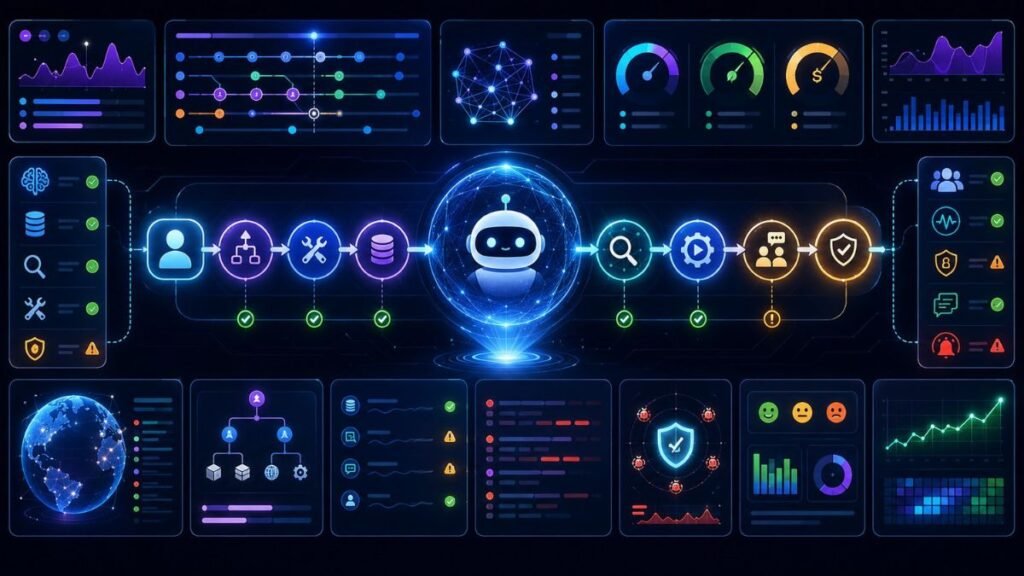
Observability for agentic AI means tracking how an AI agent thinks, acts, uses tools, retrieves information, handles errors, and completes tasks in production. Teams need more than logs. They need traces, tool-call records, memory events, latency, cost, safety signals, human review points, and outcome metrics.
In Simple Terms
Agentic AI systems do not only answer questions. They plan steps, call tools, retrieve data, update workflows, and sometimes coordinate with other agents.
That makes observability more important. If a normal chatbot gives a bad answer, you inspect the prompt and response. If an AI agent fails, you need to know which step failed, which tool it called, what data it saw, and why it made that choice.
What Is Observability for Agentic AI?
Observability for agentic AI is the ability to inspect and monitor an AI agent’s full behavior across a task. It helps teams answer questions such as:
- What did the user ask?
- What plan did the agent create?
- Which model calls happened?
- Which tools were selected?
- What arguments were passed?
- What did retrieval return?
- Did the agent use memory correctly?
- Where did it fail or escalate?
LangSmith’s observability documentation says traces record every step of an agent’s execution, from user input to final response, including tool calls, model interactions, and decision points. This is the core idea: agent observability tracks the workflow, not just the final output.
Why Agentic AI Needs Different Observability
Traditional software monitoring tracks system health: uptime, errors, CPU, memory, API latency, and logs. Agentic AI needs those signals too, but they are not enough.
AI agents are probabilistic. They may choose different tools, interpret the same context differently, or fail because of weak retrieval, stale memory, poor planning, or unsafe instructions. Fiddler describes agentic monitoring as observing and analyzing agent behavior in real time, including decision-making processes and multi-step reasoning chains.
A production agent may look healthy at the infrastructure level while still making poor workflow decisions. That is why teams need semantic observability: visibility into meaning, decisions, and task outcomes.
Core Agentic AI Observability Signals
| Signal | What It Tracks | Why It Matters |
| Trace timeline | Full execution path | Shows where failure happened |
| Model calls | Prompts, outputs, tokens | Tracks quality, cost, and drift |
| Tool calls | Tool selected, arguments, result | Catches wrong actions |
| Retrieval events | Documents or chunks returned | Shows grounding quality |
| Memory access | What was recalled or stored | Detects stale or unsafe context |
| Latency | Time per step and total task time | Finds bottlenecks |
| Cost | Tokens, tool usage, compute | Controls production spend |
| Safety events | Refusals, escalations, policy flags | Supports governance |
| Human review | Approvals, overrides, corrections | Improves trust and feedback |
Track Full Traces, Not Just Logs
A trace is the story of what happened. It should show each step of the agent workflow: user input, planning, model calls, retrieval, tool calls, outputs, errors, and final response.
OpenAI’s Agents documentation points developers toward building an improvement loop with traces and evaluations, reflecting how agent quality improves when teams can inspect execution paths.
Traces help debug questions like: Did the agent skip retrieval? Did it call the wrong tool? Did it repeat the same step? Did it ignore a tool result? Without traces, failures become guesswork.
Track Model Calls and Token Usage
Each model call should be observable. Teams should track the model used, input size, output size, token usage, latency, errors, and response quality.
This matters because agentic AI systems often make several model calls per task. A support agent may classify a ticket, retrieve knowledge, draft a response, evaluate the draft, and decide whether to escalate. Each call adds cost and latency.
Datadog’s LLM observability guidance highlights tracing prompts, retrieval steps, tool calls, agent decisions, latency, token usage, retries, and errors at each step.
Track Tool Calls Carefully
Tool calls are one of the highest-risk parts of agentic AI. A tool call may search documents, query a database, run code, send an email, update a CRM, create a ticket, or trigger a workflow.
LangChain’s agent observability guidance highlights tracking which tools were selected, what arguments were passed, what results were returned, and how long each call took.
Tool-call observability should answer:
- Did the agent choose the right tool?
- Were the arguments valid?
- Did the tool return an error?
- Did the agent interpret the result correctly?
- Was the action allowed by policy?
For high-impact tools, teams should also track approvals and rollback paths.
Track Retrieval and Context Quality
Many agentic AI systems use RAG or document retrieval. Observability should show what the agent retrieved, why it retrieved it, and whether the final response used that evidence correctly.
Track retrieved chunks, source documents, metadata, scores, citations, reranking results, and unused context. This helps diagnose hallucinations and wrong answers.
If an agent answers incorrectly, the problem may not be the model. It may be weak retrieval, bad chunking, stale documents, missing metadata, or irrelevant context.
Track Memory Events
Agentic AI memory can improve personalization and continuity, but it can also create risk. Observability should track what memory was read, what memory was written, when it was updated, and why it was used.
This is especially important for customer support, sales, coding assistants, and long-running workflows. A stale memory can cause a wrong decision. An unsafe memory write can create privacy problems.
Teams should monitor memory relevance, retention, access permissions, and deletion rules.
Track Safety, Escalation, and Human Review
Agentic AI observability must include safety events. Track policy violations, refusals, risky tool calls, human handoffs, user complaints, and human overrides.
For example, if an agent recommends a refund, sends an email, updates account data, or edits production code, the system should record whether human approval was required and whether it was given.
Human review signals are valuable training data. They show where the agent was uncertain, wrong, too aggressive, or too cautious.
Track Cost, Latency, and Reliability
Agentic AI can become expensive because one user request may trigger many model calls, retrieval steps, tool calls, and evaluation checks.
Track total task latency, latency by step, model cost, token usage, tool cost, retry count, timeout rate, and error rate. These metrics show whether the agent is practical for real users.
A multi-step agent that gives good answers but takes too long or costs too much may still be unsuitable for production.
Example: Observability for a Support Agent
Imagine a customer says, “I was charged twice.”
A strong observability setup should show:
- The original customer message.
- The classification as a billing issue.
- The policy documents retrieved.
- The payment API call and result.
- The agent’s draft response.
- The escalation decision.
- The human approval status.
- The final response sent.
- The total cost and latency.
If the agent fails, the team can inspect the trace and identify the real cause.
Common Mistakes to Avoid
The first mistake is only logging the final answer. Agentic AI failures often happen earlier in the trajectory.
The second mistake is not tracking tool arguments. Knowing that a tool was called is not enough; teams need to know what inputs were passed.
The third mistake is ignoring production drift. Agents may behave well in tests but fail when real users upload messy data, ask ambiguous questions, or trigger unusual workflow paths.
Risks of Poor Agentic AI Observability
Poor observability creates black-box automation. Teams may not know why an agent made a decision, whether it used the right source, or which action caused a failure.
Recent research on agent observability highlights that tool-use failures can be hard to diagnose and control, especially when agents skip required tools, call unnecessary tools, or make early mistakes that affect the rest of a long trajectory.
For business teams, this creates risk around compliance, customer trust, security, cost, and accountability.
Suggested Read:
- What Is Agentic AI? A Practical Guide for Beginners
- How Agentic AI Works: Planning, Memory, Tools, and Action
- Agentic AI Architecture Explained Simply
- How to Evaluate Agentic AI Systems
- What Is Context Engineering in Agentic AI?
- Single-Agent vs Multi-Agent Systems in Agentic AI
- MCP Explained: Why It Matters for AI Agents
FAQ: Observability for Agentic AI
What is observability for agentic AI?
Observability for agentic AI is the ability to inspect and monitor an AI agent’s full workflow, including traces, model calls, tools, retrieval, memory, actions, safety events, and outcomes.
What should teams track in AI agents?
Teams should track task success, traces, model calls, tool calls, retrieval, memory, latency, cost, errors, safety flags, human approvals, and user feedback.
Why are traces important for AI agents?
Traces show the full execution path. They help teams debug planning errors, wrong tool calls, weak retrieval, loops, and poor final outputs.
How do you track AI agent tool calls?
Track the selected tool, input arguments, output result, error status, execution time, permission checks, and whether human approval was needed.
What metrics matter for agentic AI observability?
Important metrics include task success rate, tool error rate, retrieval relevance, latency, cost, escalation rate, human override rate, safety incidents, and user satisfaction.
What are the risks of poor AI agent observability?
Risks include black-box decisions, wrong actions, tool misuse, privacy leaks, high costs, unresolved failures, compliance gaps, and weak accountability.
Final Takeaway
Observability for agentic AI is about seeing the whole agent workflow, not just the final answer. Teams need traces, tool-call records, retrieval visibility, memory tracking, safety events, cost metrics, latency metrics, and human review signals.
To continue learning, read How to Evaluate Agentic AI Systems, Agentic AI Architecture Explained, and Context Engineering in Agentic AI next.