

Agentic AI vs generative AI is the difference between AI that mainly creates content and AI that can pursue goals through actions. Generative AI writes, summarizes, codes, or creates images from prompts. Agentic AI plans steps, uses tools, checks progress, and completes workflows with limited human supervision.
In Simple Terms
Generative AI is like a skilled creator. You ask it to write a blog outline, summarize a report, generate code, or create an image, and it produces output.
Agentic AI is more like a goal-driven assistant. You give it an objective, and it can decide what steps to take, use tools, retrieve information, update systems, and ask for approval when needed.
The simplest difference is this:
What Is Generative AI?
Generative AI is artificial intelligence that creates new content from a user prompt or input. IBM defines generative AI as AI that can create original content in response to a user’s prompt or request.
That content can include text, code, images, audio, video, summaries, emails, reports, designs, or answers. A generative AI tool may help a marketer draft campaign copy, a developer write code, a student summarize notes, or a designer create image concepts.
Generative AI is usually prompt-response based. The user asks. The model responds. It may be very powerful, but the interaction often remains centered on content creation.
What Is Agentic AI?
Agentic AI refers to AI systems that can pursue goals with some degree of autonomy. Google Cloud describes agentic AI as AI focused on autonomous decision-making and action, where systems can set goals, plan, and execute tasks with minimal human intervention. IBM’s comparison explains agentic AI as a broader concept for solving issues with limited supervision, while AI agents are specific components inside that system.
Agentic AI usually includes planning, tool use, memory, feedback loops, and workflow execution. It may use a generative AI model internally, but its purpose is broader than generating an answer.
For example, a generative AI tool can draft a customer email. An agentic AI system can read the support ticket, check the order, retrieve policy context, draft the reply, update the CRM, and ask a human before sending.
Agentic AI vs Generative AI: Quick Comparison
| Feature | Generative AI | Agentic AI |
| Main purpose | Create content | Complete goals or workflows |
| Interaction style | Prompt → response | Goal → plan → action → feedback |
| Autonomy | Usually limited | Higher, but should be controlled |
| Tool use | Optional | Central to most systems |
| Memory/context | Often session-based | Often workflow or task-based |
| Output | Text, code, image, summary | Completed task, update, decision, action |
| Best for | Content creation and explanation | Multi-step work and automation |
| Main risk | Hallucinated or poor-quality output | Wrong action, tool misuse, weak oversight |
How Generative AI Works
Generative AI models learn patterns from large datasets and generate likely outputs based on user input. A language model predicts text. An image model generates visual content. A code model produces code from instructions.
The workflow is usually simple:
- User gives a prompt
- Model processes the prompt
- Model generates content
- User reviews or edits the output
This is useful for writing, summarization, coding help, brainstorming, translation, and content generation. The model may use retrieval or tools, but its primary job is still to create an output.
How Agentic AI Works
Agentic AI adds a workflow layer around AI models. A basic agentic AI system usually includes:
| Component | Role |
| Goal | Defines what the system should accomplish |
| Planner | Breaks the goal into steps |
| Tools | Connects the agent to apps, APIs, databases, search, or files |
| Memory/context | Stores task-relevant information |
| Feedback loop | Checks results and adjusts actions |
| Human review | Approves risky or sensitive actions |
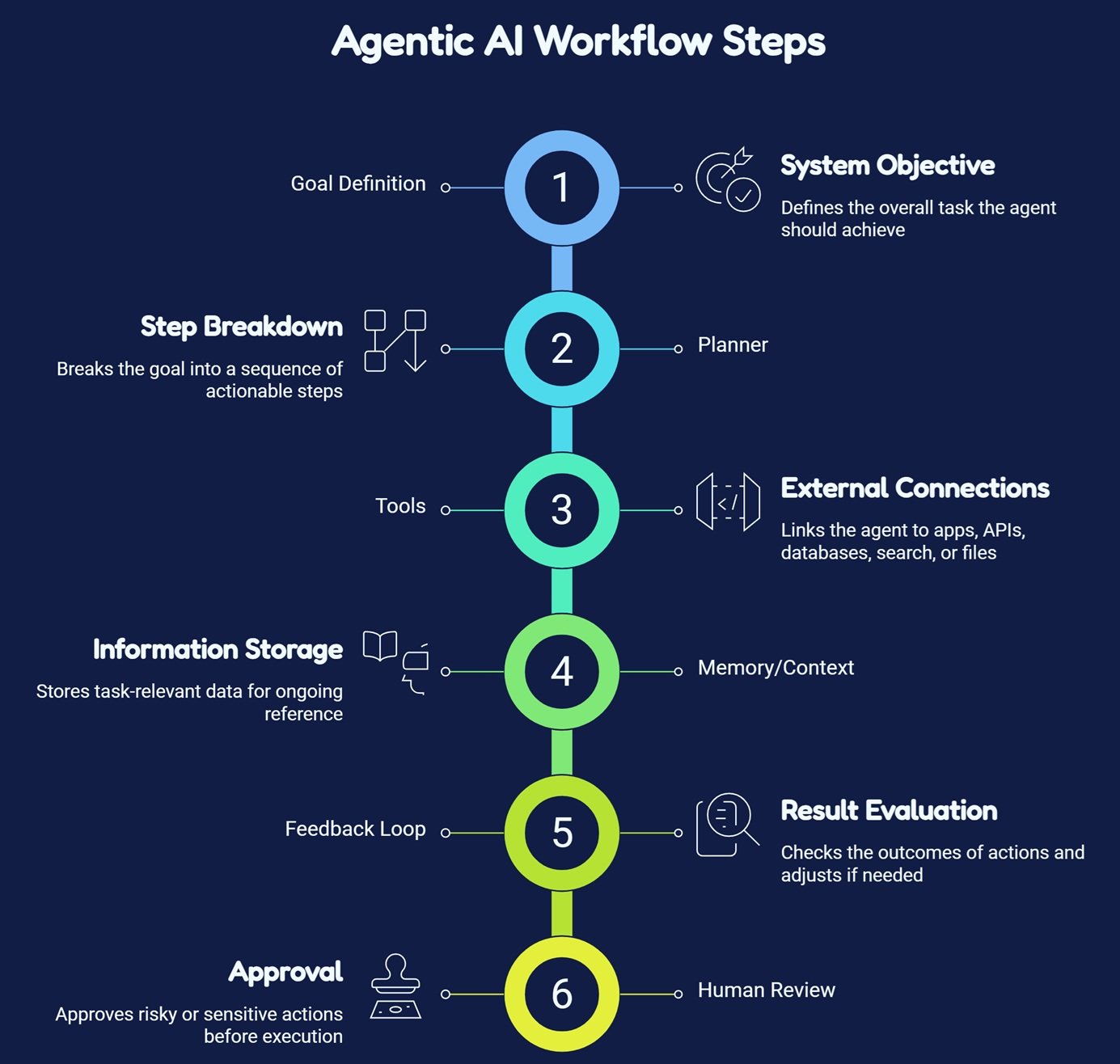
Google Cloud’s AI agent guidance describes AI agents as systems that use AI to pursue goals and complete tasks, often using reasoning, planning, and memory. A 2026 research survey on agentic AI architectures
also frames modern agents around perception, planning, action, tool use, collaboration, memory, and evaluation, while noting risks such as hallucination in action, infinite loops, and prompt injection.
Real-World Examples of Generative AI
Generative AI is useful when the task is mainly about producing or transforming content.
Examples include:
- A blogger asks AI to draft a meta description.
- A developer asks AI to explain an error message.
- A student asks AI to summarize a chapter.
- A marketer asks AI to generate campaign ideas.
- A designer asks AI to create image concepts.
- A manager asks AI to rewrite a meeting summary.
In these cases, the AI creates an output, but the human usually decides what to do with it.
Real-World Examples of Agentic AI
Agentic AI is useful when the task has multiple steps and requires action.
Examples include:
- A customer support agent checks order history, retrieves policy context, drafts a response, and escalates uncertain cases.
- A sales agent reviews a call transcript, updates the CRM, schedules a follow-up, and drafts a personalized email.
- A coding agent inspects an issue, searches the codebase, proposes a fix, runs tests, and prepares a pull request.
- An operations agent monitors alerts, gathers logs, classifies the incident, and notifies the right team.
- A research agent searches papers, extracts findings, organizes citations, and prepares a literature-review outline.
Gartner predicted that 40% of enterprise applications will include task-specific AI agents by the end of 2026, up from less than 5% in 2025, showing why this distinction matters for business software.
Which One Should You Use?
Use generative AI when you need content, explanation, summarization, drafting, ideation, or code assistance.
Use agentic AI when you need a system to complete a multi-step workflow, use tools, interact with business systems, monitor progress, or coordinate actions across apps.
In many cases, you need both. Generative AI may write the email. Agentic AI may decide when to write it, what context to include, which system to update, and when to ask a human for approval.
Benefits of Agentic AI Over Generative AI
The main benefit is workflow completion. Agentic AI can reduce manual switching between tools, documents, dashboards, and messages.
It can also improve process consistency. A well-designed agent can follow required steps, check fields, retrieve approved sources, and escalate when confidence is low.
For teams, agentic AI is most useful when the workflow is repeated often, has clear rules, and can be safely bounded.
Risks and Limitations
Generative AI can hallucinate, produce biased content, misunderstand prompts, or generate output that sounds confident but is wrong.
Agentic AI adds bigger operational risks because it can take actions. It may update the wrong record, call the wrong tool, send a message too early, follow malicious instructions, or loop through unnecessary steps. Gartner’s 2026 Hype Cycle guidance for agentic AI emphasizes the need to separate real business value from inflated expectations and assess maturity carefully.
The safest approach is to keep human review for high-risk actions, use clear permissions, log agent activity, test workflows, and start with narrow tasks before increasing autonomy.
Suggested Read:
- What Is Agentic AI? A Practical Guide for Beginners
- What Is an AI Agent? A Simple Explanation With Examples
- AI Agents vs Chatbots: Key Differences Explained
- MCP Explained: Why It Matters for AI Agents
- How to Evaluate an AI Agent Before Production
- What Is a Large Language Model? Explained Simply
FAQ: Agentic AI vs Generative AI
What is the difference between agentic AI and generative AI?
Generative AI creates content from prompts. Agentic AI pursues goals, plans steps, uses tools, and completes workflows with limited supervision.
Is agentic AI the same as generative AI?
No. Agentic AI may use generative AI internally, but it is designed for action and task completion, not only content generation.
How does agentic AI work?
It receives a goal, breaks it into steps, uses tools or data sources, checks progress, and completes or escalates the task.
How does generative AI work?
It uses trained models to generate text, code, images, summaries, or other content based on user input.
Which is better: agentic AI or generative AI?
Neither is always better. Generative AI is better for creating content. Agentic AI is better for multi-step workflows and task execution.
What are examples of agentic AI?
Examples include customer support agents, coding agents, sales follow-up agents, IT operations agents, workflow automation agents, and research assistants.
Final Takeaway
Agentic AI vs generative AI comes down to creation versus action. Generative AI helps create content. Agentic AI helps complete goals through planning, tools, memory, feedback, and controlled autonomy.
To continue learning, read What Is Agentic AI?, What Is an AI Agent?, and AI Agent Architecture Explained next.