
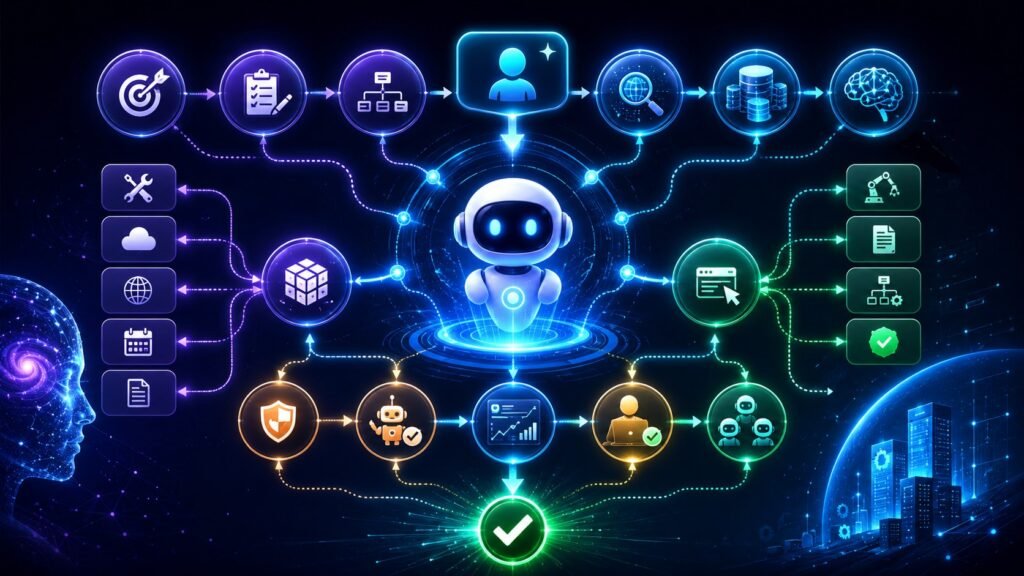
Agentic AI is a type of artificial intelligence that can pursue a goal, plan steps, use tools, make decisions, and complete tasks with limited human supervision. Instead of only answering prompts, agentic AI systems can act more like goal-driven digital workers inside software, workflows, and business processes.
In Simple Terms
Agentic AI means AI that can do more than respond.
A normal chatbot waits for a user to ask a question. An agentic AI system can take a goal such as “compare these vendors,” “summarize this customer issue,” or “schedule a follow-up meeting,” then decide what steps are needed to complete it.
It may search for information, read documents, call APIs, update a spreadsheet, draft a message, ask for approval, and continue until the task is done.
What Is Agentic AI?
Agentic AI refers to AI systems designed to act with some level of autonomy. IBM defines agentic AI as an AI system that can accomplish a specific goal with limited supervision, often through agents that perform subtasks inside a coordinated workflow. Google Cloud describes agentic AI as AI focused on autonomous decision-making and action, where systems can set goals, plan, and execute tasks with minimal human intervention.
The key word is goal. Agentic AI is not just about producing text, images, or summaries. It is about moving from intention to action.
For example, if a user asks a generative AI model, “Write an email to the supplier,” it may draft the email. If a user asks an agentic AI system, “Resolve this supplier delay,” the system may review order details, check shipment status, draft a supplier email, update an internal ticket, and ask a human before sending the message.
How Agentic AI Works
Most agentic AI systems include five core parts.
| Component | What It Does | Simple Example |
| Goal | Defines what the system should achieve | “Prepare a sales follow-up” |
| Planning | Breaks the goal into steps | Review notes, draft email, schedule reminder |
| Tools | Connects the AI to apps or data | Calendar, CRM, search, database |
| Memory or context | Keeps track of relevant information | Customer history or prior messages |
| Feedback loop | Checks progress and adjusts | Retry, ask for approval, escalate |
This does not mean the AI is fully independent. In good systems, autonomy is controlled. The agent may be allowed to read data, draft content, or suggest actions, but sensitive actions should require human approval.
Agentic AI vs Generative AI
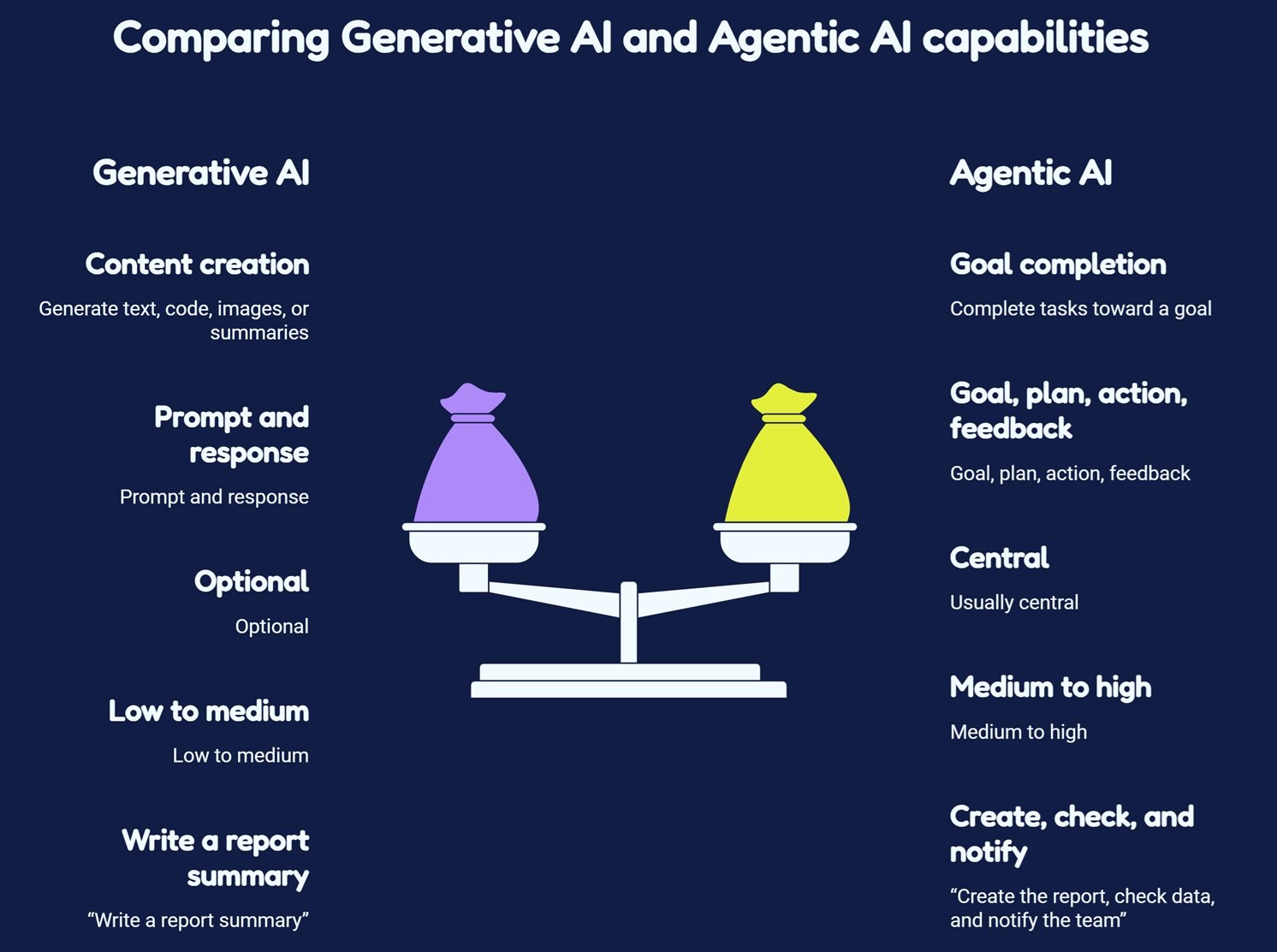
Generative AI creates content. Agentic AI uses AI to pursue goals and complete workflows.
| Feature | Generative AI | Agentic AI |
| Main purpose | Generate text, code, images, or summaries | Complete tasks toward a goal |
| User interaction | Prompt and response | Goal, plan, action, feedback |
| Tool use | Optional | Usually central |
| Autonomy | Low to medium | Medium to high |
| Example | “Write a report summary” | “Create the report, check data, and notify the team” |
Generative AI can be part of agentic AI. For example, an agent may use a language model to summarize a document, then use a tool to send that summary into a project-management system.
Agentic AI vs AI Agents
The terms are closely related, but not identical.
An AI agent is usually a software component that can perform tasks on behalf of a user or system. Google Cloud describes AI agents as software systems that use AI to pursue goals and complete tasks, often with reasoning, planning, memory, and autonomy.
Agentic AI is the broader idea or approach. It refers to AI systems designed around agency: goal pursuit, decision-making, tool use, and action.
A simple way to remember it:
An AI agent is the worker. Agentic AI is the design pattern that makes the worker goal-driven.
Real-World Examples of Agentic AI
Agentic AI is useful when work has multiple steps, changing context, and tool use.
In customer support, an agentic system can read a ticket, check order history, retrieve policy details, draft a response, and escalate uncertain cases.
In sales, it can summarize call notes, update a CRM, create follow-up tasks, and prepare a personalized email for review.
In software development, an agentic coding assistant can inspect an issue, search the codebase, propose changes, run tests, and create a pull request.
In operations, agentic AI can monitor alerts, classify incidents, gather logs, suggest fixes, and notify the right team.
In research, it can collect papers, extract key points, organize citations, and prepare a literature-review outline while keeping the researcher in control.
Why Agentic AI Matters
Agentic AI matters because it changes AI from a passive assistant into an active workflow participant.
This is why businesses are paying attention. Gartner predicted that 40% of enterprise applications will feature task-specific AI agents by 2026, up from less than 5% in 2025. That does not mean every agent will be fully autonomous. It means more software will include AI systems that can complete narrow tasks inside business workflows.
For beginners, the important point is practical: agentic AI is about getting work done, not just generating answers.
Benefits of Agentic AI
The biggest benefit is workflow automation. Agentic AI can reduce repetitive handoffs between tools, documents, messages, and dashboards.
It can also improve consistency. A well-designed agent can follow a defined process, check required fields, retrieve approved knowledge, and ask for approval when needed.
Another benefit is personalization. An agent can use context such as user preferences, account history, prior tasks, and workflow rules to produce more relevant results.
Risks and Limitations
Agentic AI also introduces new risks.
A chatbot that gives a wrong answer is a problem. An agent that takes the wrong action can create a bigger problem. It might send the wrong email, update the wrong record, access sensitive data, or trigger a workflow too early.
Security is also important. Agentic systems often connect to tools, APIs, files, browsers, and business systems. That means they need permissions, logs, approvals, monitoring, and rollback plans.
Gartner’s 2026 agentic AI guidance emphasizes that different agentic technologies mature at different speeds and that leaders need to separate real progress from inflated expectations. For most teams, the safest path is to start with narrow, supervised agents before expanding autonomy.
Common Mistakes Beginners Should Avoid
The first mistake is thinking agentic AI means “fully autonomous AI.” Most useful agentic systems are not completely independent. They work best with boundaries.
The second mistake is using agents for tasks that do not need agents. If a simple prompt, workflow rule, or automation script solves the problem, an agent may add unnecessary cost and complexity.
The third mistake is skipping evaluation. Agentic AI should be tested for task success, tool-use accuracy, hallucinations, security, latency, and escalation quality before production use.
Suggested Read:
- What Is an AI Agent? A Simple Explanation With Examples
- AI Agents vs Chatbots: Key Differences Explained
- MCP Explained: Why It Matters for AI Agents
- How to Evaluate an AI Agent Before Production
- What Is a Large Language Model? Explained Simply
- What Is RAG in AI? A Beginner-Friendly Guide
FAQ: What is agentic AI?
What is agentic AI?
Agentic AI is AI designed to pursue goals, plan steps, use tools, make decisions, and complete tasks with limited human supervision.
How does agentic AI work?
It works by taking a goal, breaking it into steps, using tools or data sources, checking progress, and adjusting actions until the task is completed or escalated.
What is the difference between agentic AI and generative AI?
Generative AI creates content. Agentic AI uses AI to complete tasks and workflows. Generative AI can be one part of an agentic system.
Is agentic AI the same as AI agents?
Not exactly. AI agents are the software entities that act. Agentic AI is the broader approach of building systems that can act toward goals.
What are examples of agentic AI?
Examples include customer support agents, coding agents, sales follow-up agents, research assistants, workflow automation agents, and IT operations agents.
What are the risks of agentic AI?
Risks include wrong actions, weak oversight, excessive autonomy, privacy exposure, tool misuse, hallucinations, and security issues.
Final Takeaway
What is agentic AI? It is AI designed to move from prompt-response interaction toward goal-driven action. It can plan, use tools, retrieve context, make decisions, and complete tasks, but it should be built with clear limits, evaluation, and human oversight.
To continue learning, read What Is an AI Agent?, AI Agents vs Chatbots, and AI Agent Architecture Explained next.