
Large Language Models transformed enterprise AI by enabling systems capable of:
- conversational AI
- document summarization
- coding assistance
- customer support automation
- enterprise search
- research automation
- workflow orchestration
- intelligent reasoning
However, organizations quickly discovered a major limitation with standalone LLMs:
they often hallucinate and lack access to updated knowledge.
This problem became increasingly important as enterprises attempted to deploy AI systems in production environments involving:
- healthcare
- legal systems
- financial services
- customer support
- enterprise search
- operational workflows
- compliance systems
Standalone LLMs work using pretrained knowledge captured during training.
That creates several enterprise challenges:
- outdated information
- hallucinations
- weak enterprise grounding
- missing real-time knowledge
- poor access to private company data
To solve these problems, modern AI systems increasingly combine:
Large Language Models + Retrieval-Augmented Generation (RAG)
This architecture fundamentally changed how enterprise AI systems operate.
Today, organizations increasingly compare:
- standalone LLM architectures
- LLM + RAG architectures
to determine which approach works better for scalability, grounded AI, enterprise search, and hallucination reduction.
Understanding the differences between standalone LLMs and retrieval-augmented AI systems is essential for designing reliable enterprise AI architectures.
In this guide, you will learn how standalone LLMs and RAG-enhanced systems work, their strengths and weaknesses, enterprise use cases, hallucination implications, infrastructure trade-offs, and why grounded retrieval architectures are rapidly becoming foundational for enterprise AI systems.
In Simple Terms
What Is a Standalone LLM?
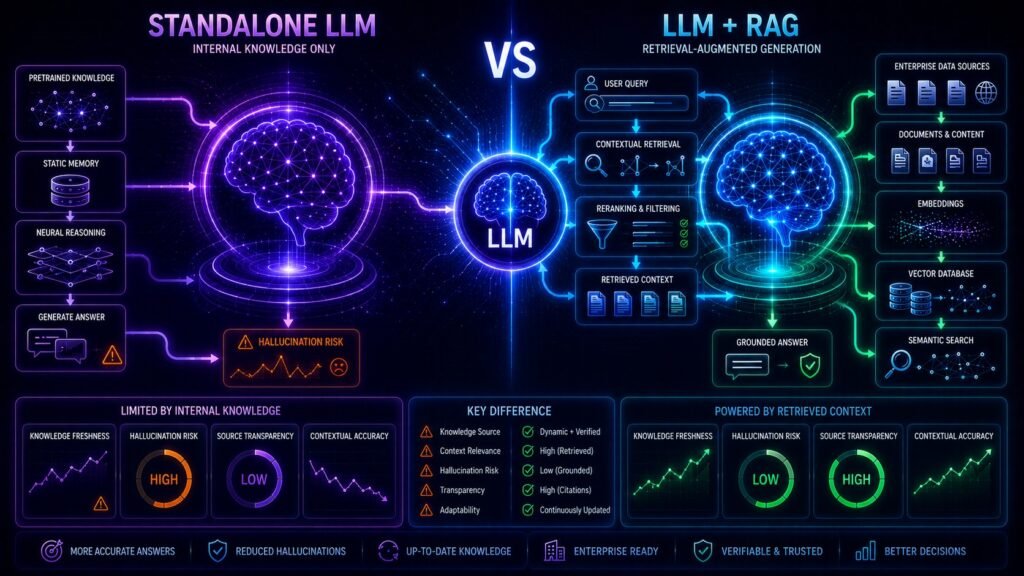
A standalone Large Language Model generates answers using knowledge learned during training.
The model relies entirely on:
- pretrained parameters
- learned patterns
- internal statistical reasoning
It does not automatically retrieve external information in real time.
What Is LLM Plus RAG?
LLM + RAG combines:
- semantic retrieval systems
- external knowledge sources
- vector databases
- enterprise documents
- contextual retrieval pipelines
with a Large Language Model.
Before generating an answer, the system retrieves relevant information and uses it as grounding context.
Easy Analogy
Imagine asking two employees a question.
A standalone LLM behaves like an employee answering entirely from memory.
An LLM + RAG system behaves like an employee who first searches company documentation before answering.
This dramatically improves factual reliability.
Why Enterprises Compare LLM + RAG vs Standalone LLMs
Modern organizations increasingly need AI systems capable of:
- grounded reasoning
- enterprise knowledge access
- contextual retrieval
- hallucination reduction
- dynamic information updates
- conversational enterprise search
Standalone LLMs are powerful, but they struggle in environments requiring constantly updated information.
This created the rise of retrieval-augmented architectures.
Understanding How Standalone LLMs Work
Standalone Large Language Models are trained on massive datasets containing:
- books
- websites
- code
- articles
- conversations
- public internet data
During training, the model learns statistical patterns between words and concepts.
After training, knowledge becomes encoded inside model parameters.
Core Components of a Standalone LLM
| Component | Purpose |
| Transformer Architecture | Processes language |
| Attention Mechanism | Understands contextual relationships |
| Training Data | Provides learned knowledge |
| Parameters | Store learned patterns |
| Decoder | Generates responses |
Standalone LLMs rely entirely on pretrained memory.
Understanding How LLM + RAG Works
Retrieval-Augmented Generation extends LLMs using external retrieval systems.
A modern RAG pipeline usually includes:
- embeddings
- vector databases
- semantic retrieval systems
- reranking pipelines
- contextual orchestration layers
- enterprise knowledge sources
The retriever finds relevant context before generation begins.
Core Components of LLM + RAG Systems
| Component | Purpose |
| Embeddings | Represent semantic meaning |
| Vector Database | Stores searchable embeddings |
| Retriever | Finds contextual information |
| Reranker | Improves retrieval quality |
| LLM | Generates grounded answers |
This architecture improves factual grounding significantly.
Why Standalone LLMs Became So Popular
Standalone LLMs became revolutionary because they enabled:
- natural language reasoning
- generalized AI behavior
- conversational interfaces
- zero-shot learning
- broad language understanding
These capabilities transformed enterprise AI adoption.
Major Advantages of Standalone LLMs
Simpler Architecture
Standalone systems require fewer infrastructure components.
Faster Initial Deployment
Organizations can deploy standalone models quickly.
Strong General Reasoning
LLMs perform well across many broad tasks.
Lower Operational Complexity
No retrieval orchestration is required.
Better Creative Generation
Standalone models often excel at open-ended generation tasks.
Strong Conversational Fluency
Standalone models generate natural responses effectively.
Major Limitations of Standalone LLMs
Despite their strengths, standalone models introduce major enterprise challenges.
Hallucinations
Standalone models may generate unsupported information confidently.
Static Knowledge
Knowledge becomes outdated after training.
No Real-Time Retrieval
Models cannot dynamically access updated information.
Weak Enterprise Grounding
Standalone models cannot inherently access private enterprise knowledge.
Poor Citation Reliability
Responses may lack verifiable evidence.
Limited Enterprise Search Capabilities
Standalone models struggle with large enterprise document repositories.
Why RAG Became Important
RAG solved several major weaknesses of standalone LLMs.
Modern enterprises increasingly require AI systems capable of:
- grounded retrieval
- dynamic knowledge access
- enterprise search
- contextual reasoning
- hallucination reduction
- document-aware generation
RAG enables these capabilities effectively.
Major Advantages of LLM + RAG Systems
Grounded AI Generation
Retrieved context improves factual reliability.
Better Hallucination Reduction
External evidence strengthens answer accuracy.
Dynamic Knowledge Updates
Organizations can update enterprise knowledge without retraining models.
Better Enterprise Search
RAG improves semantic document retrieval significantly.
Real-Time Information Access
Systems retrieve updated information dynamically.
Better Explainability
Retrieved context improves transparency.
Major Limitations of LLM + RAG Systems
RAG architectures also introduce operational complexity.
Higher Infrastructure Complexity
RAG systems contain multiple moving components.
Retrieval Dependency
Weak retrieval weakens grounded generation.
Increased Latency
Retrieval pipelines increase response time.
Monitoring Complexity
Production RAG systems require evaluation infrastructure.
Retrieval Noise Problems
Irrelevant retrieval may reduce answer quality.
LLM + RAG vs Standalone LLM: Key Differences
| Category | Standalone LLM | LLM + RAG |
| Knowledge Source | Pretrained Memory | External Retrieval + LLM |
| Hallucination Risk | High | Lower |
| Real-Time Knowledge | Weak | Strong |
| Enterprise Search | Weak | Excellent |
| Grounded Generation | Weak | Strong |
| Infrastructure Complexity | Lower | Higher |
| Dynamic Knowledge Updates | Poor | Excellent |
| Explainability | Moderate | Strong |
| Conversational AI | Strong | Strong |
| Enterprise Knowledge Access | Weak | Excellent |
Why Standalone LLMs Hallucinate
Hallucinations occur because standalone models generate answers probabilistically.
The model predicts likely word sequences based on training patterns.
However, it does not verify factual correctness inherently.
This becomes dangerous in enterprise environments involving:
- healthcare
- finance
- legal systems
- compliance workflows
Grounded retrieval helps reduce this problem significantly.
Why RAG Improves Enterprise AI Systems
Enterprise AI systems increasingly require:
- trusted knowledge access
- grounded responses
- dynamic updates
- explainability
- semantic retrieval
- contextual reasoning
RAG enables all these capabilities.
This is why retrieval-augmented architectures are rapidly becoming foundational for enterprise AI systems.
Why Retrieval Matters for Enterprise AI
Large organizations manage enormous knowledge repositories including:
- PDFs
- contracts
- policies
- reports
- support documentation
- research papers
- operational workflows
Standalone models cannot memorize all enterprise information reliably.
Retrieval solves this scalability challenge.
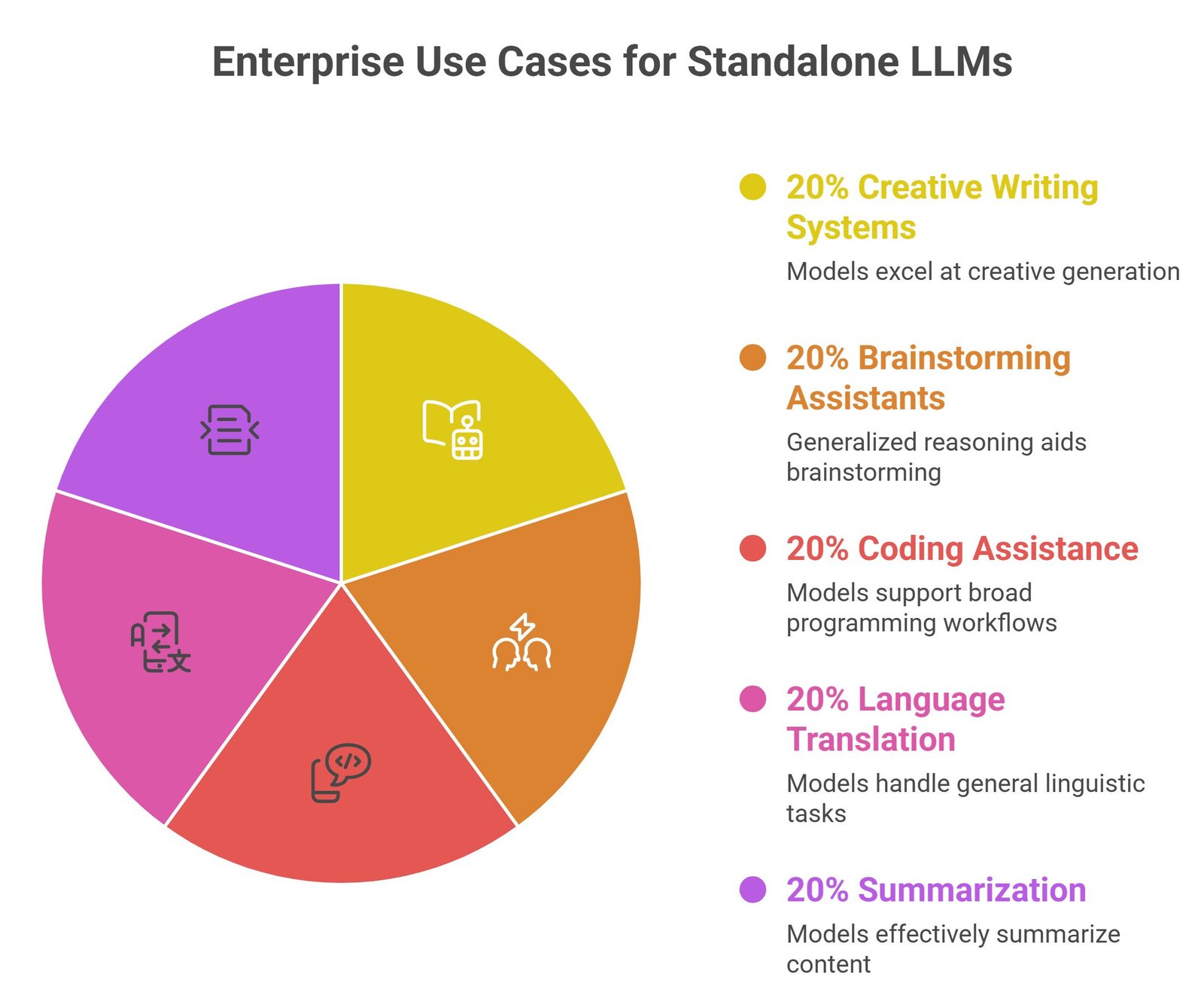
Enterprise Use Cases for Standalone LLMs
Creative Writing Systems
Standalone models perform well for creative generation.
Brainstorming Assistants
Generalized reasoning works effectively.
Coding Assistance
Standalone models help with broad programming workflows.
Language Translation
General linguistic tasks work well.
Summarization
Standalone models summarize content effectively.
Enterprise Use Cases for LLM + RAG Systems
Enterprise AI Assistants
Employees retrieve internal company knowledge dynamically.
Customer Support AI
Support copilots retrieve troubleshooting guidance semantically.
Legal AI Platforms
AI systems retrieve grounded regulations and contracts.
Healthcare AI Systems
Medical assistants retrieve updated clinical information.
Financial AI Systems
AI systems retrieve grounded financial knowledge and compliance policies.
Why Hybrid Architectures Are Becoming the Future
Modern enterprise AI systems increasingly combine:
- Large Language Models
- semantic retrieval systems
- vector databases
- enterprise search platforms
- grounded generation pipelines
This creates scalable enterprise AI architectures.
Example Enterprise RAG Architecture
| Layer | Purpose |
| Enterprise Documents | Knowledge source |
| Vector Database | Semantic retrieval |
| Retriever | Finds contextual information |
| Reranker | Improves relevance |
| LLM | Generates grounded answers |
This architecture is becoming increasingly common across enterprise AI systems.
Why LLM + RAG Reduces Hallucinations Better
Standalone models rely on statistical reasoning only.
RAG systems ground generation using retrieved evidence.
This dramatically improves factual reliability.
However, retrieval quality remains critical.
Poor retrieval may still produce hallucinations.
Common Enterprise Mistakes
Many organizations misunderstand how retrieval architectures work.
Assuming Bigger LLMs Eliminate Hallucinations
Larger models still hallucinate.
Ignoring Retrieval Quality
Weak retrieval weakens grounded generation.
Treating RAG as Optional
Enterprise AI systems increasingly require retrieval grounding.
Overcomplicating Early Infrastructure
Not every workflow requires advanced retrieval architectures immediately.
Why Evaluation Matters for Both Architectures
Organizations increasingly benchmark:
- hallucination rates
- answer faithfulness
- retrieval precision
- groundedness
- semantic relevance
- latency
- contextual accuracy
Continuous evaluation improves enterprise AI reliability significantly.
Future of LLM + RAG Systems
Enterprise AI architectures are evolving rapidly.
Major trends include:
- agentic RAG systems
- GraphRAG architectures
- multimodal retrieval systems
- retrieval-aware reasoning
- adaptive retrieval pipelines
- autonomous AI agents
- grounded enterprise copilots
Future enterprise AI systems will increasingly combine:
- semantic retrieval
- contextual reasoning
- autonomous orchestration
- grounded generation
- enterprise memory systems
into unified intelligence architectures.
Suggested Read:
- What Is RAG in AI
- How RAG Works
- Reducing Hallucinations in RAG
- RAG vs Long Context Windows
- RAG vs Semantic Search
- GraphRAG Explained
- RAG Evaluation Metrics
- RAG Monitoring
FAQ: LLM Plus RAG vs Standalone LLM
What is the difference between standalone LLMs and RAG systems?
Standalone LLMs generate answers from pretrained memory, while RAG systems retrieve external information before generating responses.
Why do standalone LLMs hallucinate?
Standalone models predict likely responses statistically and do not inherently verify factual accuracy.
Does RAG reduce hallucinations?
Yes. Retrieved grounding context improves factual reliability significantly.
Can standalone LLMs access real-time information?
Not inherently. They require retrieval systems or external tools for dynamic information access.
Which architecture is better for enterprise AI?
LLM + RAG systems are generally better for enterprise environments requiring grounded knowledge retrieval and contextual reasoning.
Final Takeaway
Understanding LLM plus RAG vs standalone LLM architectures is essential because enterprise AI reliability increasingly depends on grounded retrieval, contextual reasoning, hallucination reduction, and scalable knowledge access.
Standalone Large Language Models excel at generalized reasoning and conversational fluency, while retrieval-augmented architectures excel at grounded generation, enterprise search, semantic retrieval, and dynamic knowledge access.
Organizations that understand how retrieval-enhanced AI systems work can build more scalable, reliable, explainable, and production-ready enterprise AI platforms.
That capability is becoming foundational for enterprise AI assistants, customer support copilots, healthcare AI systems, legal intelligence platforms, semantic search architectures, and next-generation grounded AI systems.