

Embeddings for RAG: How AI Retrieval Systems Understand Meaning
Retrieval-Augmented Generation (RAG) has become one of the most important architectures in modern Artificial Intelligence systems. Enterprises increasingly rely on RAG-powered AI assistants, enterprise search systems, document retrieval platforms, and intelligent chatbots to deliver more accurate and grounded responses.
But one core technology powers nearly every successful RAG system behind the scenes:
Embeddings
Without embeddings, modern semantic retrieval systems would not function effectively.
Embeddings help AI systems understand meaning instead of simply matching exact keywords. They allow RAG applications to retrieve relevant information contextually, even when users phrase questions differently from how documents are written.
This capability is what makes Retrieval-Augmented Generation dramatically more powerful than traditional keyword search systems.
Today, embeddings are used across many AI applications including:
- enterprise search
- AI chatbots
- semantic retrieval systems
- recommendation engines
- document intelligence platforms
- AI copilots
- knowledge assistants
In this guide, you will learn how embeddings for RAG work, why they are critical for semantic search, and how they improve retrieval quality in modern AI systems.
In Simple Terms
What Are Embeddings in RAG?
Embeddings are numerical vector representations of meaning.
They convert text into mathematical representations that AI systems can understand and compare semantically.
Instead of searching for exact keywords, embeddings allow RAG systems to search based on meaning and contextual similarity.
For example:
These phrases may have different words:
- “refund policy”
- “return process”
- “cancellation rules”
But embeddings may place them close together because they share similar meaning.
This enables semantic retrieval instead of simple keyword matching.
Think of embeddings as a way for AI systems to understand relationships between concepts.
Why Embeddings Are Important for RAG
Modern RAG systems depend heavily on semantic retrieval.
Without embeddings, retrieval systems would behave more like traditional keyword search engines.
Embeddings make retrieval intelligent.
Traditional Keyword Search Has Major Limitations
Keyword search systems only match exact words.
This creates several problems.
For example:
A user may ask:
“How do employee reimbursements work?”
But the document may contain:
“travel expense compensation policy”
Traditional keyword search may fail because the wording differs.
Embeddings solve this problem by understanding contextual meaning instead of exact wording.
Enterprises Need Semantic Understanding
Enterprise documents often contain:
- technical language
- synonyms
- inconsistent phrasing
- abbreviations
- domain-specific terminology
Embeddings allow AI systems to retrieve relevant information even when wording varies significantly.
This dramatically improves enterprise search quality.
Better Retrieval Improves AI Accuracy
Retrieval quality strongly affects final AI response quality.
If the wrong information is retrieved:
- hallucinations increase
- answer quality decreases
- user trust drops
Embeddings help retrieve more contextually relevant information.
This improves grounding and factual reliability.
Easy Analogy
Imagine two librarians.
Librarian A
Searches only for exact keywords.
Librarian B
Understands concepts, meanings, and relationships between ideas.
Librarian B behaves like an embedding-powered semantic retrieval system.
That second approach is dramatically more intelligent and useful.
This is exactly why embeddings became foundational infrastructure for modern RAG systems.
How Embeddings Work in RAG Systems
Understanding embeddings becomes easier when broken into stages.
Step 1: Documents Are Collected
The RAG system first gathers external knowledge sources such as:
- PDFs
- websites
- cloud documents
- support manuals
- enterprise databases
- operational files
- research papers
These files become the knowledge base.
Step 2: Documents Are Split Into Chunks
Large documents are divided into smaller sections called chunks.
For example:
A 500-page enterprise document may be divided into hundreds of searchable text segments.
Chunking improves semantic retrieval precision.
Smaller chunks are easier to compare contextually.
Choosing the right chunk size is one of the most important optimization tasks in RAG systems.
Step 3: Embeddings Are Generated
The chunks are converted into embeddings using embedding models.
What Does an Embedding Look Like?
An embedding is essentially a list of numbers representing semantic meaning.
Example:
[0.21, -0.54, 0.83, 0.14, …]
Humans cannot interpret these vectors directly, but AI systems can compare them mathematically.
The closer two embeddings are in vector space, the more semantically similar they are.
This allows semantic search to function effectively.
Step 4: Embeddings Are Stored in a Vector Database
The embeddings are stored inside vector databases such as:
These systems are optimized for semantic retrieval.
Unlike traditional databases, vector databases search based on meaning instead of exact keywords.
This dramatically improves retrieval quality for enterprise AI systems.
Step 5: User Queries Are Converted Into Embeddings
When a user asks a question, the query is also converted into embeddings.
For example:
“How do refunds work?”
becomes a semantic vector representation.
The system now compares this query embedding against stored document embeddings.
Step 6: Semantic Retrieval Happens
The retriever searches the vector database for the most semantically similar embeddings.
This retrieval stage is what enables contextual AI search.
Even if wording differs significantly, semantically related information can still be retrieved.
For example:
“How do customer refunds work?”
may retrieve:
- return policies
- cancellation procedures
- reimbursement workflows
because embeddings capture contextual meaning.
Step 7: Retrieved Information Is Sent to the LLM
The retrieved chunks are inserted into the prompt sent to the language model.
The AI now receives:
- user query
- retrieved contextual information
- system instructions
This allows the AI to generate grounded responses using retrieved evidence.
Why Embeddings Improve RAG Systems
Embeddings solve several major retrieval problems simultaneously.
Semantic Search Instead of Keyword Search
Embeddings allow AI systems to understand meaning instead of exact wording.
This dramatically improves retrieval relevance.
Better Enterprise Knowledge Discovery
Enterprise data often contains inconsistent terminology.
Embeddings help systems retrieve relevant information despite wording differences.
Reduced Hallucinations
Better retrieval improves factual grounding.
This helps reduce hallucinations significantly.
Better User Experience
Users can ask natural language questions instead of carefully engineered keyword queries.
This improves usability dramatically.
Improved Contextual Understanding
Embeddings capture semantic relationships between concepts.
This creates more intelligent retrieval systems.
Common Embedding Models Used in RAG
Several embedding models are commonly used in modern RAG systems.
OpenAI Embedding Models
Widely used for semantic retrieval and enterprise AI systems.
Strong general-purpose performance.
Sentence Transformers
Popular open-source embedding ecosystem based on transformer architectures.
Often used for enterprise semantic search.
Cohere Embeddings
Optimized for enterprise retrieval workflows and multilingual applications.
BGE Embeddings
High-performance open-source embedding models increasingly popular in production RAG systems.
Domain-Specific Embeddings
Some enterprises train specialized embeddings for industries such as:
- healthcare
- legal services
- finance
- cybersecurity
This improves retrieval quality for domain-specific terminology.
Embeddings vs Traditional Search
| Feature | Traditional Keyword Search | Embedding-Based Search |
| Exact keyword matching | Strong | Moderate |
| Semantic understanding | Weak | Strong |
| Contextual retrieval | Weak | Strong |
| Natural language search | Limited | Strong |
| Enterprise AI integration | Moderate | High |
| Hallucination reduction | Weak | Stronger |
Advanced Embedding Techniques in RAG
Modern enterprise systems often use advanced embedding optimization strategies.
Hybrid Retrieval
Combines:
- semantic embeddings
- keyword retrieval
for stronger performance.
Re-Ranking Models
Re-ranking systems improve retrieval precision after initial embedding search.
Metadata Filtering
Enterprise systems often filter retrieval using:
- department
- permissions
- timestamps
- document types
- categories
This improves retrieval relevance.
Multi-Vector Retrieval
Some advanced architectures use multiple embeddings per document for deeper contextual understanding.
Domain-Tuned Embeddings
Specialized embeddings improve retrieval quality for industry-specific terminology.
Embedding for RAG: Real-World Use Cases
Enterprise Search Systems
Employees retrieve company information conversationally.
AI Customer Support
Support assistants retrieve troubleshooting documentation dynamically.
Legal AI Systems
Legal assistants retrieve contracts and compliance documentation semantically.
Healthcare AI
Healthcare assistants retrieve medical guidelines contextually.
Ecommerce AI
Shopping assistants retrieve product information semantically.
Research Assistants
Researchers retrieve scientific papers and technical documents conversationally.
Common Challenges With Embeddings
While embeddings are powerful, they still face limitations.
Poor Embedding Quality
Weak embedding models reduce retrieval accuracy.
Domain Mismatch
General-purpose embeddings may struggle with highly specialized terminology.
Vector Database Scaling
Large-scale enterprise systems require significant retrieval infrastructure.
Retrieval Latency
Semantic retrieval adds additional processing overhead.
Security and Permissions
Enterprise systems must ensure embeddings do not expose unauthorized data.
Future of Embeddings in RAG
Embedding systems are evolving rapidly.
Major trends include:
- multimodal embeddings
- graph-enhanced retrieval
- domain-specific embeddings
- agentic retrieval systems
- real-time embeddings
- personalized semantic retrieval
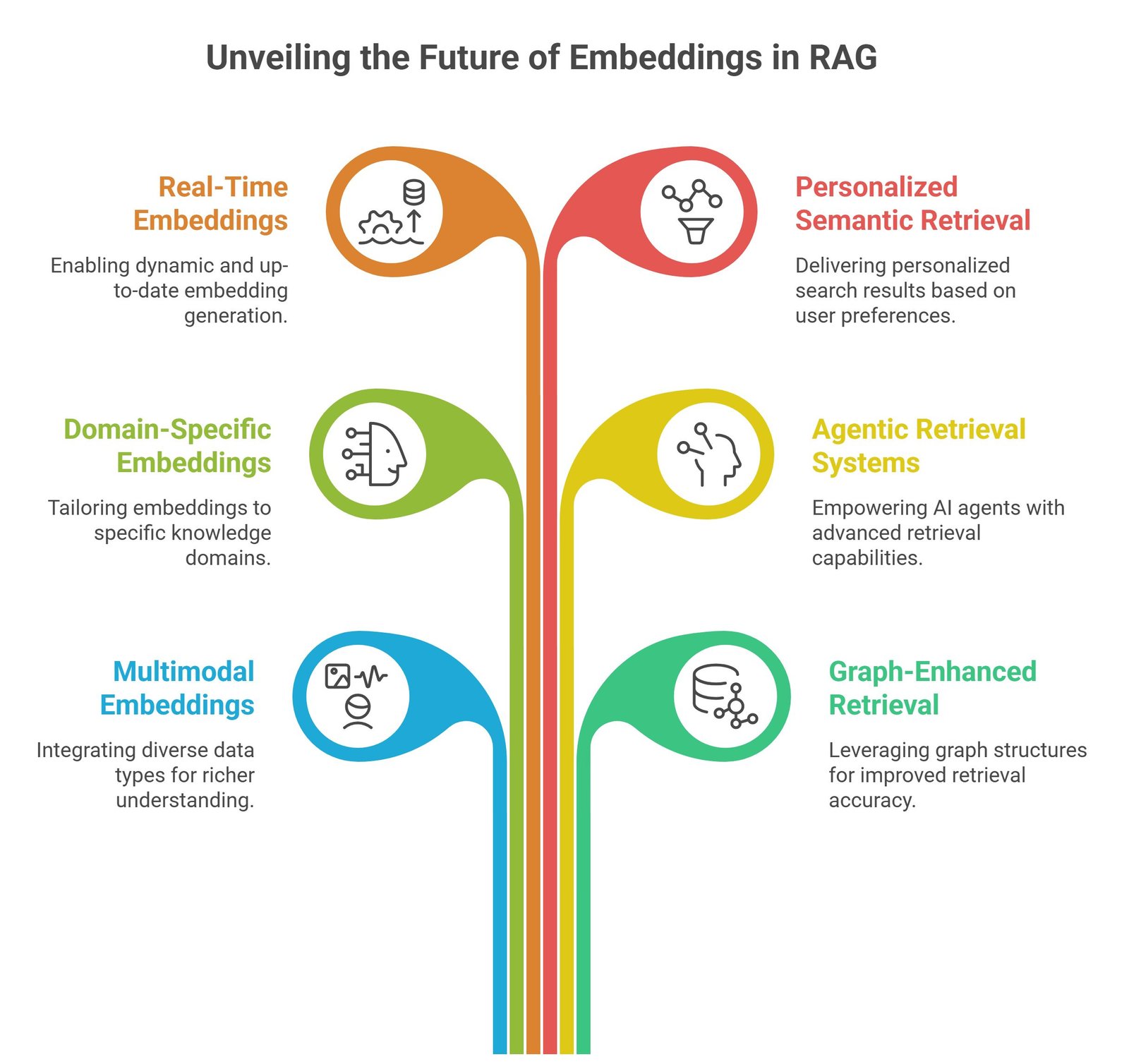
Many future AI systems will likely rely heavily on advanced embedding architectures.
Suggested Read:
- RAG Architecture Explained
- RAG Pipeline Explained
- RAG for Enterprise Search
- How RAG Works
- RAG for Document Search
- LLM Embeddings Explained
FAQ: Embeddings for RAG
What are embeddings in RAG?
Embeddings are vector representations of meaning used for semantic retrieval.
Why are embeddings important for RAG?
Embeddings enable semantic search and improve retrieval quality.
How do embeddings improve AI accuracy?
Better retrieval improves grounding and reduces hallucinations.
What is semantic search?
Semantic search retrieves information based on meaning instead of exact keywords.
What are vector databases?
Vector databases store embeddings and enable semantic retrieval.
Final Takeaway
Understanding embeddings for RAG is important because embeddings are one of the foundational technologies behind modern semantic retrieval systems.
By enabling AI systems to understand meaning instead of exact wording, embeddings dramatically improve retrieval quality, contextual understanding, and enterprise AI reliability.
That capability is transforming how AI assistants, enterprise search systems, customer support platforms, and intelligent retrieval systems operate today.