
RAG for Beginners: Complete Beginner Guide to Retrieval-Augmented Generation
Artificial Intelligence is evolving rapidly, especially with the rise of Large Language Models (LLMs). Modern AI systems can answer questions, generate content, summarize reports, write code, and automate workflows at an impressive level.
But despite these capabilities, traditional AI systems still face a major problem: they often generate incorrect or outdated information.
This problem is called hallucination.
That is exactly why Retrieval-Augmented Generation (RAG) became one of the most important concepts in modern AI architecture.
Instead of relying only on training data, RAG systems retrieve external information before generating answers. This dramatically improves AI accuracy, reliability, and enterprise usefulness.
Today, RAG powers many AI applications including:
- customer support assistants
- enterprise search systems
- AI copilots
- research assistants
- legal AI tools
- healthcare knowledge systems
In this beginner-friendly guide, you will learn what RAG is, how it works, why it matters, and how beginners can start learning Retrieval-Augmented Generation step by step.
In Simple Terms
What Is RAG?
RAG stands for:
Retrieval-Augmented Generation
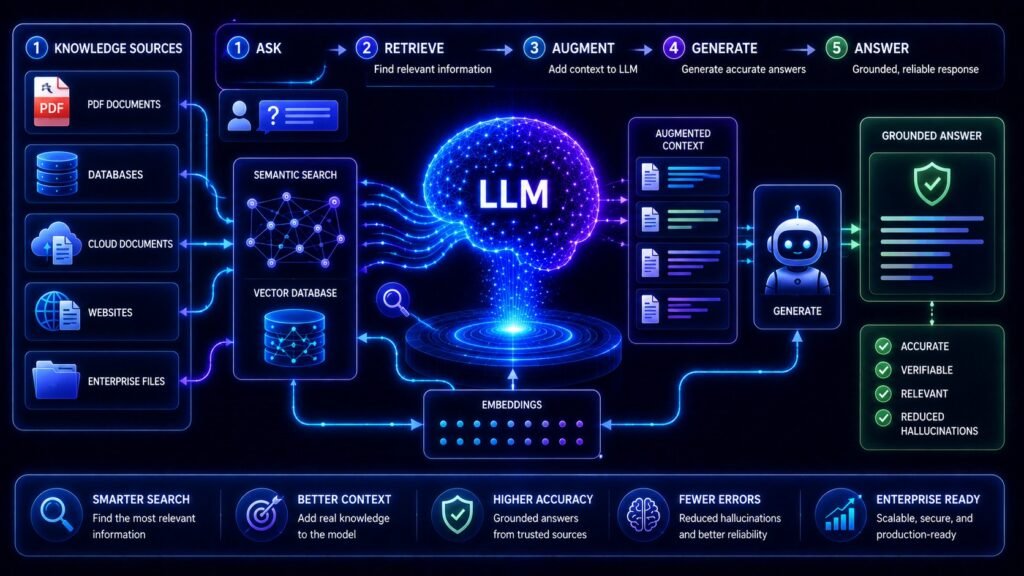
It is an AI architecture where a system retrieves relevant information from external knowledge sources before generating a response.
Instead of answering entirely from memory, the AI first searches trusted sources such as:
- PDFs
- databases
- documents
- websites
- internal company files
- product manuals
- support documentation
The retrieved information is then added to the AI prompt so the language model can generate a grounded answer.
Think of RAG as giving AI systems the ability to research before responding.
Why Beginners Should Learn RAG
Many beginners focus only on prompt engineering or LLM APIs, but modern enterprise AI increasingly depends on retrieval-based architectures.
Learning RAG is important because it helps explain how production AI systems actually work in the real world.
RAG is becoming foundational AI infrastructure because businesses need systems that are:
- more accurate
- less hallucination-prone
- connected to private data
- able to access updated information
- enterprise-ready
Understanding RAG also helps beginners understand related concepts such as:
- embeddings
- semantic search
- vector databases
- AI retrieval systems
- enterprise AI pipelines
As AI applications continue evolving, RAG skills are becoming increasingly valuable for developers, engineers, researchers, and AI product builders.
Why Traditional LLMs Are Not Enough
Large Language Models are powerful, but they still have limitations.
AI Models Can Hallucinate
Traditional LLMs sometimes generate incorrect information confidently because they predict language patterns instead of verifying facts.
This becomes dangerous in industries like:
- healthcare
- finance
- legal services
- cybersecurity
Businesses need more grounded AI systems.
Knowledge Becomes Outdated
LLMs are trained on historical datasets.
Once training is complete, the model does not automatically know new information unless retrained.
For example:
- company policies change
- research evolves
- product catalogs update
- regulations change frequently
RAG helps solve this problem dynamically.
Enterprises Need Private Data Access
Most business information exists inside:
- internal databases
- cloud storage systems
- PDFs
- enterprise documentation
- support systems
Traditional public AI models cannot access this information directly.
RAG enables AI systems to retrieve private enterprise knowledge securely.
Easy Analogy
Imagine asking two students the same difficult question.
Student A
Answers entirely from memory.
Student B
First checks books, notes, and research papers before answering.
Student B uses a RAG-style approach.
That second workflow is usually more accurate because it uses external information before responding.
This is the core idea behind Retrieval-Augmented Generation.
How RAG Works
Understanding how RAG works for beginners becomes easier when broken into simple steps.
Step 1: Documents Are Collected
The system gathers external knowledge sources such as:
- PDFs
- websites
- support docs
- enterprise files
- databases
- contracts
- manuals
These files become the knowledge base.
The quality of the data matters heavily because retrieval quality depends on source quality.
Step 2: Documents Are Split Into Chunks
Large documents are divided into smaller sections called chunks.
For example:
A 500-page manual may be divided into hundreds of searchable text segments.
Chunking improves retrieval precision because smaller sections are easier to search semantically.
Choosing the right chunk size is an important part of RAG system design.
Step 3: Embeddings Are Created
The chunks are converted into embeddings.
What Are Embeddings?
Embeddings are numerical vector representations of meaning.
Instead of understanding only keywords, embeddings allow systems to understand semantic similarity.
For example:
- “refund policy”
- “return process”
- “cancellation rules”
may all generate similar embeddings because they have related meanings.
This enables semantic search instead of simple keyword matching.
Step 4: Embeddings Are Stored in a Vector Database
The embeddings are stored inside a vector database.
Popular vector database ecosystems include:
These systems help AI applications retrieve relevant information quickly at scale.
Vector databases are a core part of modern RAG systems.
Step 5: User Sends a Query
Example:
“What is the enterprise cancellation policy?”
The system now prepares for retrieval.
Step 6: Retrieval Happens
The query is converted into embeddings.
The retriever searches for semantically relevant document chunks inside the vector database.
This retrieval stage is what makes RAG different from traditional AI systems.
Step 7: Retrieved Information Is Added to the Prompt
The retrieved context is inserted into the prompt sent to the LLM.
Instead of relying only on memory, the AI now receives supporting evidence before generating an answer.
This improves factual grounding significantly.
Step 8: The LLM Generates a Response
The language model generates a final answer using:
- retrieved information
- prompt instructions
- language reasoning abilities
This creates a more accurate and trustworthy response.
Why RAG Is Important
RAG is becoming one of the most important AI architectures because it solves several major enterprise AI problems simultaneously.
Better Accuracy
The AI retrieves actual information before responding.
This improves factual grounding significantly.
For many business applications, accurate answers matter more than creative generation.
Reduced Hallucinations
RAG systems reduce hallucinations by grounding responses in retrieved evidence.
This creates more reliable AI systems.
Access to Updated Information
Traditional LLMs only know information from training time.
RAG systems can retrieve updated information dynamically without retraining the model.
Enterprise Knowledge Integration
RAG allows AI systems to work with:
- internal company documents
- operational workflows
- support knowledge
- technical manuals
- enterprise databases
This makes enterprise AI dramatically more useful.
Better User Trust
Users trust AI systems more when answers are based on real information sources.
Some RAG systems even provide citations or document references.
Real-World RAG Use Cases
Customer Support AI
Support assistants retrieve answers from help center documentation before responding.
This improves support quality and reduces hallucinations.
Enterprise Search
Employees can search internal company files conversationally instead of manually browsing folders.
Healthcare AI
Healthcare assistants retrieve medical guidelines and protocols before answering questions.
Legal AI Systems
Legal tools retrieve contracts, compliance documents, and regulations before generating responses.
Ecommerce AI
RAG systems retrieve product information, inventory data, and shipping policies dynamically.
Research Assistants
Researchers use RAG systems to search papers, reports, and technical documents conversationally.
Beginner RAG Project Ideas
Learning RAG becomes easier with hands-on experimentation.
Here are beginner-friendly project ideas:
PDF Chatbot
Upload PDFs and ask questions conversationally.
This is one of the best beginner RAG projects.
Internal Knowledge Assistant
Create a searchable assistant for company documents.
AI Research Assistant
Build a paper retrieval and summarization tool.
Ecommerce Product Assistant
Create an assistant that retrieves product information dynamically.
Support Documentation Chatbot
Build an AI assistant that answers questions from support articles.
RAG vs Traditional LLMs
| Feature | Traditional LLM | RAG System |
| Uses external knowledge | Limited | Strong |
| Updated information access | Weak | Better |
| Hallucination reduction | Weak | Stronger |
| Enterprise readiness | Moderate | High |
| Private data integration | Limited | Strong |
Common Challenges in RAG
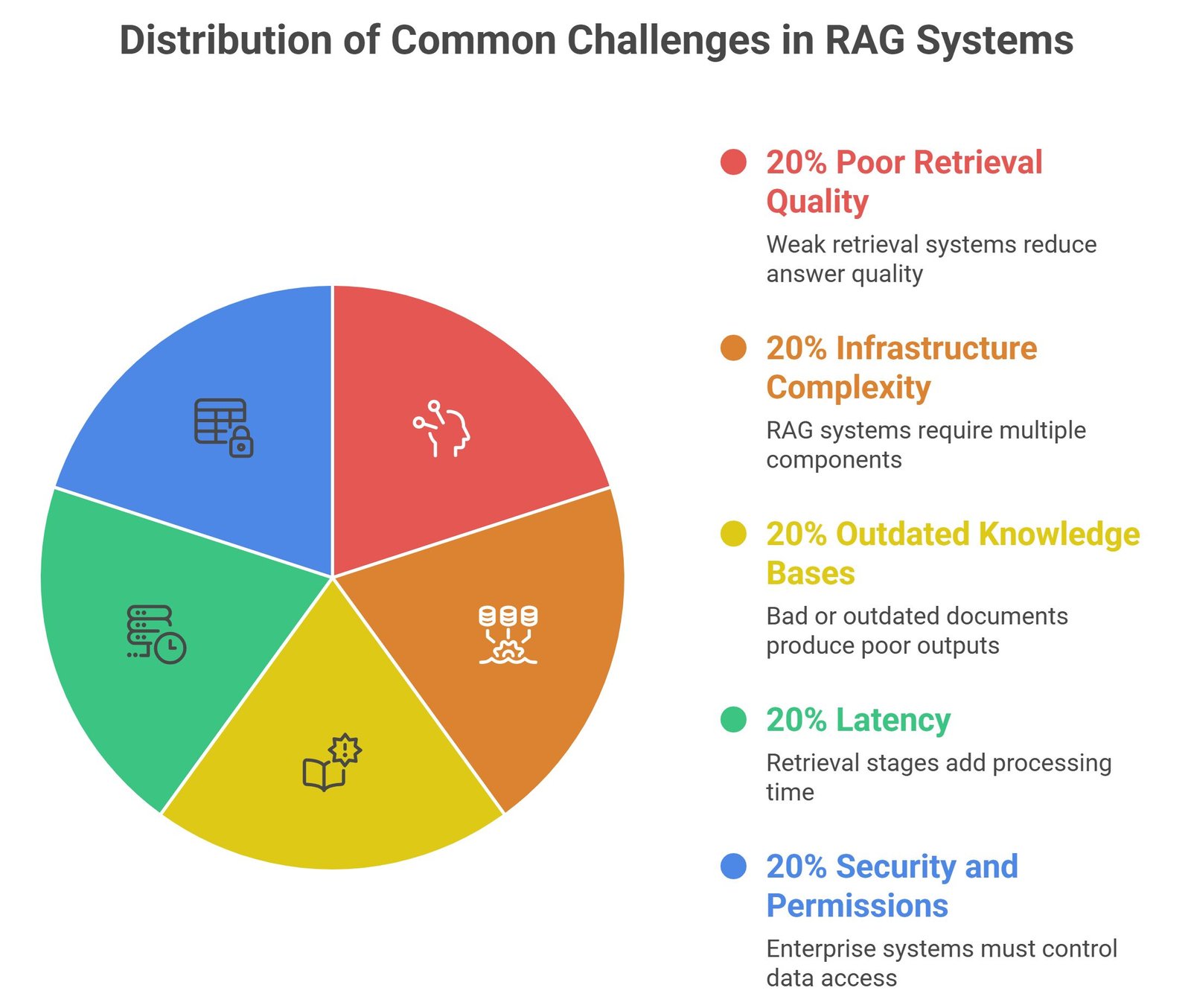
While RAG systems are powerful, they still face challenges.
Poor Retrieval Quality
Weak retrieval systems can reduce answer quality significantly.
Infrastructure Complexity
RAG systems require embeddings, retrievers, vector databases, and orchestration pipelines.
Outdated Knowledge Bases
Bad or outdated documents produce poor outputs.
Latency
Retrieval stages add additional processing time.
Security and Permissions
Enterprise systems must control data access carefully.
Future of RAG
RAG is evolving rapidly as enterprise AI adoption grows.
Major trends include:
- multimodal RAG
- graph-based retrieval systems
- AI agents with retrieval abilities
- autonomous enterprise copilots
- personalized retrieval systems
- real-time enterprise retrieval
Many future AI systems will likely combine retrieval and generation by default.
Suggested Read:
- What Is RAG in AI
- RAG Explained Simply
- How RAG Works
- RAG Use Cases
- LLM vs RAG
- How to Reduce LLM Hallucinations
FAQ: RAG for Beginners
What is RAG in AI?
RAG stands for Retrieval-Augmented Generation, an AI architecture that retrieves information before generating responses.
Why is RAG important?
RAG improves AI accuracy, reduces hallucinations, and enables access to updated or private knowledge.
Is RAG difficult for beginners?
The basic concepts are beginner-friendly once broken into simple steps.
What are embeddings in RAG?
Embeddings are vector representations of meaning used for semantic search.
What is the best beginner RAG project?
A PDF chatbot is one of the easiest and most practical beginner RAG projects.
Final Takeaway
Understanding RAG for beginners is important because Retrieval-Augmented Generation is becoming foundational infrastructure for modern AI systems.
By combining retrieval systems with language generation, RAG helps AI become more accurate, grounded, reliable, and enterprise-ready.
That simple idea is transforming how AI assistants, enterprise copilots, customer support systems, and intelligent search platforms work today.