

LLM Interview Questions: Top 50 Questions & Answers for 2026 Jobs
Large Language Models (LLMs) have created new job roles across AI engineering, product development, prompt engineering, research support, and enterprise automation.
As hiring grows, interviews now test more than machine learning theory. Employers want candidates who understand how to build useful AI systems.
This guide covers the most common LLM interview questions with simple answers to help beginners and professionals prepare confidently.
In simple terms
LLM interviews often test five areas:
- fundamentals
- practical prompting
- RAG systems
- deployment knowledge
- business thinking
You do not need to know everything. You need to show useful understanding.
Why Companies ask LLM Interview Questions
They want to know whether you can:
- build reliable AI features
- reduce hallucinations
- work with APIs
- optimize cost and speed
- connect company data
- evaluate outputs
- ship production systems
Easy analogy
Think of interviews for web developers.
They ask coding + system design + problem solving.
LLM interviews are similar, but focused on AI systems.
Popular ecosystems candidates may discuss
Many interviews reference tools or providers such as:
Focus on concepts over vendor memorization.
Top 50 LLM Interview Questions & Sample Answers
Fundamentals
1. What is an LLM?
A neural network trained on large text datasets to understand and generate language.
2. What is a token?
A chunk of text processed by the model.
3. What is a context window?
Maximum amount of input/output text a model can consider.
4. What is inference?
Running the trained model to generate responses.
5. What is fine-tuning?
Further training a base model on targeted data.
Architecture
6. What is a transformer?
A neural architecture using attention mechanisms.
7. What is attention?
A method that helps models focus on relevant tokens.
8. Why are transformers important?
They scale well and handle sequence relationships effectively.
9. What are embeddings?
Vector representations of meaning.
10. What is tokenization?
Breaking text into tokens.
Prompt Engineering
11. What is zero-shot prompting?
Asking without examples.
12. What is few-shot prompting?
Providing examples in the prompt.
13. How do you improve prompts?
Be specific, structured, and test iteratively.
14. What is chain prompting?
Breaking tasks into steps.
15. Why request structured output?
Easier automation and parsing.
Hallucinations & Safety
16. What is hallucination?
False or invented output.
17. How do you reduce hallucinations?
RAG, better prompts, human review.
18. What are guardrails?
Controls that improve safe behavior.
19. What is prompt injection?
Malicious instructions trying to override rules.
20. Why does safety matter?
Because AI errors create business risk.
RAG & Search
21. What is RAG?
Retrieval-Augmented Generation combines search with generation.
22. Why use RAG?
Improves grounding on private or recent data.
23. What is chunking?
Splitting documents into searchable pieces.
24. What is a vector database?
Stores embeddings for similarity search.
25. What is reranking?
Reordering retrieved results for relevance.
Engineering & Deployment
26. How do you deploy an LLM app?
Backend API + model provider + frontend + monitoring.
27. How do you reduce latency?
Smaller prompts, caching, streaming, better routing.
28. How do you reduce cost?
Optimize tokens, route models, cache responses.
29. What should you monitor?
Latency, cost, quality, failures, user feedback.
30. What is rate limiting?
Restricting request volume.
Evaluation
31. How do you evaluate an LLM?
Use test prompts, human review, metrics.
32. What metrics matter?
Accuracy, relevance, latency, hallucination rate, cost.
33. Why A/B test models?
To compare performance in real use.
34. What is benchmarking?
Structured comparison across models.
35. Why is observability useful?
It explains production behavior.
Product Thinking
36. Best first startup use case?
Support or internal productivity.
37. When should you avoid LLMs?
If deterministic logic is enough.
38. How do you choose a model?
Quality, cost, speed, privacy, fit.
39. What is model routing?
Using different models by task.
40. Why human-in-the-loop?
For high-risk workflows.
Behavioral Questions
41. Describe an AI project you built.
Use STAR method.
42. How did you fix poor outputs?
Show testing process.
43. How do you learn new tools fast?
Mention experimentation system.
44. How do you handle ambiguity?
Clarify requirements, prototype quickly.
45. How do you prioritize tasks?
Business impact first.
Coding / Practical Questions
46.Build a chatbot architecture?
Explain frontend, backend, retrieval, logging.
47. Design a PDF Q&A system?
OCR + chunking + embeddings + retrieval + LLM.
48. Improve failing prompts?
Analyze examples and iterate.
49. Handle sensitive data?
Mask, restrict, secure vendors.
50. Scale to many users?
Caching, async queues, monitoring.
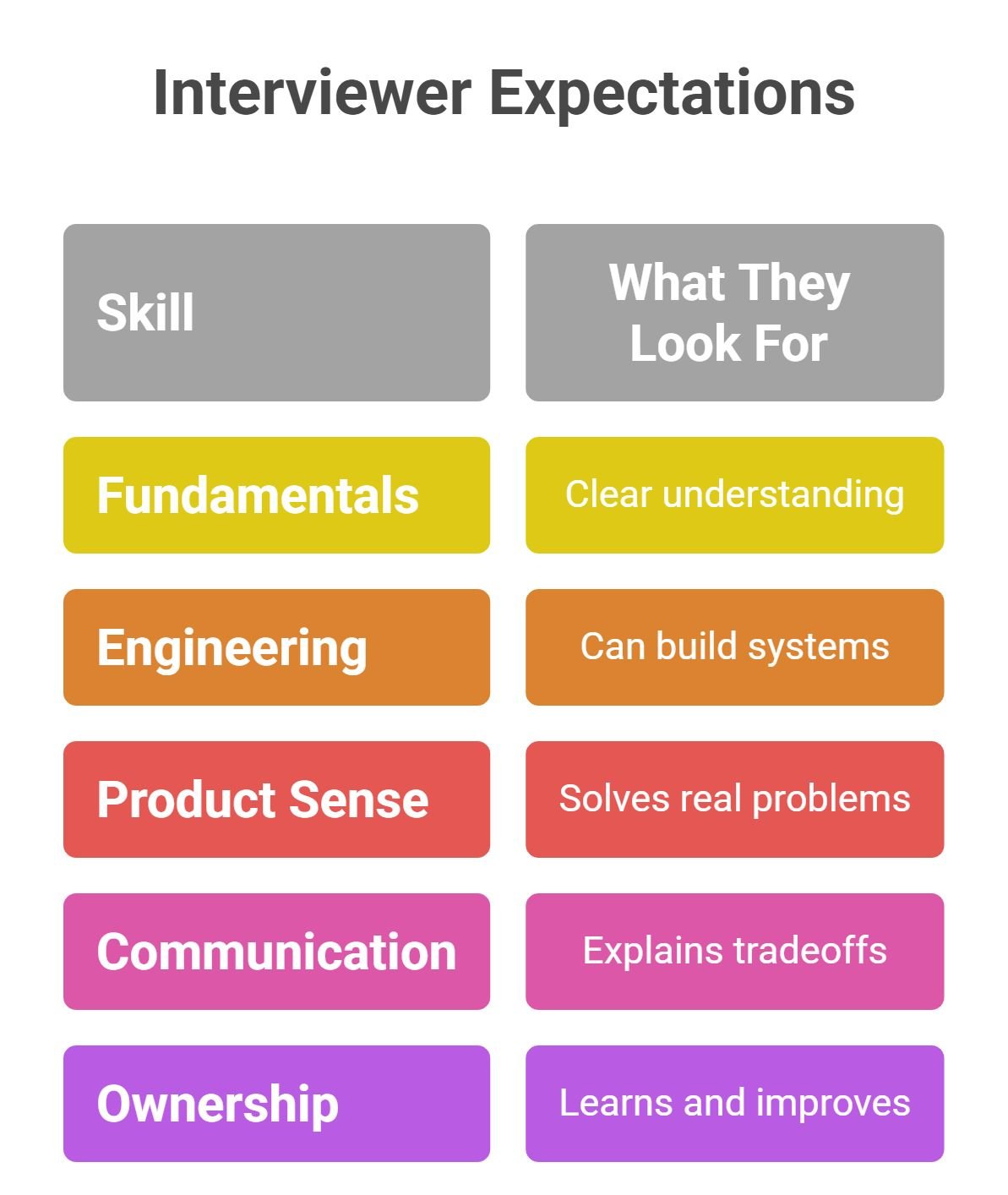
What Interviewers Really Want
| Skill | What They Look For |
| Fundamentals | Clear understanding |
| Engineering | Can build systems |
| Product Sense | Solves real problems |
| Communication | Explains tradeoffs |
| Ownership | Learns and improves |
Common Mistakes Candidates Make
Memorizing Buzzwords
Understand concepts instead.
Ignoring Projects
Real work matters.
No Cost Awareness
Businesses care about economics.
Weak Communication
Clear thinking wins.
No Examples
Use projects to prove skill.
How to prepare in 7 days
Day 1–2
LLM basics + architecture.
Day 3
Prompting + hallucinations.
Day 4
RAG systems.
Day 5
Deployment + monitoring.
Day 6
Mock interviews.
Day 7
Project storytelling.
Suggested Read:
- LLM Engineer Roadmap
- LLM Roadmap for Beginners
- LLM Deployment Basics
- LLM Evaluation Metrics
- How to Reduce LLM Hallucinations
- LLM for Beginners
FAQ: LLM Interview Questions
Do I need deep ML math?
Not always for applied roles.
Are coding rounds common?
Yes, for engineering roles.
Are projects important?
Very important.
Should I know RAG?
Usually yes.
What matters most?
Practical thinking + communication.
Final takeaway
LLM interview questions are increasingly practical. Companies want candidates who can turn AI models into useful products safely and efficiently.
Learn fundamentals, build projects, explain tradeoffs, and you can stand out strongly.