

LLM Roadmap for Beginners: Step-by-Step Career Guide in 2026
Large Language Models (LLMs) are creating new opportunities across AI, software, product development, automation, and enterprise technology.
Companies need people who understand how to build, use, evaluate, and deploy LLM systems.
The good news: you do not need a PhD to start learning.
This guide gives you a practical LLM roadmap for beginners so you can build relevant skills, create projects, and prepare for real jobs.
In simple terms
An LLM roadmap is:
A step-by-step plan to learn the skills needed to work with language model technology.
Depending on your goal, that may mean:
- prompt engineering
- AI application development
- data science
- model evaluation
- RAG systems
- LLMOps
- product management
- AI consulting
You do not need to master everything on day one.
Why LLM Skills are Valuable
Businesses are adopting AI for:
- customer support
- search assistants
- coding copilots
- internal automation
- content systems
- analytics workflows
That creates demand for practical talent.
Easy analogy
Think of learning LLMs like learning web development years ago.
At first, many people thought it was niche.
Later, it became a major career path.
LLM skills may follow a similar trend.
Career Paths in The LLM Ecosystem
Technical Roles
- LLM Engineer
- AI Engineer
- Machine Learning Engineer
- Applied AI Developer
- NLP Engineer
- Data Scientist
Non-Technical Roles
- AI Product Manager
- Prompt Specialist
- AI Consultant
- AI Operations Analyst
- Technical Content Creator
Popular Ecosystems Beginners Explore
Many learners experiment with tools and platforms from:
Learning concepts matters more than loyalty to one provider.
Step-by-Step LLM Roadmap for Beginners
Stage 1: Core Foundations (2–6 Weeks)
Learn:
Python Basics
- variables
- loops
- functions
- APIs
- file handling
Data Basics
- CSV / JSON
- text cleaning
- basic analytics
Git Basics
Version control is useful.
Stage 2: AI & NLP Basics (2–4 Weeks)
Learn:
- machine learning basics
- embeddings
- tokenization
- NLP concepts
- transformers overview
You do not need deep math initially.
Stage 3: Understand LLMs (2–4 Weeks)
Study:
- how LLMs work
- context windows
- inference
- fine-tuning basics
- hallucinations
- safety basics
This creates strong conceptual grounding.
Stage 4: Practical Prompting (1–3 Weeks)
Learn:
- zero-shot prompts
- few-shot prompting
- structured outputs
- chain workflows
- evaluation prompts
Great early skill for beginners.
Stage 5: Build Real Projects (4–8 Weeks)
Create portfolio projects such as:
Project 1
PDF Q&A assistant.
Project 2
AI resume optimizer.
Project 3
Customer support chatbot.
Project 4
Meeting summary tool.
Project 5
Internal knowledge search bot.
Projects help more than certificates.
Stage 6: Learn RAG Systems
Understand:
- embeddings
- vector databases
- retrieval pipelines
- grounding outputs
- document chunking
RAG is highly practical.
Stage 7: Learn Deployment
Study:
- APIs
- cloud hosting
- cost control
- monitoring
- rate limits
- authentication
This separates hobbyists from professionals.
Stage 8: Learn Evaluation & LLM Ops
Important topics:
- benchmarking
- observability
- hallucination reduction
- prompt versioning
- A/B testing
- red teaming basics
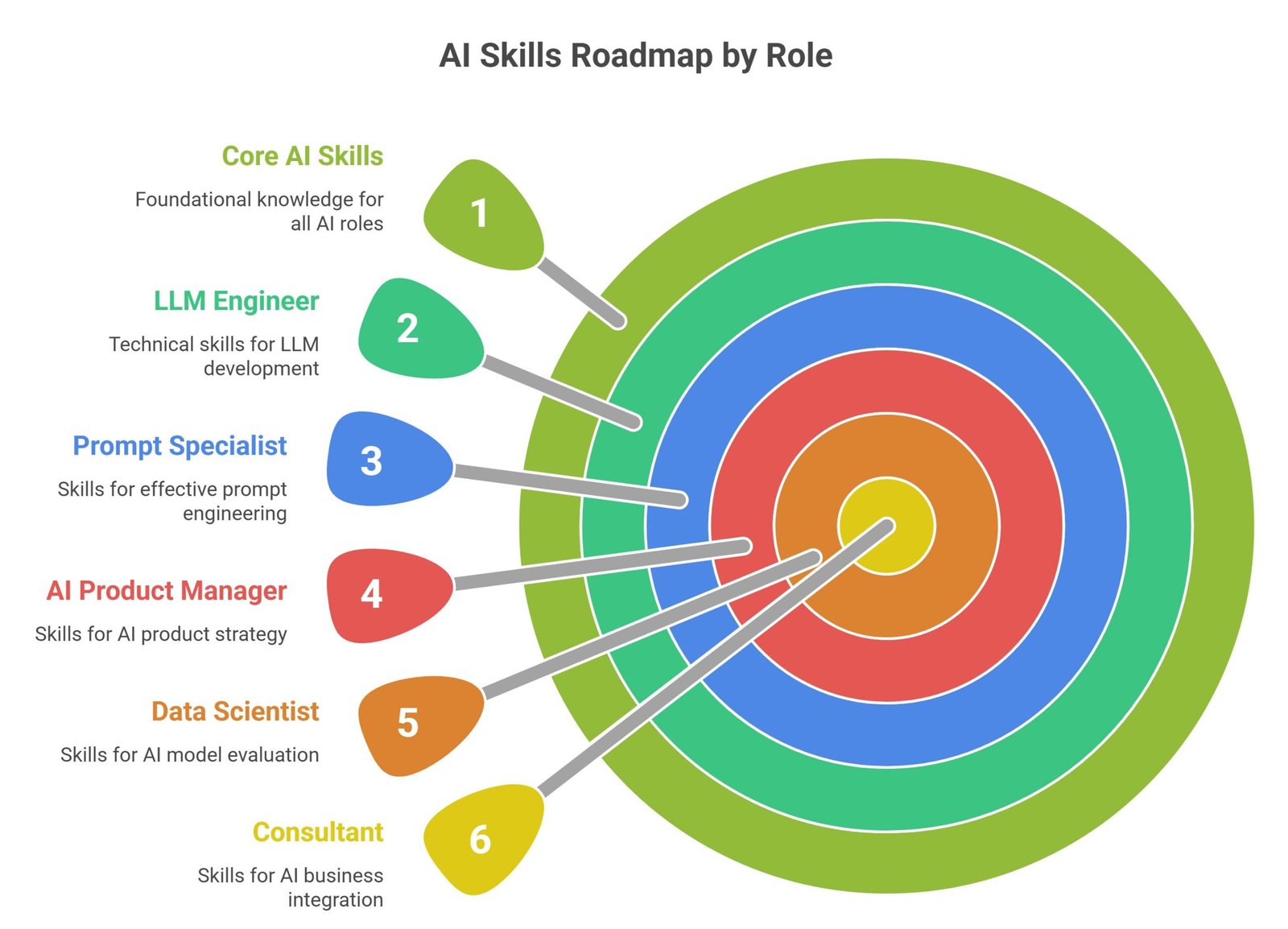
Skills Roadmap by Role
| Role | Priority Skills |
| LLM Engineer | Python, APIs, RAG, deployment |
| Prompt Specialist | Prompting, testing, UX |
| AI Product Manager | Use cases, metrics, workflows |
| Data Scientist | Evaluation, experimentation |
| Consultant | ROI, tools, business workflows |
Best LLM Beginner Projects for Jobs
SaaS AI Assistant
Great for startups.
AI Content Tool
Shows workflow design.
Research Copilot
Demonstrates retrieval systems.
Support Chatbot
Strong commercial relevance.
AI Dashboard
Shows monitoring skills.
Common mistakes beginners make
Chasing Every New Tool
Focus on fundamentals.
Ignoring Python
Still valuable for serious roles.
Only Watching Videos
Build projects instead.
No Portfolio
Proof matters.
Learning Theory Only
Employers want execution.
How to Get Your first LLM Job
Build 3 Strong Projects
Better than 20 weak ones.
Publish on GitHub
Show code and demos.
Write Case Studies
Explain your thinking.
Learn Business Use Cases
Employers hire for outcomes.
Apply Consistently
Many roles are still emerging.
Future opportunities
Expect growth in:
- AI automation consulting
- enterprise copilots
- AI agents
- multimodal systems
- private company LLM tools
- domain-specific AI apps
This space is still early.
Suggested Read:
- LLM for Beginners
- How LLMs Work
- LLM Fine Tuning Basics
- LLM Deployment Basics
- LLM Evaluation Metrics
- LLM Use Cases for Startups
FAQ: LLM Roadmap for Beginners
Can beginners learn LLMs without coding?
Yes, especially prompting and product roles.
Do I need advanced math?
Not for many applied roles.
Is Python necessary?
Highly recommended for technical jobs.
How long to become job-ready?
Often 3–6 focused months for applied beginner roles.
What matters most?
Projects, practical skill, and consistency.
Final takeaway
The best LLM roadmap for beginners is simple: learn foundations, understand LLM concepts, build real projects, and solve business problems.
You do not need to know everything. You need to know enough to create value.