

The best AI tools for bloggers help with topic research, blog outlines, first drafts, SEO optimization, editing, images, and content repurposing. The smartest bloggers do not use one AI tool to write everything. They build a workflow that combines research, writing, optimization, originality, visuals, and human editing.
In Simple Terms
AI tools for bloggers are content assistants.
They can suggest blog topics, create outlines, draft sections, improve headlines, optimize keywords, generate images, rewrite social posts, and check grammar. But they should not replace your experience, opinions, examples, or final judgment. AI is most useful when it speeds up repeatable work while you keep control of quality.
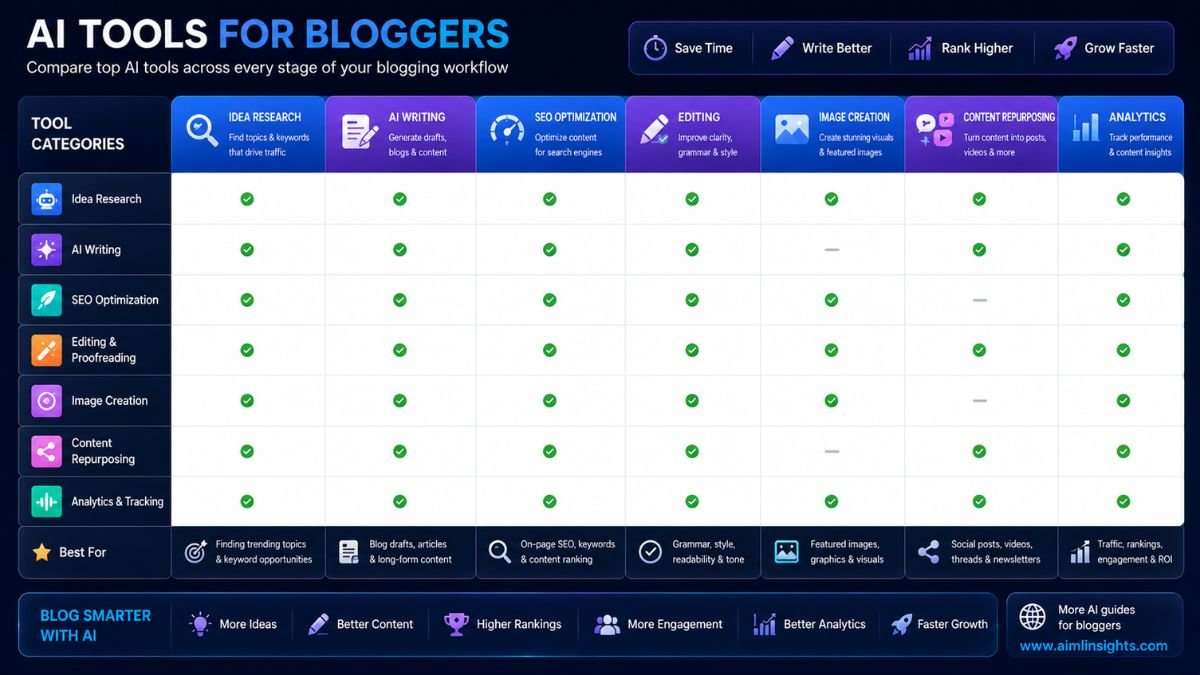
Best AI Tools for Bloggers: Quick Comparison
| Tool | Best For | Strong Blogging Use Case | Main Limitation |
| ChatGPT | Flexible writing and planning | Topic ideas, outlines, drafts, FAQs, rewrites | Needs strong prompts and fact-checking |
| Claude | Long-form editing and structure | Improving flow, clarity, tone, and long drafts | Still needs source verification |
| Jasper | Marketing-focused blog content | Brand voice, campaigns, content workflows | Better for marketers than casual bloggers |
| Surfer SEO | SEO content optimization | Content scoring, SERP-informed structure, keyword coverage | Can encourage over-optimization if used blindly |
| Semrush Content Toolkit | SEO-led content workflow | Ideas, SEO data, content briefs, optimization | More useful if you already care about SEO deeply |
| Writesonic | AI writing and AI search visibility | Blog drafts, content workflows, AI visibility tracking | Quality depends on inputs and editing |
| Copy.ai | Marketing and GTM content | Repurposing, sales/blog workflows, campaign content | Less focused on solo blogging now |
| Grammarly | Editing and clarity | Grammar, tone, readability, final polish | Does not replace strategic editing |
| Canva AI | Blog images and visuals | Featured images, social graphics, presentation visuals | Not a writing or SEO tool |
| Perplexity | Research and source discovery | Fast topic research and source-backed exploration | Must verify important claims |
ChatGPT: Best Flexible AI Tool for Blog Planning
ChatGPT is one of the best AI tools for bloggers who want a flexible assistant for planning and drafting. It can help create blog outlines, brainstorm title angles, simplify technical ideas, write meta descriptions, generate FAQ ideas, and repurpose a blog post into social snippets.
For bloggers, the best use is not “write a full article about this topic.” A better workflow is to ask for search-intent analysis, outline options, reader questions, examples, and editing suggestions. This keeps the article more original and less generic.
Best for: outlines, ideation, rewrites, FAQ planning, content repurposing.
Use carefully for: facts, statistics, tool features, and current product claims.
Claude: Best for Long-Form Blog Editing
Claude is strong for bloggers who write longer posts and need help improving structure. It can review drafts, tighten paragraphs, improve transitions, identify repetitive sections, and make a blog easier to read.
This makes Claude useful after you already have a draft. Instead of using it to generate everything, use it as an editor. Ask it to find weak sections, unclear explanations, missing examples, and places where the article does not match search intent.
Best for: long-form editing, flow, clarity, tone, structure.
Use carefully for: research claims and source-heavy sections.
Jasper: Best for Brand-Focused Blogging
Jasper is built more for marketing teams than casual one-off writing. Its official site positions it around AI agents for marketing workflows, and its brand voice features are designed to keep content aligned with tone, style, and visual guidelines.
For bloggers, Jasper is useful when consistency matters. A niche site, affiliate blog, SaaS blog, or agency blog can use it to maintain voice across articles, landing pages, emails, and campaigns.
Best for: brand voice, marketing blogs, campaign content, team workflows.
Use carefully for: highly personal essays or expert-led opinion posts.
Surfer SEO: Best AI SEO Tool for Bloggers
Surfer SEO is useful when ranking on Google is the main goal. Surfer positions itself around AI search visibility, Google visibility, content scoring, and SEO content optimization.
Bloggers can use Surfer to compare top-ranking content, identify missing terms, improve structure, and avoid underdeveloped sections. The risk is writing only for the score. A high content score does not automatically mean the article is useful. Use Surfer as a guide, not the editor-in-chief.
Best for: SEO optimization, content briefs, keyword coverage, SERP alignment.
Use carefully for: natural writing and originality.
Semrush Content Toolkit: Best for SEO Research and Content Ideas
Semrush Content Toolkit is useful for bloggers who want AI writing connected to SEO data. Semrush says its content tools combine AI writing capabilities with real-time SEO data, and its Content Toolkit supports creating, optimizing, and repurposing content for Google, social media, and AI search platforms. This makes it helpful for bloggers who want topic ideas, content briefs, SEO guidance, and optimization in one workflow.
Best for: SEO-led blogging, topic research, content optimization, repurposing.
Use carefully for: beginners who may not need a full SEO platform yet.
Writesonic: Best for AI Writing and AI Search Visibility
Writesonic has moved beyond basic AI writing and now positions itself as an AI search growth platform. Its documentation also describes an AI Article Writer suite for long-form content creation.
For bloggers, Writesonic can help generate drafts, create outlines, build articles from briefs, and support content workflows. It is useful for content-heavy sites that publish regularly and want speed, but human editing is still necessary.
Best for: AI drafts, long-form content, AI search-focused workflows.
Use carefully for: originality, depth, and expert examples.
Copy.ai: Best for Blog Repurposing and Marketing Workflows
Copy.ai now presents itself as a GTM AI platform rather than only a simple AI copywriting tool. Its platform focuses on automating repetitive go-to-market tasks and supporting marketing and sales workflows.
For bloggers, Copy.ai is useful when blog content connects to newsletters, landing pages, sales emails, LinkedIn posts, or product campaigns. It is especially helpful for repurposing one article into multiple marketing assets.
Best for: repurposing, marketing workflows, campaign content, sales copy.
Use carefully for: purely editorial blogs that do not need GTM workflows.
Grammarly: Best for Editing, Tone, and Readability
Grammarly remains useful for bloggers because editing quality matters. Its official site describes AI writing assistance that works across apps and supports personalized guidance and text generation.
Use Grammarly near the end of your workflow. It can catch grammar issues, improve clarity, adjust tone, and reduce awkward phrasing. It is not a substitute for content strategy, but it helps make posts cleaner.
Best for: grammar, clarity, tone, final polish.
Use carefully for: preserving your voice and avoiding over-sanitized writing.
Canva AI: Best for Blog Images and Social Graphics
Bloggers often ignore visuals, but images matter for click-through rate, social sharing, and Google Discover appeal. Canva AI is useful for featured images, Pinterest graphics, social cards, diagrams, and simple branded visuals.
A blogger can use Canva AI to create a featured image concept, then adapt it into a newsletter image, LinkedIn carousel, or Pinterest pin. That makes one blog post easier to distribute across channels.
Best for: featured images, social graphics, diagrams, thumbnails.
Use carefully for: generic AI visuals that do not match the article topic.
Perplexity: Best for Research Before Writing
Perplexity is useful for bloggers who need fast research and source discovery. It can help explore a topic, compare viewpoints, and find sources before writing.
The important rule is verification. Do not copy its wording or trust every summary. Use it to discover sources, then read the original pages before making claims.
Best for: source discovery, topic research, competitor scanning.
Use carefully for: final factual claims and niche technical details.
How Bloggers Should Build an AI Content Workflow
The best AI tools for bloggers work better together.
Start with Perplexity, Semrush, or Surfer for topic and SERP research. Use ChatGPT or Claude to create an outline and improve structure. Use Jasper, Writesonic, or Copy.ai for first drafts or marketing variations. Use Surfer or Semrush to optimize the article. Use Grammarly for editing. Use Canva AI for visuals. Then review everything manually before publishing.
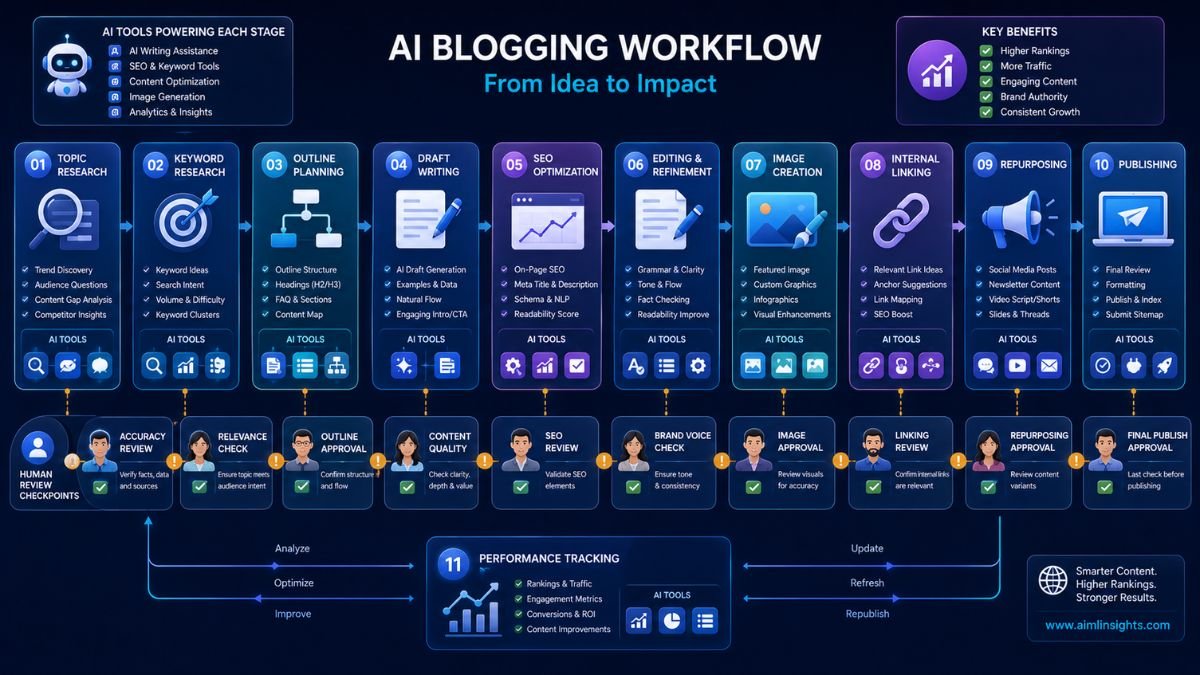
This workflow is stronger than relying on one AI blog writing tool from start to finish.
Common Mistakes Bloggers Should Avoid
The biggest mistake is publishing AI-generated content without adding original examples, experience, or useful judgment. Generic AI writing can look complete but still offer nothing new.
Another mistake is over-optimizing for keywords. SEO tools can help, but keyword stuffing makes content harder to read.
A third mistake is ignoring accuracy. AI tools can invent claims, outdated features, and fake examples. For tool comparisons, always check official pages before publishing.
Finally, bloggers should avoid using the same AI structure repeatedly. If every post has the same rhythm, headings, and examples, readers notice.
Suggested Read:
- Best AI Tools for Beginners in 2026
- Best AI Tools for Bloggers and Content Writers
- Best AI Tools for Content Creation
- AI Tools With Free Plans Worth Using in 2026
- Best AI Workflow Automation Tools for Teams
- ChatGPT vs Perplexity vs Claude for Research Tasks
- Best Prompt Templates for Summarization and Research
- Prompt Engineering for Beginners: A Practical Guide
FAQ: Best AI Tools for Bloggers in 2026
What are the best AI tools for bloggers?
The best AI tools for bloggers include ChatGPT for planning, Claude for editing, Jasper for brand-focused content, Surfer SEO for optimization, Semrush Content Toolkit for SEO workflows, Writesonic for drafts, Grammarly for polish, Canva AI for visuals, and Perplexity for research.
Which AI tool is best for blog writing?
ChatGPT, Claude, Jasper, and Writesonic are strong for blog writing, but the best choice depends on your workflow. Solo bloggers may prefer ChatGPT or Claude, while marketing teams may prefer Jasper or Writesonic.
Can AI tools help bloggers rank on Google?
Yes, AI tools can help bloggers with keyword research, content structure, SEO optimization, internal linking, and editing. They cannot guarantee rankings. Content still needs originality, accuracy, search-intent match, and useful examples.
Are AI blog writing tools worth it?
AI blog writing tools are worth it when they save time and improve quality. They are not worth it if they produce generic posts that need heavy rewriting.
What AI tools help with blog SEO?
Surfer SEO, Semrush Content Toolkit, Writesonic, and Perplexity can support blog SEO through research, optimization, content briefs, source discovery, and AI visibility workflows.
Can AI write full blog posts?
AI can draft full posts, but bloggers should not publish them without editing. The final article should include original insight, verified facts, clear examples, internal links, and a human editorial review.
Final Takeaway
The best AI tools for bloggers are not just writing generators. They are workflow tools. Use AI for research, outlines, drafting, SEO optimization, editing, visuals, and repurposing — but keep your own experience and judgment at the center.
For most bloggers, a strong starter stack is ChatGPT or Claude for planning, Surfer or Semrush for SEO, Grammarly for editing, Canva AI for visuals, and Perplexity for research. That combination gives you speed without giving up originality.