
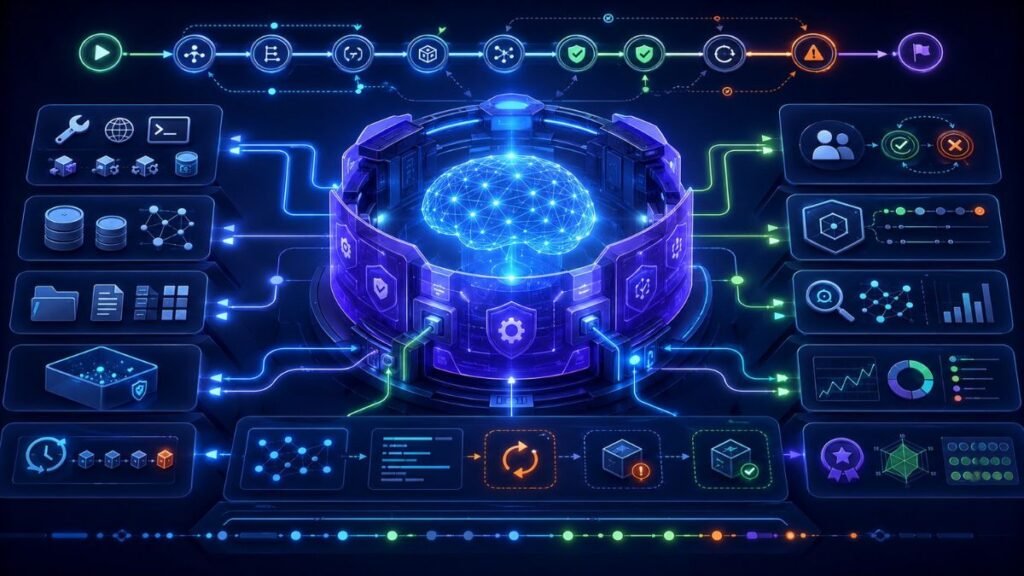
Harnesses in long-running AI agents are the execution layers around an AI model that help agents use tools, manage memory, preserve state, build context, recover from failures, verify outputs, and stay observable. A strong harness turns a capable language model into a more reliable long-running agentic system.
In Simple Terms
A model is the brain. A harness is the support system around it.
The model reasons and generates. The harness decides how the model interacts with tools, files, APIs, memory, checkpoints, sandboxes, logs, approvals, and verification steps.
For long-running AI agents, this matters because the agent may work across many steps, tools, sessions, and failures. Without a harness, the agent can lose context, repeat work, misuse tools, or become hard to debug.
What Is an Agent Harness?
An agent harness is the runtime and control layer that surrounds an AI model and helps it operate as an agent.
It usually handles:
Tool execution.
Memory access.
State persistence.
Context construction.
Skill or tool routing.
Retries and error handling.
Verification and guardrails.
Tracing and observability.
Human approval checkpoints.
A 2026 preprint on harness scaling defines the agent harness as the system that translates model capability into long-horizon agent behavior through components such as memory, context construction, skill routing, orchestration, verification, and governance.
That is the key idea: the model alone does not make a reliable long-running agent. The harness shapes how the agent behaves over time.
Why Long-Running AI Agents Need Harnesses
Long-running agents are different from one-shot assistants. They may debug code, research across sources, process customer cases, monitor workflows, or coordinate multi-step operations.
OpenAI describes agents as applications that can plan, call tools, collaborate across specialists, and keep enough state to complete multi-step work. That stateful, multi-step nature creates problems a simple prompt-response app does not have.
A long-running agent must remember what happened, avoid repeating steps, recover from failures, handle tool outputs, preserve the original goal, and stop safely. The harness provides that structure.
Agent Harness vs Agent Framework
The terms overlap, but they are not identical.
| Concept | What It Means | Example Role |
| Agent framework | Developer toolkit for building agents | Provides abstractions, SDKs, patterns |
| Agent harness | Runtime/control layer around the model | Manages execution, tools, state, memory |
| Agent platform | Hosted environment for agents | Deployment, monitoring, security |
| Agent app | The final user-facing system | Support agent, coding agent, research agent |
A framework may include a harness. A team may also build a custom harness using workflow engines, queues, state stores, tool adapters, and observability systems.
The practical question is not “framework or harness?” It is: does your agent have the runtime support it needs to run safely over time?
The Core Parts of an Agent Harness
| Harness Component | What It Does | Why It Matters |
| Context builder | Selects relevant information | Prevents overload and drift |
| Tool executor | Runs tools safely | Reduces tool misuse |
| State manager | Tracks progress | Avoids repeating work |
| Memory layer | Stores useful context | Enables continuity |
| Skill router | Chooses tools or subagents | Improves task handling |
| Verifier | Checks outputs or actions | Catches errors earlier |
| Guardrails | Enforces limits | Prevents unsafe behavior |
| Tracing layer | Records events | Makes debugging possible |
| Human checkpoint | Pauses risky actions | Keeps accountability |
These pieces can be simple in early prototypes and more rigorous in production systems.
1. Tool Execution: Connecting the Agent to Real Systems
Long-running AI agents often need tools: search, databases, code runners, browsers, CRMs, calendars, document stores, sandboxes, or internal APIs.
The harness manages how these tools are called. It validates arguments, checks permissions, handles errors, and returns results to the model.
OpenAI’s tracing docs describe traces that include LLM generations, tool calls, handoffs, guardrails, and custom events, which reflects the kinds of events a harness must coordinate and record.
Without a tool execution layer, the model may request actions that are unsafe, invalid, or impossible to audit.
2. State Persistence: Remembering Where the Agent Is
State persistence is one of the biggest reasons long-running agents need a harness.
A coding agent should know which files it changed and which tests failed. A customer support agent should know which policy was retrieved and whether approval is pending. A research agent should know which sources were already checked.
The harness stores this task state so the agent can resume after delays, retries, tool failures, or human review. This prevents the agent from starting over or relying on a messy transcript.
3. Context Construction: Giving the Model the Right Information
A long-running agent generates too much information to pass everything back into the model. The harness needs to decide what context matters now.
Context may include the current goal, recent tool results, memory summaries, relevant documents, constraints, user preferences, and safety rules.
Anthropic describes context as a finite resource for agents and frames context engineering as the practice of curating and managing it effectively. For a harness, context construction is not optional. It is one of the main ways the system keeps the agent from drifting.
4. Memory Management: Keeping Useful History Without Hoarding Everything
Memory helps agents maintain continuity across steps and sessions. But memory can also create risk if it stores stale, sensitive, or misleading information.
A harness should control memory reads and writes. It should decide what gets stored, what expires, what must be redacted, and what should remain in a secure system of record instead of general agent memory.
For long-running agents, memory hygiene matters as much as memory capacity.
5. Verification: Checking Work Before the Agent Continues
Long-running agents can compound errors. If the first tool result is misread, the rest of the workflow may go in the wrong direction.
A harness can add verification points:
Was the tool call valid?
Did the command succeed?
Does the answer match retrieved evidence?
Did tests pass?
Is the action allowed?
Should a human review this step?
A 2026 preprint on harness scaling argues that harness-level benchmarks should measure trajectory quality, memory hygiene, context efficiency, communication fidelity, verification cost, and safe evolution over time, not only final task success.
6. Observability: Making Agent Behavior Debuggable
Long-running agents are hard to debug without traces. A final answer does not show what the agent did.
A good harness records model calls, tool calls, handoffs, memory events, context construction, guardrail checks, errors, costs, and approvals. This helps developers see where the workflow stayed on track or drifted.
Research on Agentic Harness Engineering argues that harnesses are central to coding-agent performance because they mediate how models interact with tools and execution environments. The paper introduces observability-driven methods for evolving harness components such as tools, middleware, and memory.
7. Human-in-the-Loop: Pausing at the Right Moments
A harness should know when not to continue automatically.
High-risk actions such as sending customer emails, issuing refunds, modifying production code, deleting files, or changing permissions should pause for approval.
Human checkpoints are not a sign that the agent is weak. They are how long-running agents stay accountable when decisions affect people, money, security, or business systems.
Example: Harness in a Coding Agent
A coding agent receives a bug report. The harness helps it:
Load the task and repository context.
Route the agent to file-search and terminal tools.
Run commands in a sandbox.
Save state after each edit.
Capture test results.
Compress context when the session gets long.
Verify whether tests passed.
Pause before creating or merging a pull request.
Record the trace for review.
Without the harness, the model may still write code, but the workflow will be less reliable, less observable, and harder to control.
Common Mistakes to Avoid
The first mistake is treating the model as the whole agent. The model matters, but the harness determines how the model acts.
The second mistake is storing everything in context. Long-running agents need curated context, not endless transcripts.
The third mistake is skipping observability. If the harness does not record trajectories, failures are hard to debug.
The fourth mistake is allowing tool access without permissions. Tool calls should be validated, logged, and bounded.
The fifth mistake is evaluating only the final answer. Long-running agents should be evaluated by trajectory quality, recovery behavior, verification, and safe stopping.
Suggested Read:
- What Is Agentic AI? A Practical Guide for Beginners
- The Core Building Blocks of an Agentic AI System
- How Long-Running Agentic AI Systems Stay on Track
- Tool Use in Agentic AI: Function Calling, APIs, and External Actions
- Memory in Agentic AI Systems: Short-Term vs Long-Term Context
- How Orchestration Works in Agentic AI Systems
- Observability for Agentic AI: What Teams Need to Track
- How to Evaluate Agentic AI Systems
FAQ: Harnesses in Long-Running AI Agents
What is an agent harness?
An agent harness is the runtime and control layer around an AI model that manages tools, memory, state, context, verification, observability, and safety.
Why do long-running AI agents need harnesses?
They need harnesses because long-running tasks require state, checkpoints, tool execution, context control, error recovery, monitoring, and human approval.
How do harnesses help AI agents stay reliable?
Harnesses keep agents reliable by preserving progress, validating tool use, managing memory, building relevant context, verifying outputs, and recording traces.
What is the difference between an agent harness and an agent framework?
A framework is usually a developer toolkit. A harness is the execution layer that surrounds the model and manages runtime behavior. Some frameworks include harness-like features.
How do harnesses manage tools, memory, and state?
They define tool adapters, validate calls, store task state, control memory reads and writes, summarize context, and record events for debugging.
What risks do agent harnesses reduce?
They reduce context drift, repeated work, unsafe tool use, memory pollution, missing approvals, poor debugging, and uncontrolled long-running behavior.
Final Takeaway
Harnesses in long-running AI agents are what make agentic systems more than a model in a loop. They manage tools, memory, state, context, verification, observability, and human approval so long-running agents can work through complex tasks without drifting, repeating, or acting unsafely.
To continue learning, read How Long-Running Agentic AI Systems Stay on Track, Tool Use in Agentic AI, and Observability for Agentic AI next.