
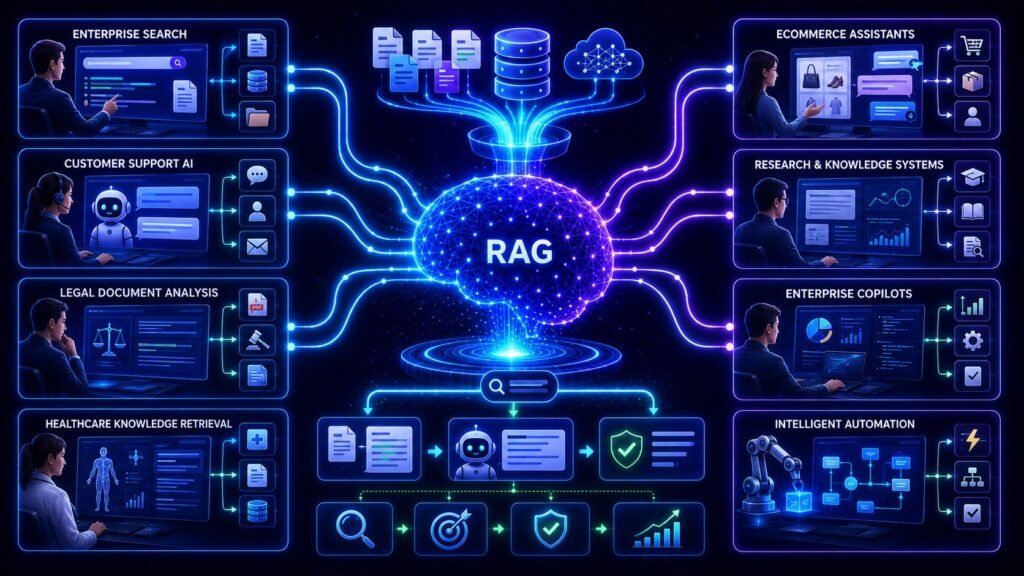
Top RAG Use Cases Transforming Enterprise AI in 2026
Retrieval-Augmented Generation (RAG) has quickly become one of the most important architectures in modern AI systems. While Large Language Models (LLMs) are powerful, they still face serious limitations when used in real-world enterprise environments. They can hallucinate, provide outdated information, and struggle with private company knowledge that was never part of their original training data.
That is where RAG changes everything.
By combining information retrieval systems with language generation, RAG allows AI systems to search external knowledge sources before generating responses. This simple architectural shift dramatically improves reliability, accuracy, and enterprise usefulness.
Today, some of the most advanced AI applications rely on RAG workflows behind the scenes. From customer support assistants and enterprise search systems to healthcare AI and legal document analysis, RAG is becoming foundational infrastructure for intelligent applications.
In this guide, we explore the top RAG use cases, real-world Retrieval-Augmented Generation applications, industry adoption trends, and why enterprises are rapidly investing in retrieval-powered AI systems.
In Simple Terms
What Is RAG?
RAG stands for:
Retrieval-Augmented Generation
It is an AI architecture where a system retrieves relevant information from external sources before generating a response.
Instead of answering only from training memory, the AI first searches trusted knowledge sources such as:
- company documents
- databases
- PDFs
- websites
- policy files
- internal knowledge bases
- product manuals
The retrieved information is then added to the model prompt so the AI can generate more accurate and grounded answers.
Think of RAG as giving AI systems the ability to research before responding.
Why RAG Became Essential for Modern AI
Traditional LLMs work well for general-purpose tasks, but enterprise environments require much higher reliability. Businesses cannot depend on AI systems that confidently invent information or fail to access internal company knowledge.
This is one of the main reasons why enterprise AI architecture is shifting toward retrieval-based systems.
RAG solves several important problems at once:
Reduces Hallucinations
The AI retrieves supporting evidence before answering.
Uses Updated Information
Knowledge can be refreshed dynamically without retraining the entire model.
Connects to Private Data
Internal enterprise knowledge becomes searchable.
Improves Enterprise Search
Employees can ask natural language questions instead of using keyword search.
Enhances Trust
Source-grounded responses improve reliability and user confidence.
Because of these advantages, many experts now consider RAG one of the most important AI infrastructure layers for production systems.
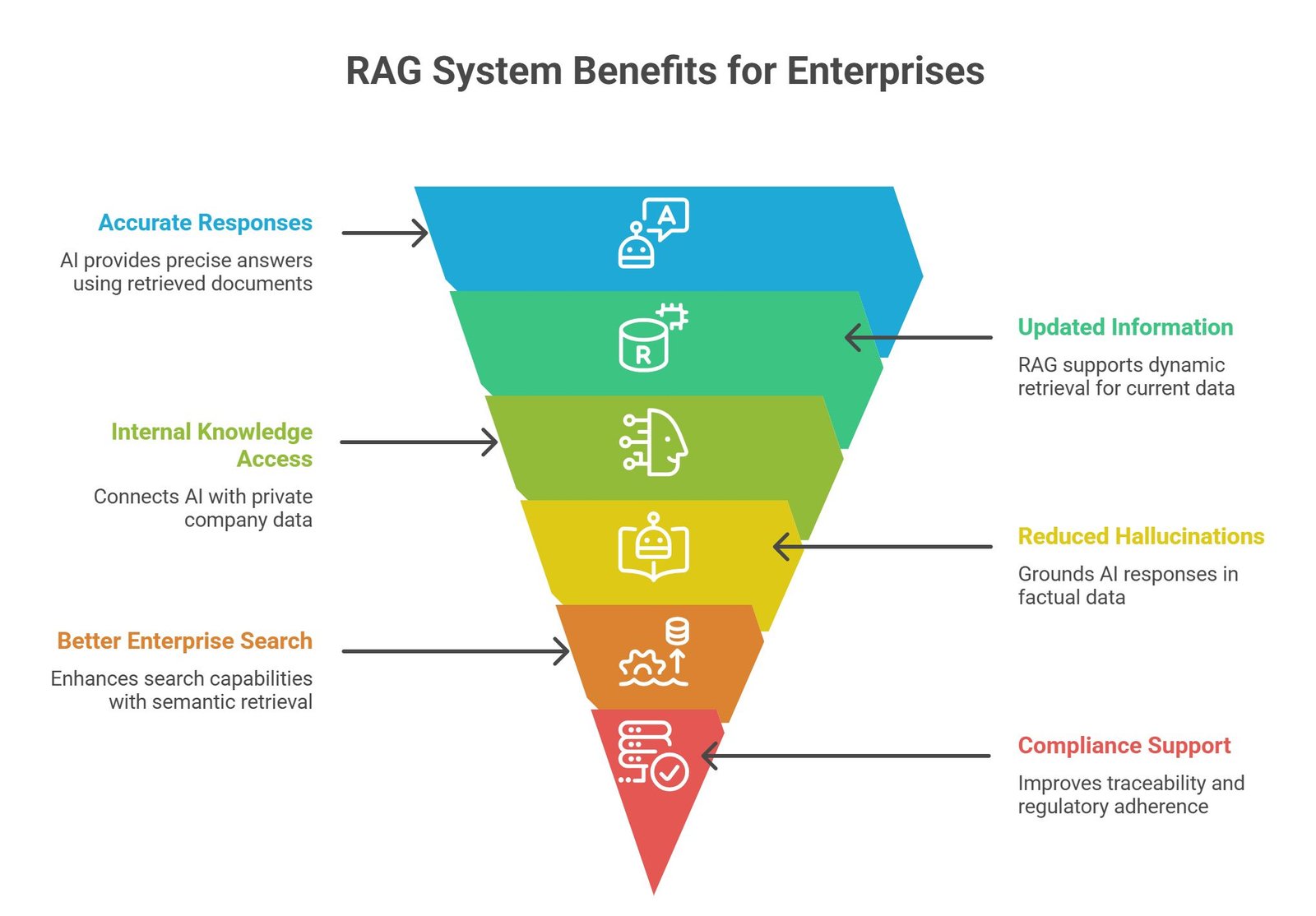
Why Enterprises Prefer RAG Systems
| Business Need | How RAG Helps |
| Accurate responses | Uses retrieved documents |
| Updated information | Supports dynamic retrieval |
| Internal knowledge access | Connects private company data |
| Reduced hallucinations | Grounds AI responses |
| Better enterprise search | Uses semantic retrieval |
| Compliance support | Improves traceability |
Top RAG Use Cases in AI
1. Customer Support AI
One of the most popular RAG use cases is customer support automation. Traditional support chatbots often struggle because they rely on static scripts or incomplete training knowledge. This leads to poor customer experiences, inaccurate responses, and frustrating support interactions.
RAG-powered support systems solve this problem by retrieving information from live support documentation before answering users.
These systems can search:
- FAQs
- troubleshooting guides
- return policies
- shipping information
- billing procedures
- product manuals
This retrieval-first workflow helps customer support AI generate grounded and context-aware responses instead of generic answers.
Modern support assistants can also summarize previous tickets, retrieve account-related policies, and provide contextual troubleshooting instructions dynamically. This dramatically improves response quality while reducing human support workload.
As a result, RAG-based customer support systems are becoming common across SaaS, ecommerce, telecom, banking, and enterprise software industries.
2. Enterprise Knowledge Search
Enterprise knowledge retrieval is one of the fastest-growing real-world RAG applications.
Most organizations store information across dozens of disconnected systems:
- PDFs
- internal wikis
- cloud drives
- Slack conversations
- SOPs
- HR documents
- onboarding manuals
- training resources
Traditional search systems often fail because employees do not know exact keywords or file locations.
RAG systems solve this by enabling semantic search with natural language queries.
Employees can ask:
- “What is our remote work reimbursement policy?”
- “How do we onboard enterprise customers?”
- “What is the escalation process for security incidents?”
Instead of manually searching folders, the AI retrieves relevant information and generates summarized answers instantly.
This improves organizational productivity significantly and reduces time wasted searching for internal knowledge.
3. Legal AI Systems
Legal workflows involve massive amounts of documentation, regulations, and contract analysis. Traditional legal search systems can be slow and difficult to navigate, especially for large firms or enterprise legal departments.
RAG systems are transforming legal AI because they retrieve relevant clauses, contracts, and regulations before generating responses.
Legal AI assistants can help with:
- contract analysis
- clause retrieval
- compliance review
- legal research
- policy interpretation
- document summarization
For example, a legal assistant could search thousands of contracts to identify termination clauses or compliance risks within seconds.
This does not replace lawyers, but it significantly improves research efficiency and document navigation.
Because legal work depends heavily on factual grounding and traceability, RAG architectures are especially valuable in this industry.
4. Healthcare AI Assistants
Healthcare is another industry where hallucinations can create serious risks. Medical AI systems need accurate, up-to-date, and evidence-backed information.
RAG helps healthcare AI retrieve:
- medical guidelines
- clinical protocols
- treatment documentation
- patient education resources
- hospital knowledge bases
Instead of relying only on pretrained knowledge, healthcare assistants can retrieve verified medical sources before responding.
This improves reliability for:
- clinical search systems
- medical documentation assistants
- patient support tools
- healthcare research workflows
Healthcare organizations increasingly view retrieval-based AI as safer than standalone LLM systems for knowledge-intensive workflows.
5. Ecommerce AI Assistants
Ecommerce businesses use RAG systems to improve customer experiences and automate support workflows.
Traditional ecommerce bots often fail because product catalogs, inventory systems, and policies change constantly.
RAG-powered ecommerce assistants can retrieve live information about:
- product availability
- shipping timelines
- pricing
- returns
- warranties
- product specifications
This enables more accurate and personalized shopping assistance.
For example, customers can ask:
- “Which laptop supports 32GB RAM upgrades?”
- “What is the fastest shipping option available today?”
- “Compare these two products.”
The AI retrieves current product data before generating responses.
This creates a much more intelligent shopping experience.
6. Research and Knowledge Assistants
Research-intensive industries increasingly use RAG for document retrieval and summarization.
Research assistants powered by RAG can search:
- academic papers
- reports
- internal research databases
- scientific publications
- technical documentation
Instead of manually reviewing hundreds of documents, researchers can retrieve relevant insights conversationally.
This dramatically improves information discovery and accelerates knowledge workflows.
RAG-based research assistants are becoming especially important in biotechnology, pharmaceuticals, engineering, and scientific publishing.
7. Internal Enterprise Copilots
Many organizations are building internal AI copilots for employees.
These copilots help answer operational questions by retrieving internal company information dynamically.
Employees can ask:
- HR questions
- onboarding questions
- IT troubleshooting questions
- compliance questions
- workflow process questions
Because the AI retrieves current company information first, the responses are usually more reliable than standalone LLM outputs.
Enterprise copilots may become one of the largest long-term RAG markets.
RAG vs Traditional AI Systems
| Feature | Traditional LLM | RAG System |
| Uses external knowledge | Limited | Strong |
| Accesses current information | Weak | Better |
| Supports enterprise knowledge | Limited | Strong |
| Hallucination reduction | Weak | Stronger |
| Enterprise readiness | Moderate | High |
Common Challenges in RAG Systems
While RAG systems are powerful, they are not perfect.
Poor Retrieval Quality
If retrieval systems return irrelevant documents, answer quality decreases significantly.
Outdated Knowledge Sources
Old documents can produce inaccurate outputs.
Access Control Issues
Enterprise systems must protect sensitive data carefully.
Latency Problems
Retrieval pipelines add additional processing steps.
Infrastructure Complexity
RAG systems require embeddings, vector databases, retrievers, and orchestration pipelines.
Despite these challenges, the benefits often outweigh the complexity for enterprise use cases.
Future of RAG Use Cases
RAG is evolving rapidly as enterprises demand more reliable AI systems.
Major trends include:
- multimodal RAG
- graph-based retrieval systems
- AI agents using retrieval
- personalized retrieval pipelines
- autonomous enterprise copilots
- real-time retrieval systems
Many future enterprise AI systems will likely use retrieval architectures by default.
Instead of relying entirely on model memory, AI systems will increasingly combine retrieval, reasoning, and generation together.
Suggested Read:
- RAG for Beginners
- RAG Explained Simply
- How RAG Works
- LLM vs RAG
- LLM for Document Search
- LLM for Knowledge Bases
FAQ: Top RAG Use Cases
What are the best RAG use cases?
Customer support, enterprise search, legal AI, healthcare retrieval, document analysis, and enterprise copilots are among the most important RAG applications today.
Why is RAG important for enterprises?
RAG improves AI accuracy, supports private company knowledge, reduces hallucinations, and enables more reliable enterprise workflows.
How does RAG reduce hallucinations?
The AI retrieves external evidence before generating responses, reducing reliance on guessing.
Which industries benefit most from RAG?
Technology, healthcare, legal, finance, ecommerce, and research-heavy industries benefit significantly from retrieval-based AI systems.
Is RAG replacing traditional LLMs?
No. RAG usually works together with LLMs to improve response quality and grounding.
Final Takeaway
The rise of modern RAG use cases shows how AI systems are evolving beyond simple text generation into grounded knowledge systems.
By combining retrieval with language generation, RAG enables enterprises to build AI applications that are more accurate, trustworthy, scalable, and useful in real-world environments.
That is why Retrieval-Augmented Generation is rapidly becoming one of the most important architectures in enterprise AI.