

LLM API Pricing Comparison in 2026: Best Value Models Ranked
Choosing an LLM API is no longer only about model quality. For startups, SaaS teams, and enterprise buyers, pricing often becomes the deciding factor.
Two models may perform similarly, but one could cost far more at scale.
That is why searches for LLM API pricing comparison keep growing.
This guide explains how AI API pricing works, compares major providers, and helps you choose the best value option.
In simple terms
LLM API pricing means:
What you pay to send prompts to an AI model and receive outputs through an API.
Costs usually depend on:
- input tokens
- output tokens
- model tier
- context size
- usage volume
- add-on features
Think of it like cloud computing for language intelligence.
Why Pricing Matters So Much
A prototype may look cheap. Production scale can be very different.
For example:
- 100 users = manageable cost
- 10,000 users = serious budget line
- millions of requests = strategic infrastructure decision
Pricing affects:
- profit margins
- product pricing
- startup runway
- enterprise ROI
- scaling speed
Major LLM API ecosystems
Many teams compare providers such as:
- OpenAI
- Anthropic
- Microsoft cloud ecosystems
- Amazon cloud ecosystems
- Mistral AI
Actual pricing changes frequently, so always verify official pages before purchase.
How LLM API pricing usually works
1. Input Tokens
You pay for prompt text sent in.
2. Output Tokens
You pay for generated response text.
3. Premium Models
Higher intelligence tiers cost more.
4. Batch / Async Jobs
Sometimes cheaper for non-live tasks.
5. Enterprise Contracts
Custom pricing may apply.
LLM API Pricing Comparison
| Provider Type | Typical Positioning | Best For | Cost Pattern |
| Premium frontier APIs | Highest quality | Reasoning, premium apps | Higher |
| Balanced mainstream APIs | Mix of price/performance | SaaS products | Medium |
| Efficient challenger APIs | Budget-conscious scaling | Cost-sensitive apps | Lower |
| Open model hosting APIs | Flexible workloads | Custom deployments | Varies |
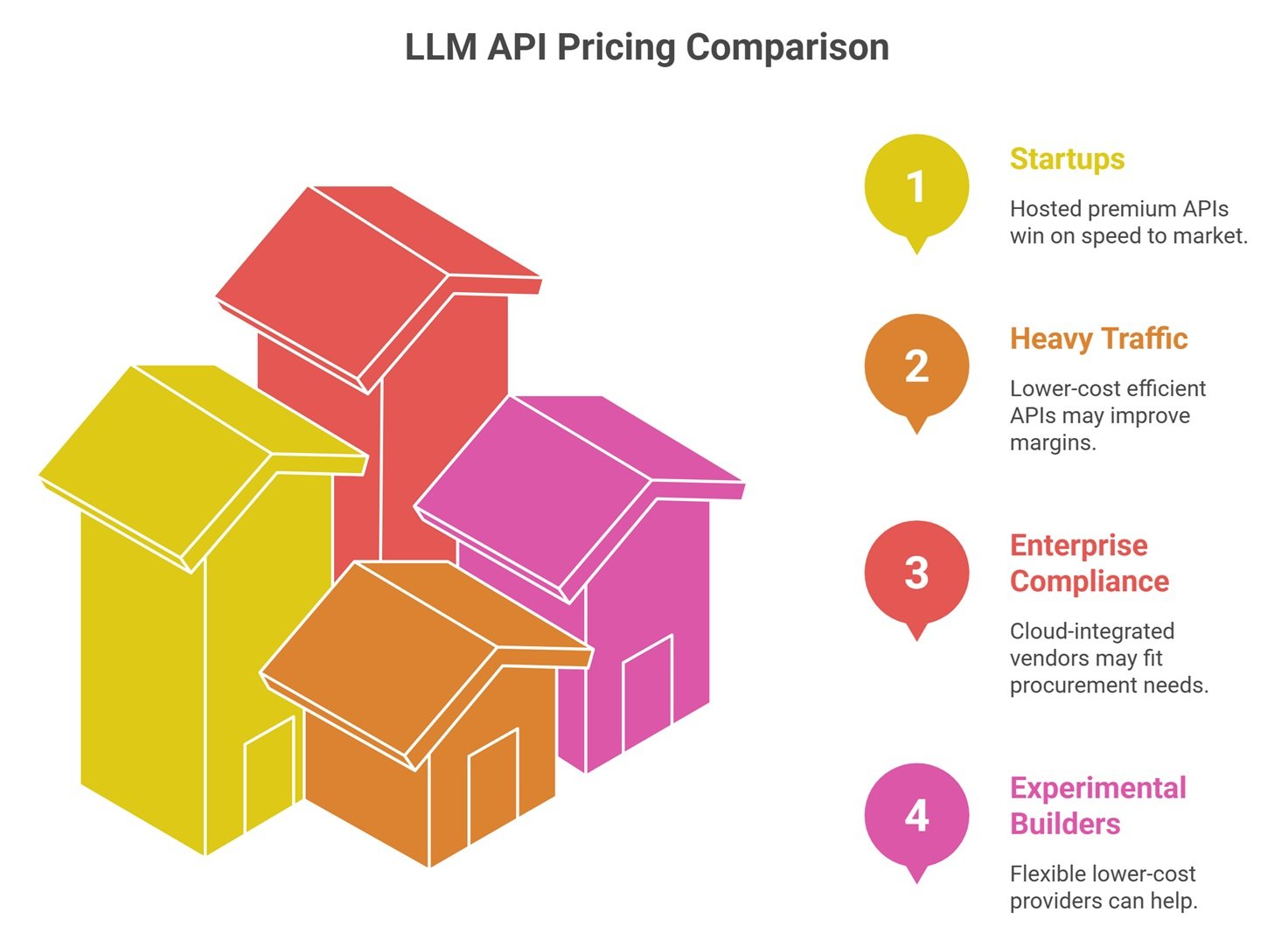
LLM API Pricing Comparison: Best value by use case
Best for Startups Launching Fast
Hosted premium APIs often win on speed to market.
Best for Heavy Traffic Apps
Lower-cost efficient APIs may improve margins.
Best for Enterprise Compliance
Cloud-integrated vendors may fit procurement needs.
Best for Experimental Builders
Flexible lower-cost providers can help.
Easy analogy
Imagine transportation pricing:
- Luxury taxi = premium frontier API
- Standard ride = balanced mainstream API
- Budget cab = efficient provider
- Own vehicle = self-hosted open model
Best choice depends on trip type.
Hidden costs many teams miss
Long Prompts
Large context raises token bills.
Long Outputs
Verbose responses increase spend.
Retries / Failures
Bad prompts can waste requests.
Tool Calls / Agents
Multi-step workflows can multiply cost.
Idle Engineering Time
Cheap API with poor docs can cost team time.
How to lower LLM API Pricing
1. Use Smaller Models for Simple Tasks
Not every request needs premium reasoning.
2. Shorten Prompts
Reduce unnecessary tokens.
3. Limit Output Length
Keep responses efficient.
4. Use Caching
Reuse repeated outputs.
5. Route by Task Difficulty
Cheap model first, premium fallback.
6. Batch Background Jobs
Often better economics.
API Pricing vs Self-hosting
| Factor | API Usage | Self-Hosting |
| Setup Speed | Fast | Slower |
| Upfront Cost | Low | Higher |
| Scaling Cost | Usage based | Infra based |
| Maintenance | Provider handles | You handle |
| Flexibility | Moderate | High |
Many mature teams eventually compare both.
Common Mistakes When Comparing Pricing
Looking Only at Token Price
Quality and speed matter too.
Ignoring Output Costs
Outputs may exceed inputs.
No Real Usage Testing
Estimate with real prompts.
Choosing Cheapest by Default
Poor quality can cost conversions.
Ignoring Vendor Lock-In
Future migration has cost.
How to choose the right API
Blogger / Solo Builder
Prioritize simplicity.
Startup SaaS
Balance margin + quality.
Enterprise
Need governance + support.
AI Product Team
Use multi-model routing strategy.
Developer Testing Ideas
Use low-cost experimental tiers.
Future of LLM API pricing
Expect:
- cheaper efficient models
- premium tiers for advanced reasoning
- more competition
- usage bundles
- dynamic routing platforms
- hybrid API + self-hosted stacks
Pricing pressure will continue.
Suggested Read:
- Closed Source vs Open Source LLMs
- Open Source LLMs
- LLM Deployment Basics
- LLM Serving Explained
- LLM Latency Optimization
- Best LLMs for Coding
FAQ: LLM API Pricing Comparison
Which LLM API is cheapest?
It changes frequently by provider and tier.
Are premium APIs worth it?
Often yes for complex tasks.
Can startups reduce costs?
Yes, by routing simple tasks to cheaper models.
Is self-hosting cheaper?
Sometimes at scale.
How often do prices change?
The AI market changes quickly.
Final takeaway
LLM API pricing is now a strategic business decision, not just a technical detail. The cheapest option is not always best, and the most expensive is not always necessary.
Choose based on real workload economics, output quality, and long-term scale.