

Closed Source vs Open Source LLMs: Which Is Better in 2026?
The AI market now offers two major choices for teams adopting Large Language Models (LLMs):
- Closed source LLMs from commercial providers
- Open source LLMs that can be self-hosted or customized
Both options can deliver strong results, but they differ in cost, control, privacy, setup complexity, and long-term flexibility.
This guide compares closed source vs open source LLMs so businesses, developers, and startups can choose the right path.
In simple terms
Closed Source LLMs
Commercial AI models accessed through hosted platforms or APIs.
Examples may come from:
Open Source LLMs
Models with openly available weights or ecosystems, often used for self-hosting.
Examples may come from:
- Meta Llama ecosystem
- Mistral AI models
- Microsoft Phi family
- Alibaba Group Qwen ecosystem
Why this Comparison Matters
Choosing the wrong model strategy can create:
- higher costs
- weak privacy controls
- slower launches
- vendor lock-in
- poor scalability
- unnecessary complexity
The right choice depends on your goals.
Closed Source vs Open Source LLMs: Quick Comparison Table
| Feature | Closed Source LLMs | Open Source LLMs |
| Setup Speed | Fast | Slower |
| Infrastructure Work | Low | Higher |
| Customization | Moderate | High |
| Privacy Control | Depends on vendor | High |
| Upfront Complexity | Low | High |
| Long-Term Cost at Scale | Can rise | Can be lower |
| Best for Startups | Often yes | Sometimes |
| Best for Internal Secure Systems | Sometimes | Often yes |
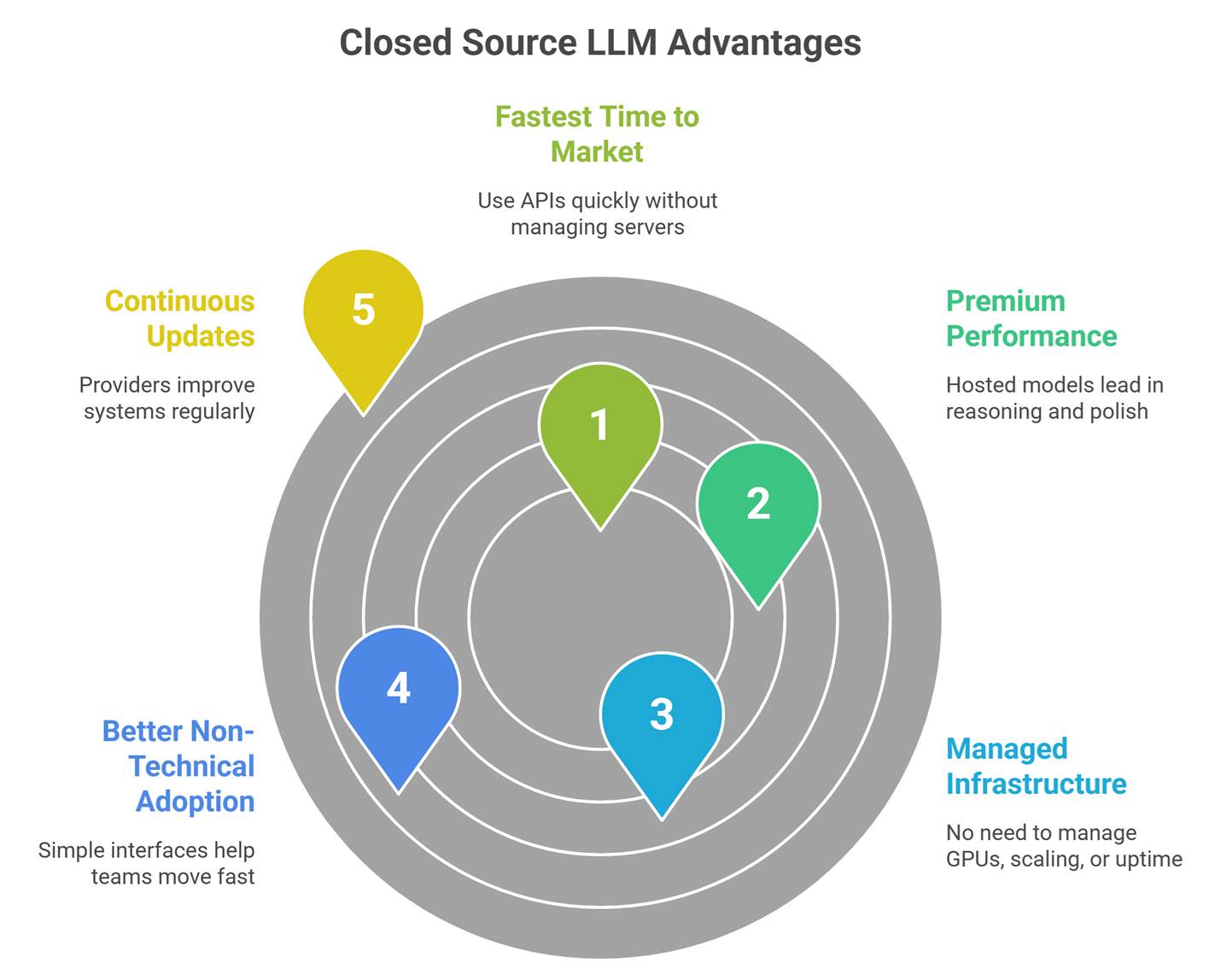
Closed Source LLM Advantages
1. Fastest Time to Market
Use APIs quickly without managing servers.
2. Premium Performance
Many hosted models lead in reasoning and polish.
3. Managed Infrastructure
No need to manage GPUs, scaling, or uptime.
4. Better Non-Technical Adoption
Simple interfaces help teams move fast.
5. Continuous Updates
Providers improve systems regularly.
Closed Source LLM Drawbacks
Usage Costs
Heavy traffic can become expensive.
Vendor Dependence
You rely on one provider.
Limited Control
Customization may be restricted.
Data Governance Concerns
Sensitive industries need careful review.
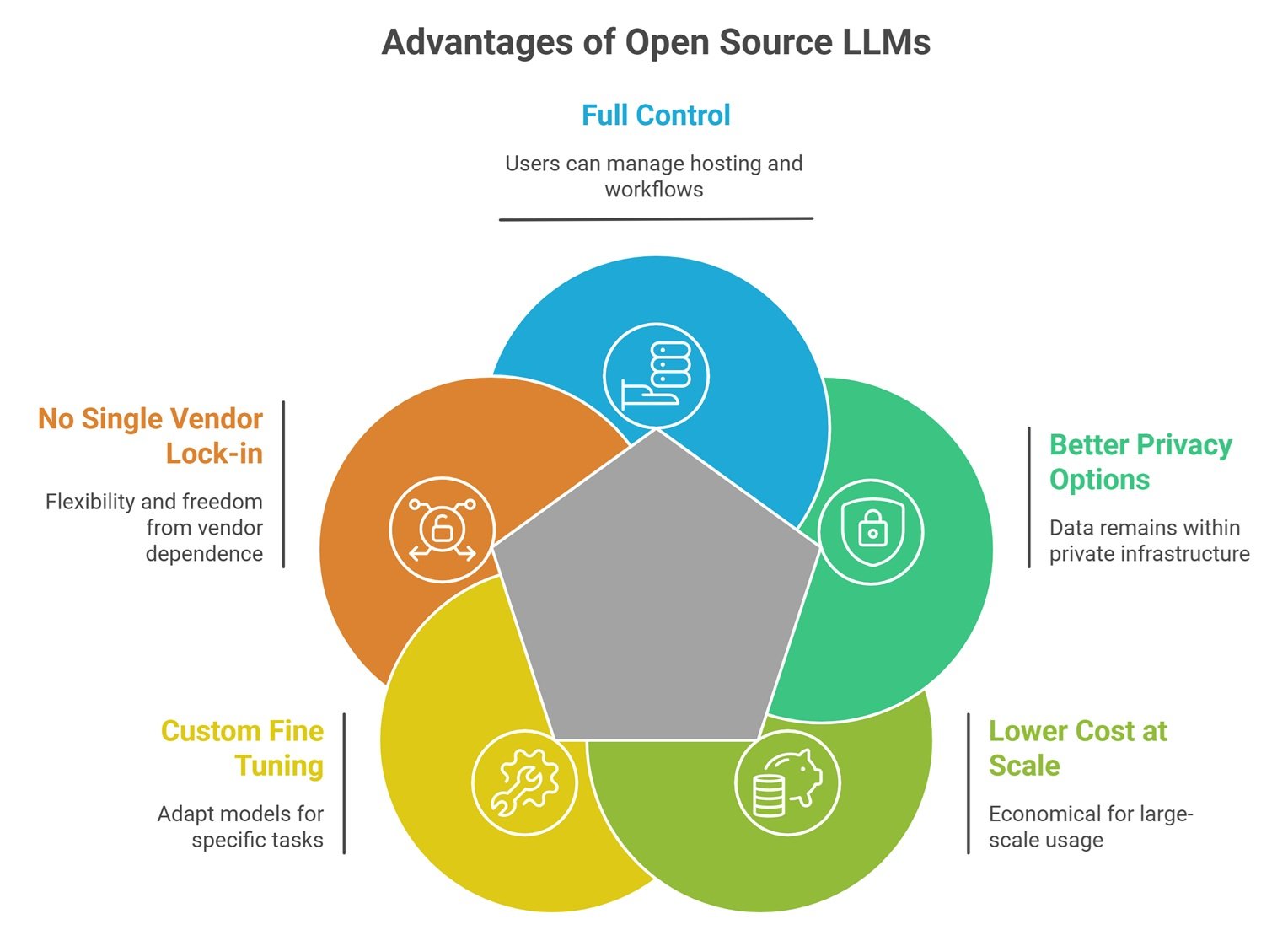
Open Source LLM Advantages
1. Full Control
Choose hosting environment and workflow.
2. Better Privacy Options
Keep data in private infrastructure.
3. Lower Cost at Scale
Can outperform API economics for large usage.
4. Custom Fine Tuning
Adapt models deeply for niche tasks.
5. No Single Vendor Lock-in
More flexibility over time.
Open Source LLM Drawbacks
Higher Setup Complexity
Need infrastructure and engineering.
Operational Maintenance
Monitoring, patching, scaling required.
Performance Variation
Best model depends on tuning and hardware.
Slower Initial Launch
Takes longer than using APIs.
Easy analogy
Think of transportation:
- Closed source = ride-sharing app
- Open source = owning your own vehicle fleet
Ride-sharing is easy fast access.
Owning vehicles gives long-term control.
Best choice by user type
Startup MVP
Closed source often wins for speed.
Enterprise with Sensitive Data
Open source may win for privacy.
Solo Builder
Closed APIs often easiest.
AI Product at Scale
Hybrid or open source can improve margins.
Research Teams
Open models allow experimentation.
Closed Source vs Open Source LLMs: Real Use Cases
Closed Source Wins
- quick chatbot launch
- content generation SaaS
- coding copilots with fast deployment
- business productivity tools
Open Source Wins
- on-prem enterprise assistant
- regulated industry workflows
- internal document search
- local private AI systems
Hybrid strategy is growing
Many smart companies use both.
Example:
- Open source model handles routine tasks
- Closed model handles premium reasoning tasks
Benefits:
- lower cost
- better privacy balance
- stronger flexibility
Cost comparison mindset
Closed Source
Usually easier short-term cost model.
Pay per usage.
Open Source
May require upfront infrastructure but better unit economics later.
Real answer depends on traffic volume.
Common mistakes when choosing
Choosing only by hype
Use case matters more.
Ignoring compliance
Especially in regulated industries.
Underestimating engineering time
Open source requires operations.
Ignoring long-term cost curves
API growth can surprise teams.
Future trend in 2026+
Expect:
- stronger open models
- premium closed reasoning systems
- more hybrid stacks
- enterprise private AI growth
- cheaper inference hardware
- model routing across vendors
The market is moving toward choice, not one winner.
Suggested Read:
- Open Source LLMs
- Open Source LLMs for Local Use
- LLM Deployment Basics
- LLM Serving Explained
- LLM Fine Tuning Basics
- Best LLMs for Coding
FAQ: Closed Source vs Open Source LLMs
Which is better: open or closed source LLMs?
Depends on cost, privacy, speed, and internal expertise.
Are open source LLMs free?
Models may be free, but hosting costs money.
Are closed source LLMs more powerful?
Some often lead in polish and reasoning, but gaps are narrowing.
Which is better for startups?
Often closed APIs early, hybrid later.
Which is better for enterprises?
Many use hybrid strategies.
Final takeaway
Closed source vs open source LLMs is not a battle with one winner. It is a strategic choice.
Choose closed source for speed and convenience. Choose open source for control and privacy. Choose hybrid if you want the strengths of both.