
Prompt Chaining Explained: How to Build Better AI Workflows
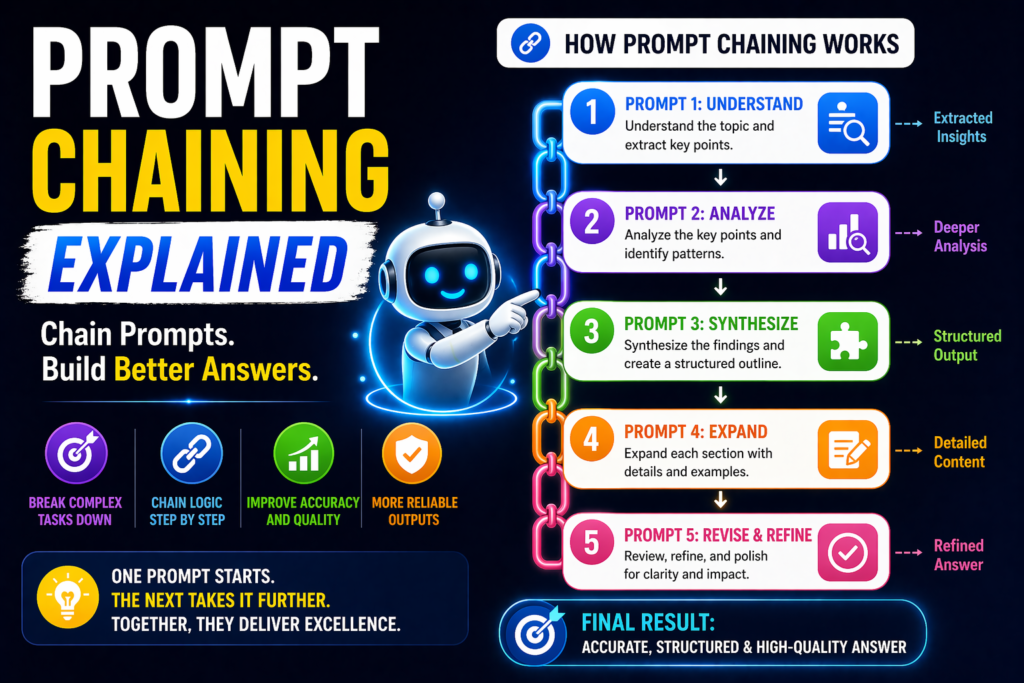
Prompt chaining is a powerful way to get better AI outputs by breaking one large task into smaller connected prompts.
Instead of asking AI to do everything in one request, you create a sequence where each output becomes the input for the next step.
This method improves quality, accuracy, and control.
In this guide, you’ll learn what prompt chaining is, how it works, when to use it, and how to build effective chains.
In simple terms
Prompt chaining means:
One task = multiple prompts in sequence.
Instead of:
“Write a complete blog post about AI tools.”
Use:
- Generate blog outline
- Write introduction
- Expand sections
- Edit for SEO
- Final polish
That workflow usually performs better than one large prompt.
What is Prompt Chaining?
Prompt chaining is a prompt engineering technique where a complex task is split into multiple smaller prompts linked together.
Each step has a focused objective, such as:
- research
- summarize
- classify
- write
- review
- format
The output of one step becomes the input for the next.
This creates more reliable and controllable results.
Why Prompt Chaining Works
Large tasks often fail because they ask AI to do too much at once.
Prompt chaining improves results by:
- reducing complexity
- improving focus
- allowing step-by-step refinement
- lowering hallucinations
- making outputs easier to review
It turns AI into a workflow engine instead of a one-shot tool.
Simple Prompt Chaining Examples
Example 1: Blog Writing
Step 1: Create outline on AI tools for students
Step 2: Write intro using outline
Step 3: Expand each section
Step 4: Add SEO title and meta description
Step 5: Proofread final draft
Example 2: Research Workflow
Step 1: Summarize article
Step 2: Extract key findings
Step 3: Compare with another source
Step 4: Create final report
Example 3: Coding Workflow
Step 1: Generate code structure
Step 2: Write functions
Step 3: Debug errors
Step 4: Optimize performance
Example 4: Customer Support
Step 1: Classify customer issue
Step 2: Draft response
Step 3: Adjust tone
Step 4: Final quality check
Best use cases for Prompt Chaining
Prompt chaining works best for:
1.Long-form content
Blogs, reports, ebooks.
2.Research tasks
Summaries, comparisons, notes.
3.Coding projects
Build, debug, optimize.
4.Automation systems
Support tickets, lead handling.
5.Multi-step reasoning
Complex planning and decisions.
Prompt Chaining vs Single Prompts
| Method | How It Works | Best For |
| Single Prompt | One request | Quick simple tasks |
| Prompt Chaining | Multi-step workflow | Complex tasks |
| Few Shot Prompting | Uses examples | Consistency |
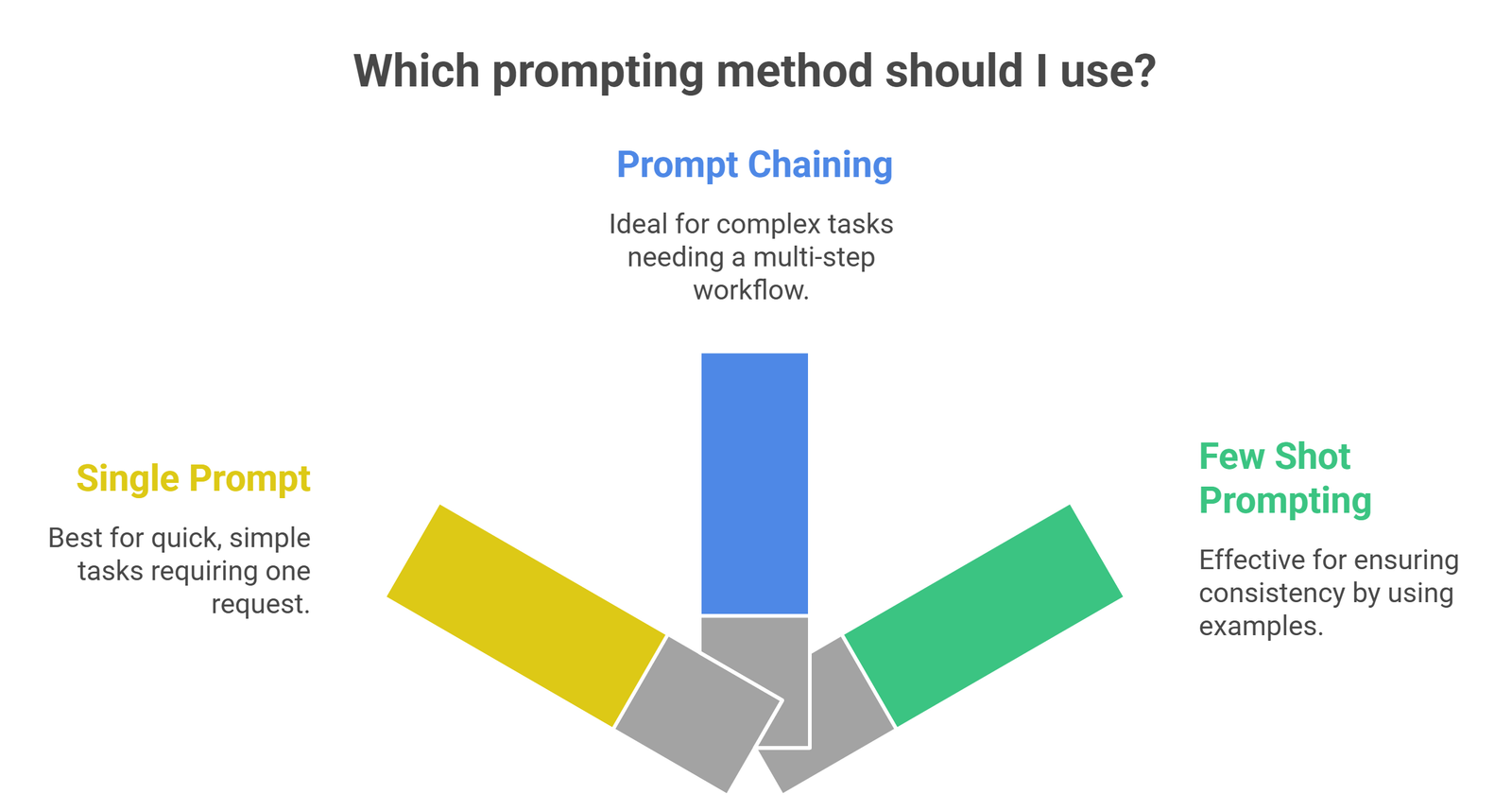
If one large prompt feels weak, switch to chaining.
How to build better prompt chains
1.Split tasks logically
Break work into clear stages.
Example:
Research → Draft → Edit
2.Keep each step focused
Each prompt should solve one job.
3.Review outputs between steps
Correct issues before continuing.
4.Use structured outputs
Examples:
- bullet lists
- tables
- JSON
5.Automate repeated chains
Great for recurring workflows.
Common mistakes
Too many steps
Unnecessary complexity slows work.
Weak first step
Bad early outputs damage later stages.
No quality checks
Errors can multiply across chain steps.
Overlapping prompts
Unclear stages reduce efficiency.
Using chains for simple tasks
Not every request needs a workflow.
Copy-paste prompt chain templates
Writing Chain
- Create outline for [topic]
- Write first draft
- Improve readability
- Optimize for SEO
- Final edit
Coding Chain
- Plan architecture
- Generate code
- Test logic
- Refactor
- Document code
Research Chain
- Summarize sources
- Extract insights
- Compare findings
- Create report
Business Chain
- Identify problem
- Generate solutions
- Compare options
- Recommend action plan
When not to use prompt chaining
It may be unnecessary for:
- quick facts
- short emails
- simple summaries
- translations
- one-step creative prompts
Use it when complexity increases.
Suggested Read:
- What Is Prompt Engineering? Complete Beginner Guide
- Few Shot Prompting Explained
- Reflective Prompting Explained
- Prompt Engineering Workflow Step by Step
- Prompt Engineering Best Practices
- ChatGPT Prompting Guide
FAQ: Prompt Chaining
What is prompt chaining?
A method where multiple prompts are linked together to complete one task.
Does prompt chaining improve quality?
Often yes, especially for complex workflows.
Is it useful for ChatGPT?
Yes. It is excellent for writing, coding, and research.
Can I automate prompt chains?
Yes. Many AI tools and agents use chained prompts.
Final takeaway
Prompt chaining is one of the most practical prompt engineering techniques because it transforms AI from a single-response tool into a step-by-step workflow system.
For writing, coding, research, and business automation, it often outperforms one large prompt.
If tasks feel messy, break them into chains.