
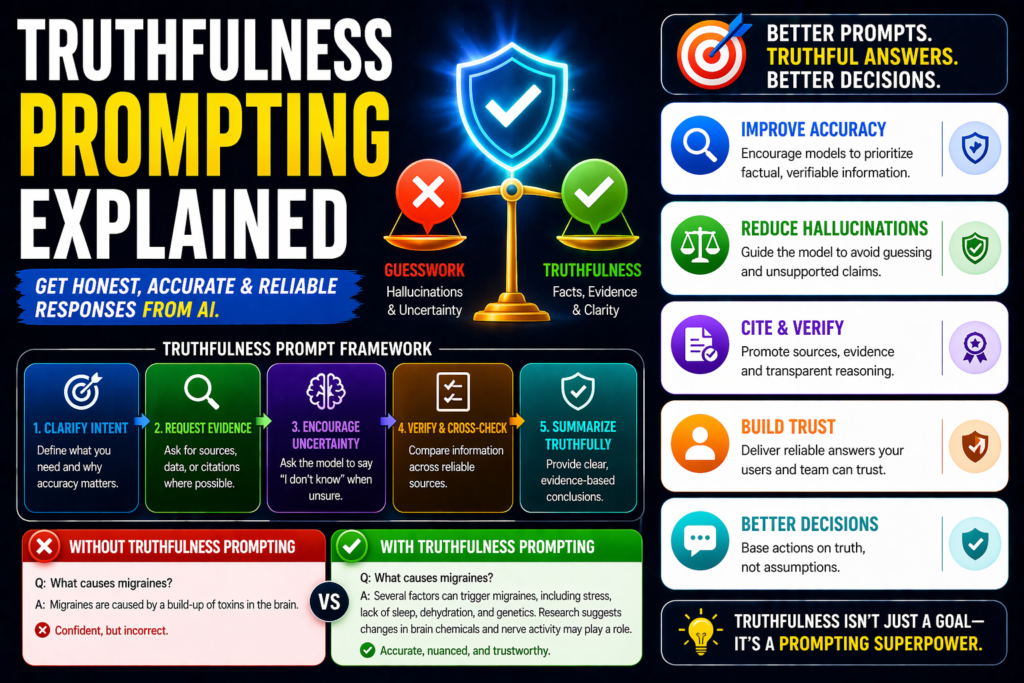
Truthfulness Prompting Explained: Meaning, Examples, and How It Works
AI models can produce fluent answers even when facts are weak or uncertain. That is why truthfulness prompting has become an important prompt engineering technique.
Truthfulness prompting means designing prompts that encourage the model to prioritize accuracy, admit uncertainty, avoid guessing, and separate facts from assumptions.
This guide explains what truthfulness prompting is, how it works, examples, benefits, and best practices for ChatGPT, Claude, Gemini, and other AI tools.
In simple terms
Truthfulness Prompting means:
Asking AI to be accurate, cautious, and honest about uncertainty.
Instead of:
“Give me the answer quickly.”
Use:
“Answer only if confident. If uncertain, say what is unknown and suggest how to verify.”
Why Truthfulness Prompting Matters
Many users focus on speed and style. But for research, business, coding, and education, truth matters more than fluent wording.
Truthfulness prompting helps:
- reduce hallucinations
- improve factual accuracy
- expose uncertainty
- separate evidence from guesses
- build user trust
- improve decision-making
This is especially useful for high-stakes tasks.
How Truthfulness Prompting Works
Language models predict likely text. They do not automatically “know” when certainty is low.
A truthfulness-focused prompt nudges the model to:
- verify internally before answering
- avoid invented details
- mention confidence limits
- ask clarifying questions
- state assumptions clearly
- recommend sources when needed
This often improves practical reliability.
Truthfulness Prompting Examples
1.Factual Q&A
Weak prompt:
“Who invented this technology?”
Better prompt:
“Answer only with well-supported facts. If uncertain, say uncertainty clearly.”
2.Research Summary
Prompt:
“Summarize this topic using only broadly accepted facts. Separate evidence, debate, and unknowns.”
3.Business Decision Support
Prompt:
“Recommend an option, but list assumptions and risks before concluding.”
4.Coding Help
Prompt:
“Provide code only if syntax is likely correct. Mention any uncertain library versions.”
5.Historical Question
Prompt:
“Answer using commonly accepted historical evidence. Note disputed claims separately.”
When to use Truthfulness Prompting
Truthfulness prompting works best for:
Research Tasks
Reports, market studies, comparisons.
Learning & Education
Study help, exam prep, explanations.
Business Decisions
Strategy, operations, investments.
Coding & Technical Tasks
Debugging, architecture, implementation advice.
Health, Legal, Finance Support
For general guidance only—always verify with professionals.
Truthfulness Prompting vs Standard Prompting
| Method | Focus | Typical Output |
| Standard Prompting | Fast response | Fluent but may overstate |
| Truthfulness Prompting | Accuracy and uncertainty | More cautious and reliable |
Truthfulness prompts often trade speed for trustworthiness.
Benefits of Truthfulness Prompting
1.Fewer hallucinations
Reduces invented claims.
2.Better transparency
Shows uncertainty clearly.
3.Stronger decisions
Better for professional use.
4.More trustworthy outputs
Useful for teams and clients.
5.Better follow-up questions
The model may request missing context.
Limitations of truthfulness prompting
1.Not perfect accuracy
Prompts help, but do not guarantee truth.
2.More cautious answers
Some responses may feel less direct.
3.Needs clear context
Weak inputs still reduce quality.
4.Verification still required
Especially for critical topics.
Best practices for Truthfulness Prompting
Ask for uncertainty disclosure
Example:
“If unsure, say so clearly.”
Separate facts from assumptions
Useful for planning tasks.
Request confidence levels
Example:
“Rate confidence: high, medium, low.”
Ask for sources or verification paths
Useful for research.
Encourage clarifying questions
If context is missing.
Copy-paste Truthfulness Prompt Templates
General Accuracy Prompt
“Answer accurately. If uncertain, state uncertainty and avoid guessing.”
Research Prompt
“Use well-supported facts only. Separate known facts, assumptions, and open questions.”
Decision Prompt
“Recommend an option, but list risks and unknowns first.”
Coding Prompt
“Provide likely-correct code and note version assumptions.”
Common mistakes
- asking for speed over accuracy
- forcing certainty on uncertain topics
- ignoring caveats
- not verifying critical claims
- using vague questions with missing context
Suggested Read:
- What Is Prompt Engineering? Complete Beginner Guide
- Prompt Evaluation Methods
- Testing Prompts Systematically
- Prompt Engineering Best Practices
- Structured Prompting Guide
- Prompts for Question Answering
FAQ: Truthfulness Prompting Explained
What is truthfulness prompting?
It is prompting AI to prioritize accuracy, caution, and honesty about uncertainty.
Does it stop hallucinations completely?
No, but it can reduce them significantly.
Which tools support it?
ChatGPT, Claude, Gemini, and most modern LLMs.
Should I still fact-check outputs?
Yes, especially for medical, legal, financial, or business-critical topics.
Final takeaway
Truthfulness prompting is one of the most practical prompt engineering methods for real-world AI use. It encourages models to be accurate, transparent, and careful instead of confidently wrong.
Use it whenever decisions, learning, or trust matter more than speed.