
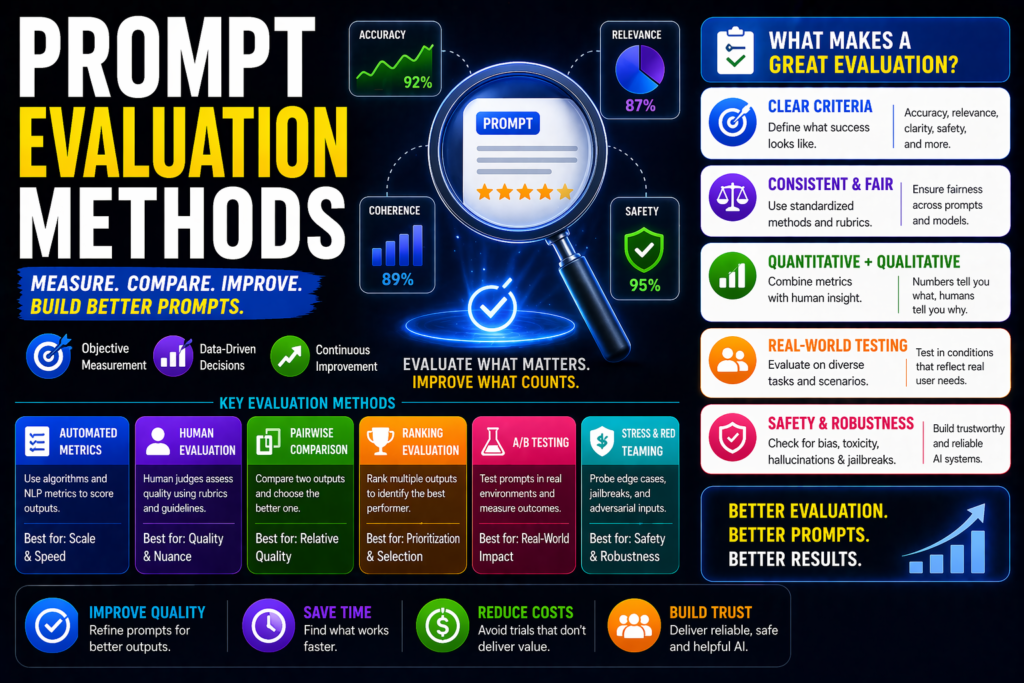
Prompt Evaluation Methods: How to Test and Improve AI Prompts
Writing a prompt is only the first step. If you want reliable AI results, you need to evaluate prompts systematically. Many teams use prompts in customer support, content creation, coding, analytics, and automation—but never measure whether those prompts actually perform well.
That creates inconsistent outputs, wasted time, and weak ROI.
This guide explains the best prompt evaluation methods for ChatGPT, Claude, Gemini, and custom AI workflows so you can improve prompts with real data.
In simple terms
Prompt evaluation means:
Testing prompts against clear criteria to see which version performs best.
Instead of guessing which prompt is better, you compare outputs using metrics.
Why Prompt Evaluation Matters
Top prompt users do not rely on intuition alone. They test prompts repeatedly.
Good evaluation helps you:
- improve output quality
- reduce hallucinations
- increase consistency
- lower token costs
- speed up workflows
- scale AI operations confidently
What should you measure?
Before choosing a method, define success.
Common prompt metrics include:
- accuracy
- relevance
- completeness
- clarity
- consistency
- safety
- speed
- token cost
- user satisfaction
Different tasks need different metrics.
Example:
A coding prompt values correctness.
A marketing prompt values persuasion and tone.
Best Prompt Evaluation Methods
1.Human Review Scoring
Ask reviewers to score outputs from 1–5.
Criteria:
- accuracy
- usefulness
- tone
- readability
Best for content, support, and business tasks.
2.A/B Prompt Testing
Compare two prompt versions using the same inputs.
Example:
Prompt A = short instruction
Prompt B = structured instruction with examples
Measure which performs better.
3.Golden Dataset Testing
Create a fixed set of test inputs with expected outputs.
Run prompts against the same benchmark regularly.
Best for:
- classification
- extraction
- coding
- support routing
4.Pass/Fail Checklists
Use binary checks:
- correct format?
- answered question?
- no policy issue?
- includes required fields?
Simple and scalable.
5.Automated LLM-as-Judge
Use another model to score outputs against rules.
Example:
“Rate this answer for relevance from 1–10.”
Useful for high-volume testing, but should be validated.
6.User Feedback Loops
Collect signals such as:
- thumbs up/down
- edits required
- satisfaction score
- completion rate
Great for real-world optimization.
7.Cost Efficiency Testing
Measure:
- tokens used
- latency
- retries needed
Sometimes the best prompt is cheaper, not just smarter.
8.Consistency Testing
Run the same prompt multiple times.
Check whether outputs remain stable.
Important for production workflows.
9.Edge Case Testing
Test difficult scenarios:
- vague input
- conflicting data
- missing fields
- adversarial wording
Strong prompts handle edge cases better.
10.Regression Testing
When updating prompts, test old benchmark cases again.
This prevents improvements in one area from breaking another.
Example prompt scorecard
| Metric | Prompt A | Prompt B |
| Accuracy | 7/10 | 9/10 |
| Speed | Fast | Medium |
| Cost | Low | Medium |
| Format Compliance | 80% | 98% |
| User Preference | 55% | 78% |
Prompt B may be worth using despite higher cost.
How to Evaluate Prompts step by step
1.Define the task
Examples:
- summarize calls
- classify tickets
- generate blogs
- answer FAQs
2.Build test inputs
Use real examples.
3.Create success metrics
What matters most?
4.Compare prompt versions
Test multiple approaches.
5.Score results
Use humans, automation, or both.
6.Iterate prompts
Improve wording, structure, examples, constraints.
7.Monitor production
Evaluation should continue after launch.
Common Prompt Evaluation Mistakes
- testing only one example
- no defined metrics
- choosing prompts by personal opinion
- ignoring cost and latency
- no regression testing
- no real user feedback
Copy-paste Prompt Evaluation Template
Task: Support ticket classification
Inputs: 100 historical tickets
Metrics:
- accuracy
- routing correctness
- response speed
- cost per run
Compare:
- Prompt A
- Prompt B
- Prompt C
Choose highest overall performer.
Suggested Read:
- What Is Prompt Engineering? Complete Beginner Guide
- Prompt Engineering Best Practices
- Reusable Prompt Templates
- Structured Prompting Guide
- How to Evaluate an AI Agent Before Production
- System Prompt Examples
FAQ: Best Prompt Evaluation Methods
What are prompt evaluation methods?
They are systems for testing how well prompts perform.
Which method is best?
Usually a mix of human review, A/B testing, and benchmark datasets.
Should small teams evaluate prompts?
Yes. Even simple scorecards improve quality.
How often should prompts be tested?
Continuously, especially after model or workflow changes.
Final takeaway
Strong prompts are not guessed—they are tested. The best prompt evaluation methods combine metrics, real examples, and iteration.
If AI matters to your business, treat prompts like product assets. Measure them, improve them, and monitor them over time.
Pingback: How to Test AI Prompts Before You Trust the Output