
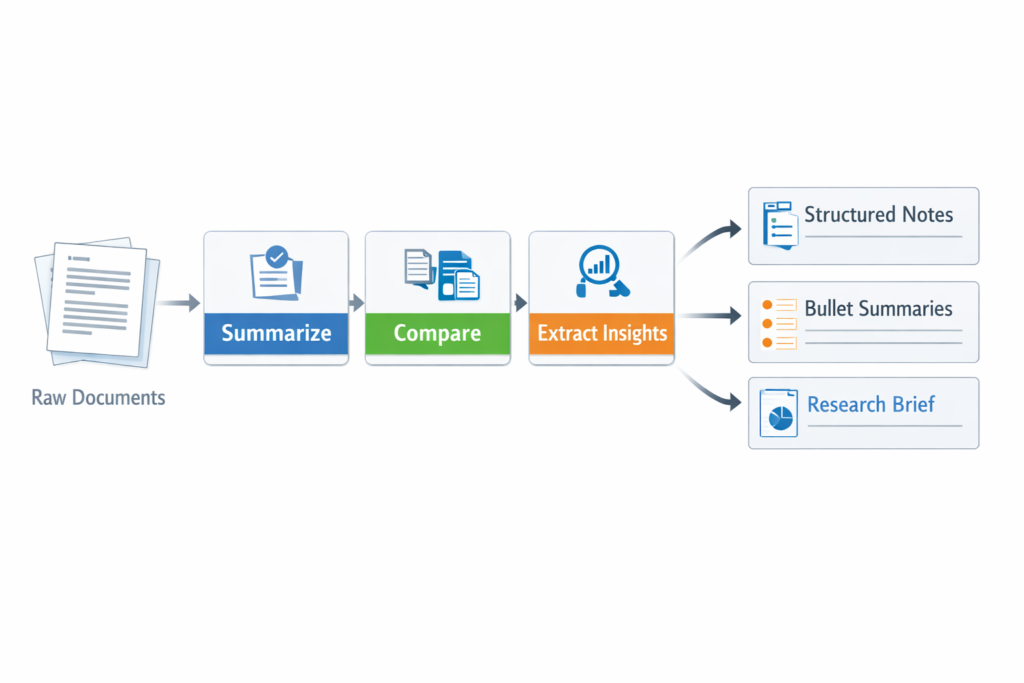
Best Prompt Templates for Summarization and Research
The best prompt templates for summarization and research help AI turn messy information into something usable. A strong template does not just ask for a summary. It defines the goal, audience, depth, format, and limits. That is what makes the output more reliable for study notes, literature reviews, market research, article drafting, and source comparison.
In simple terms
A prompt template is a reusable instruction pattern. Instead of writing a new prompt from scratch every time, you keep a structure that already works and swap in the topic, source, or objective.
For summarization and research, this matters because the tasks repeat often. You may need to summarize a paper, compare articles, extract key findings, turn notes into a brief, or identify gaps in a topic. A good template saves time and produces more consistent output.
Templates for Standardizing Research Summaries
For academics and analysts, consistency is key. Using standard templates for summarizing research papers ensures that every study you analyze is parsed into the exact same structural components.
Here is a high-performance research article summary template built for tool frameworks:
The Academic Standardization Template
[Role]: Act as an elite academic research assistant.
[Task]: Analyze the provided research paper and generate a standardized summary.
[Context]: I am building a literature review repository and need strict visual formatting.
[Constraints]: Do not use complex jargon. Keep explanations accessible but highly precise.
[Format]: Structure your output exactly like this markdown schema:
– **Core Hypothesis:** (1-2 sentences explaining what the study tests)
– **Methodology:** (A brief bulleted list of the exact testing environment or data models)
– **Key Findings:** (3 high-impact data takeaways or research conclusions)
– **Limitations:** (Any boundaries or sample limitations mentioned by the authors)
[Insert Text Here]
This structure provides a reliable summary prompt framework that strips out conversational filler, making it the best prompt for summarizing a research paper down to its pure architectural truth.
Why prompt templates work better than one-off prompts
- Many weak prompts fail because they are too vague. “Summarize this” gives the model very little direction. It does not explain who the summary is for, what details matter, how long it should be, or what structure you want.
- Templates solve that by forcing clarity. They also reduce repeated effort. Once you find a structure that works for research or summarization, you can reuse it across papers, reports, PDFs, interviews, blog research, or internal notes.
For most users, the goal is not to create the most complex prompt. It is to create a prompt that is easy to reuse and hard to misunderstand.
What makes a good summarization or research prompt?
A useful template usually includes five parts:
- the task
- the source or context
- the audience
- the constraints
- the output format
A simple formula is: Role + task + source + constraints + format
For example:
“Act as a research assistant. Summarize the text below for a beginner reader. Focus on the main argument, methods, findings, and limitations. Keep it under 200 words and return the output in 4 bullet points.”
That prompt works better because it defines what matters.
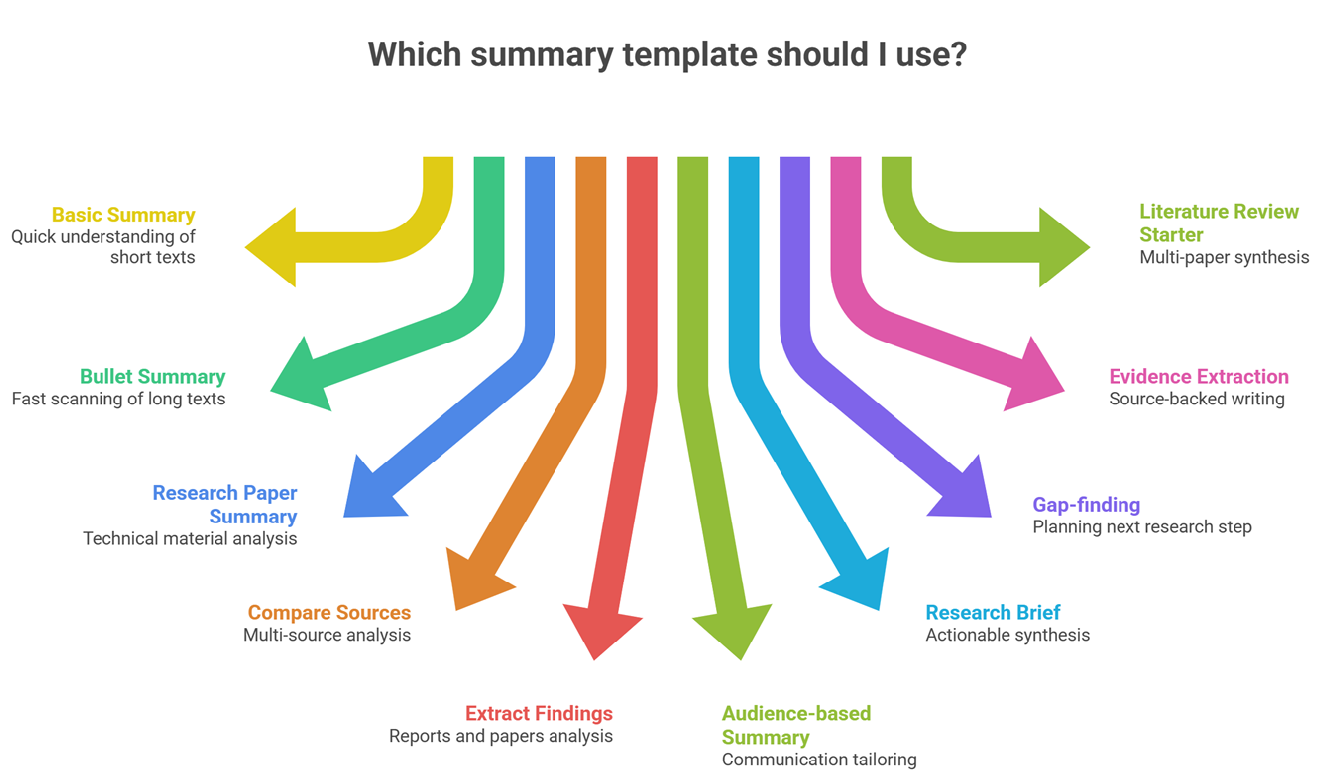
Best prompt templates for summarization and research
1. Basic summary template: Use this when you want a quick, clean summary.
Template:
“Summarize the text below in simple language. Focus on the main idea, key supporting points, and conclusion. Keep it under [word count] words.”
Best for:
articles, blog posts, notes, lecture content
2. Bullet-point summary template: Use this when you want faster scanning.
Template:
“Summarize the text below in [number] bullet points. Each bullet should cover one key idea. Avoid jargon and keep each point concise.”
Best for:
study notes, executive summaries, revision sheets
3. Research paper summary template: Use this for papers and technical articles.
Template:
“Summarize this research paper for a beginner reader. Include: problem statement, method, key findings, limitations, and practical relevance. Keep the explanation clear and avoid unnecessary technical language.”
Best for:
paper reviews, literature scanning, research blogs
4. Compare multiple sources template: Use this when you need differences, not just summaries.
Template:
“Compare the following sources on [topic]. Identify where they agree, where they differ, and what unique insight each source adds. Return the answer as a table with columns: Source, Main Claim, Strength, Limitation.”
Best for:
literature reviews, competitive research, topic analysis
5. Extract key findings template: Use this when the source is dense and you need only the important outcomes.
Template:
“Read the text below and extract the most important findings. For each finding, include a short explanation of why it matters.”
Best for:
reports, academic papers, market research
6. Summarize for a specific audience template: Use this when the same material must be explained differently.
Template:
“Summarize the text below for [audience]. Explain the topic in a way that matches their level of knowledge. Focus on what they need to understand first.”
Best for:
students, executives, beginners, technical teams
7. Source-grounded research brief template: Use this when you want something closer to a usable brief.
Template:
“Act as a research analyst. Based only on the source material below, create a brief on [topic]. Include: overview, key insights, evidence from the source, unanswered questions, and next steps for research.”
Best for:
content planning, business research, internal memos
8. Gap-finding template: Use this to identify missing areas in your research.
Template:
“Review the material below and identify what questions remain unanswered. List the gaps, why they matter, and what additional information would help close them.”
Best for:
research planning, content gaps, follow-up investigation
9. Quote and evidence extraction template: Use this when you want traceable support.
Template:
“Extract the most useful evidence from the text below. Return key claims with supporting quotes or passages, then explain what each one means in plain language.”
Best for:
source-backed writing, academic work, content research
10. Structured literature review starter template: Use this when you need to organize several papers fast.
Template:
“Review the following papers on [topic]. For each one, identify the research question, method, main finding, limitation, and relevance to the broader topic. Then summarize the overall pattern across all papers.”
Best for:
literature reviews, synthesis notes, background research
Comparison table: Which template should you use?
| Template type | Best use case | Output style |
| Basic summary | Quick understanding | Short paragraph |
| Bullet summary | Fast scanning | Bullet points |
| Research paper summary | Technical material | Structured explanation |
| Compare sources | Multi-source analysis | Table |
| Extract findings | Reports and papers | Key insights list |
| Audience-based summary | Communication tailoring | Audience-specific |
| Research brief | Actionable synthesis | Brief/report |
| Gap-finding | Planning next research step | Question list |
| Evidence extraction | Source-backed writing | Claims plus support |
| Literature review starter | Multi-paper synthesis | Structured review |
How to Summarize Dense Technical Documents into Simple Language
A primary challenge in prompt engineering templates development is translating complex systems into plain terms. When figuring out what prompts get ai to summarize dense technical documents into simple language, the secret lies in setting a clear target audience constraint within your instruction.
Try using this summarizing template for technical translations:
“Act as a technical educator. Review the following text and explain the core mechanism using simple language appropriate for a non-technical stakeholder. Avoid industry acronyms.”
What is the Most Important Factor in a Summarization Prompt?
When developing a summarization prompt example, developers often wonder what element is most critical for success.When creating a prompt to summarize text content, what is most important?
The answer is clarity of constraints. Rather than writing an open-ended question, you must ensure the prompt strictly specifies the desired length, format, and target style of the summary. For example, a crisp what is an example of a prompt designed for text summarization? query looks like this:
“Summarize the following passage in exactly one sentence: [Insert text].” This level of constraint prevents the AI from generating generalized paragraphs or omitting key boundaries.
Real-world use cases
A student can use the research paper template to turn dense journal articles into readable study notes.
A blogger can use the compare-sources template to organize multiple references before drafting a long-form article.
A market researcher can use the research brief template to transform scattered reports into a clean working memo.
A founder can use the gap-finding template to see what is still unclear before making a product or market decision.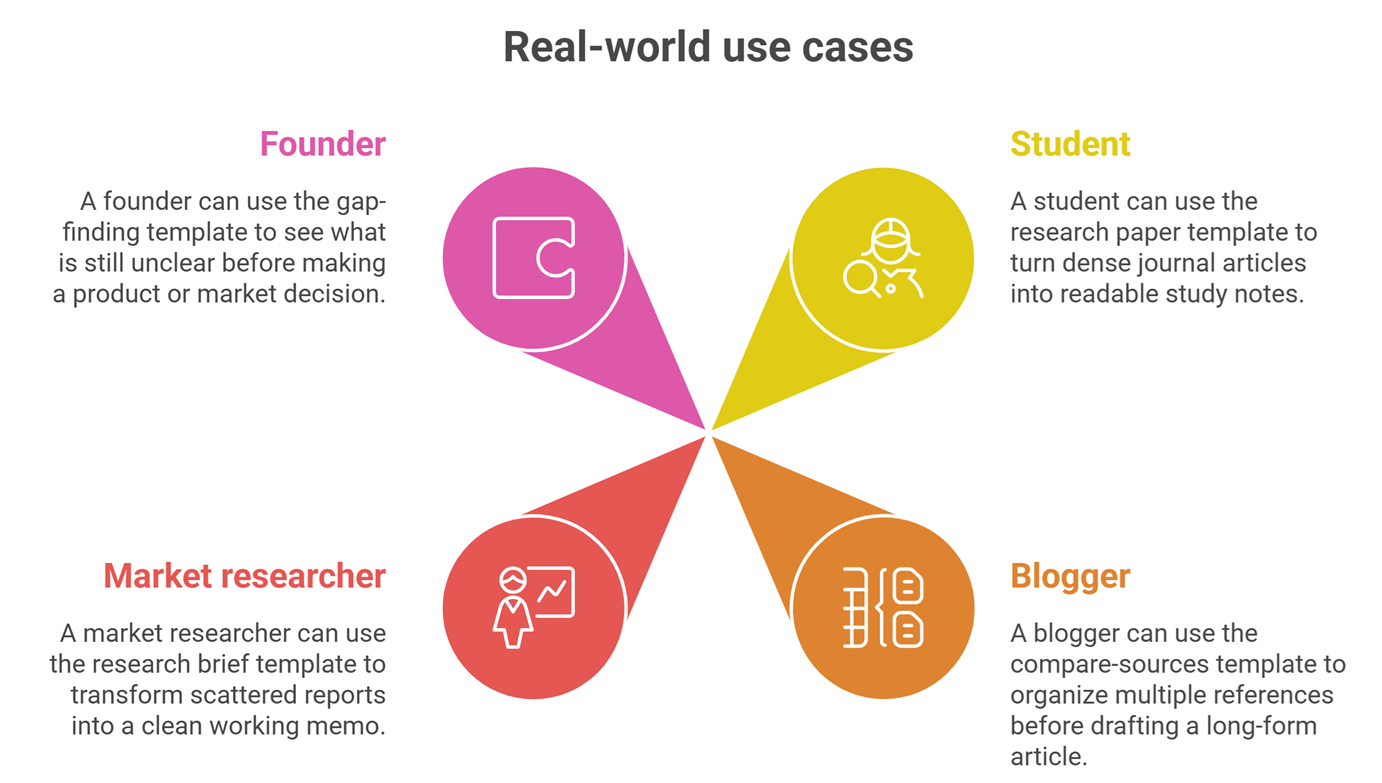
In each case, the value comes from asking for the right output shape, not just asking for a generic summary.
Common mistakes to avoid
- One mistake is using a summarization prompt when you actually need comparison or extraction. Not every research task is a summary task.
- Another mistake is failing to define the audience. A summary for a technical reader should not look the same as a summary for a beginner.
- A third mistake is not limiting the source scope. If you want source-grounded output, say “based only on the text below.” That reduces unsupported additions.
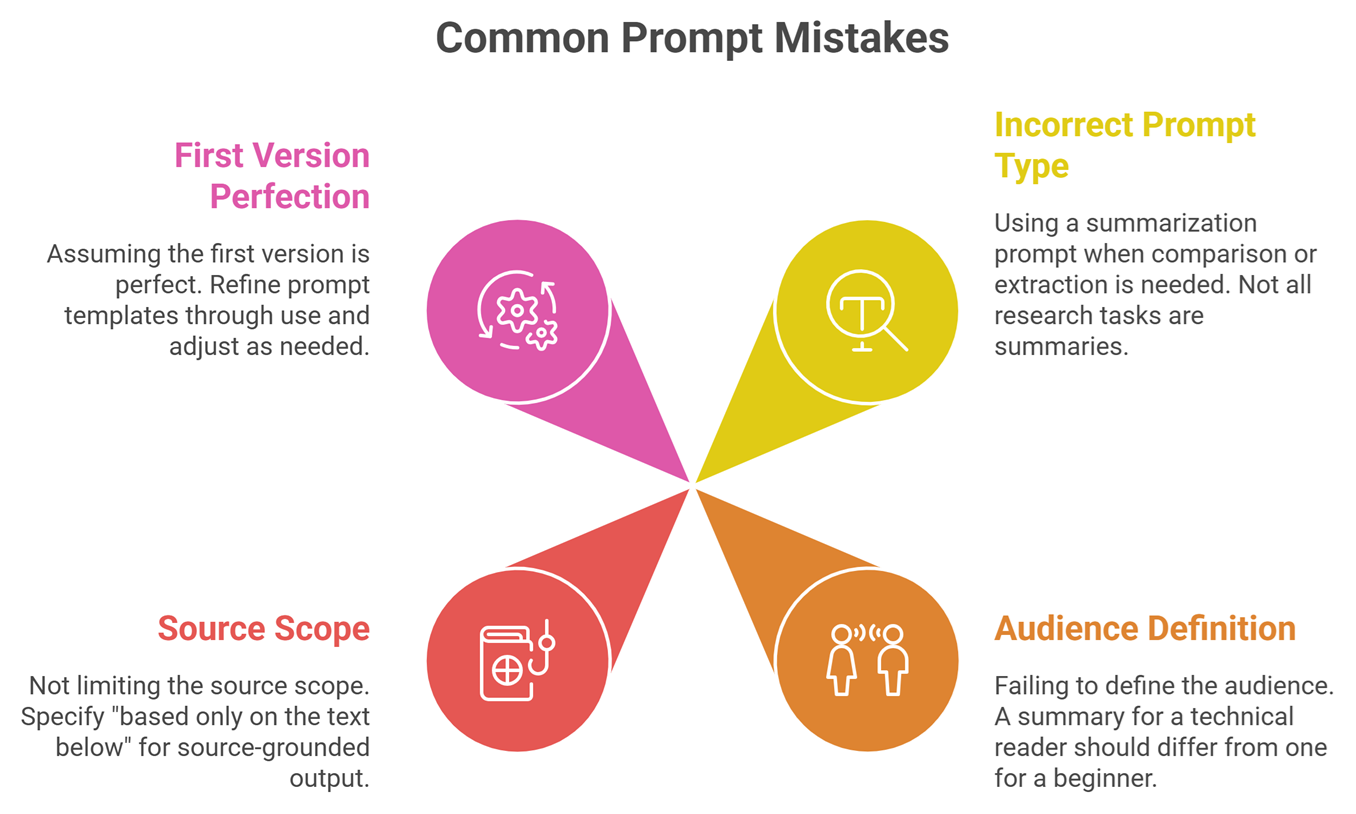
Finally, do not assume the first version is perfect. Good prompt templates are often refined through use. If the output is too broad, shorten it. If it misses limitations, add that field directly.
Suggested Read:
- Prompt Engineering for Beginners: A Practical Guide
- 25 Prompt Engineering Techniques With Examples
- Zero-Shot vs Few-Shot Prompting Explained
- What Is a Large Language Model? Explained Simply
- What Is RAG in AI? A Beginner-Friendly Guide
FAQ: Best Prompt Templates for Summarization and Research
What is the best prompt for summarization?
The best prompt depends on the task. A basic summary prompt works for short articles, while a research paper template is better for technical content.
How do I make AI summaries more useful?
Define the audience, length, focus areas, and output format. Generic prompts usually create generic summaries.
What is the best prompt template for research?
A strong research template asks for structured output such as key insights, evidence, limitations, unanswered questions, and next steps.
Should I use the same template for every source?
No. Use different templates for summarizing, comparing, extracting evidence, or planning further research.
Can prompt templates reduce hallucinations?
They can reduce vague output, especially when you ask the model to stay grounded in provided source material, but they do not remove the need for verification.
Final takeaway
The best prompt templates for summarization and research are the ones that make the task specific. Instead of asking AI to “summarize this,” ask it what kind of summary you need, for whom, and in what format. That small shift is what turns AI from a generic assistant into a practical research tool.