AI News


Latest Artificial Intelligence News | AI Trends & Updates


Artificial Intelligence is evolving faster than any technology in history. From breakthroughs in large language models to real-world AI applications in healthcare, finance, and automation, staying updated is no longer optional—it’s essential.

In this AI News section, we bring you the latest developments in artificial intelligence, including major announcements, research breakthroughs, new AI tools, and industry trends. Whether you’re a developer, researcher, business owner, or simply curious about the future of AI, this blog page delivers reliable and easy-to-understand updates.

We cover everything from generative AI models like ChatGPT, Claude AI to emerging technologies such as autonomous systems, AI agents, robotics, and machine learning innovations from top global ai companies like Anthropic, OpenAI, Google AI, GrokAI, and more. Each article is optimized to give you quick insights along with deeper understanding—without overwhelming technical jargon.

Stay informed. Stay ahead.


LFM2.5 Embedding 350M: Liquid AI’s New Retrieval Models Explained
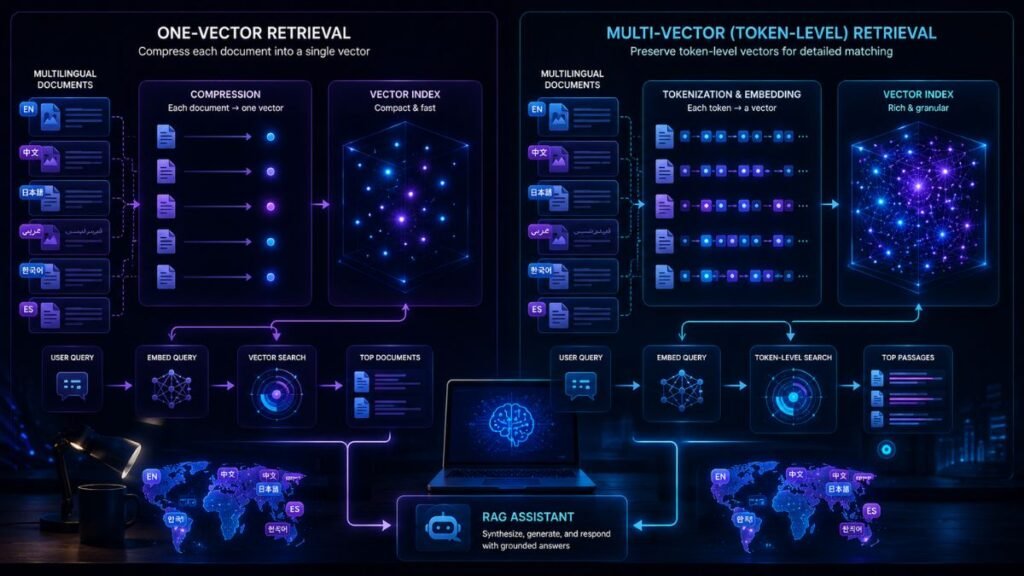
: LFM2.5 Embedding 350M and ColBERT multilingual retrieval models compared

 Liquid AI released two compact retrieval models on June 18, 2026, giving developers a choice between fast dense embeddings and more precise token-level retrieval. LFM2.5 Embedding 350M converts each document into one vector, making it suitable for low-cost semantic search and large indexes. Its companion, LFM2.5-ColBERT-350M, preserves a separate representation for each token and uses […]

LFM2.5 Embedding 350M: Liquid AI’s New Retrieval Models Explained Read More »

Google ADK A2A Tutorial: Connect Python and Go AI Agents

Google ADK A2A tutorials: Google ADK A2A workflow connecting Python contract extraction with Go policy validation

Google published a practical cross-language agent tutorial on June 22, 2026, showing how a Python service and a Go service can participate in one contract-compliance workflow through the Agent2Agent protocol. The architecture solves a common enterprise problem. A data or AI team may build document processing in Python, while a platform or security team maintains

Google ADK A2A Tutorial: Connect Python and Go AI Agents Read More »

OpenAI o3 Rare Disease Study: What the 18 Diagnoses Really Show

OpenAI o3 rare disease study workflow with genomic analysis expert review and laboratory confirmation

A study published in NEJM AI on June 18, 2026 used OpenAI o3 Deep Research to reanalyze 376 rare-disease cases that had remained unsolved after earlier specialist review. The result was not autonomous diagnosis. The model generated evidence-linked hypotheses that physicians and genetic experts investigated through established clinical processes. After expert review, additional testing, variant

OpenAI o3 Rare Disease Study: What the 18 Diagnoses Really Show Read More »

MosaicLeaks AI Agents: How Web Searches Can Expose Private Files

: MosaicLeaks AI agents exposing private document information through public web searches

Researchers published MosaicLeaks on May 29, 2026, revealing a privacy weakness in AI research agents that combine confidential documents with public web search. The risk is subtle. An agent does not need to upload an internal report or paste a secret into one search box. A series of ordinary-looking web queries can collectively expose what

MosaicLeaks AI Agents: How Web Searches Can Expose Private Files Read More »

Proactive Coding Agent Benchmark: Google’s Jules Research Explained

Proactive coding agent benchmark measuring useful code insights before developers ask

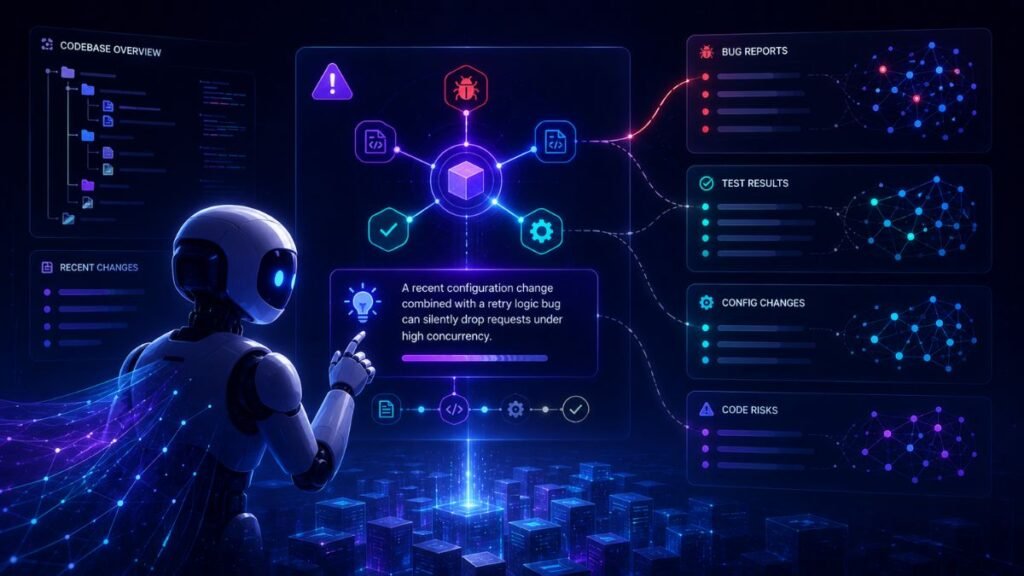
Google published a preliminary evaluation framework for proactive coding agents on June 22, 2026, arguing that current benchmarks do not measure whether an AI system can notice useful engineering problems before a developer explicitly assigns them. The research matters because coding agents are already becoming more autonomous. Tools such as Jules can inspect repositories, plan

Proactive Coding Agent Benchmark: Google’s Jules Research Explained Read More »

FAPO Prompt Optimization: Cisco’s LLM Pipeline System Explained

FAPO prompt optimization diagnosing and improving a multi-step LLM pipeline

Cisco Foundation AI published FAPO on June 17, 2026, introducing an automated system for optimizing multi-step LLM applications rather than tuning one prompt in isolation. The research matters because modern AI systems rarely make only one model call. A production pipeline may retrieve documents, extract evidence, reason over the evidence, classify the result, and format

FAPO Prompt Optimization: Cisco’s LLM Pipeline System Explained Read More »

prime-rl 0.6.0 Scales Agentic RL to Trillion-Parameter Models

prime-rl 0.6.0 training trillion-parameter AI agents across distributed GPU infrastructure

Prime Intellect released prime-rl 0.6.0 on June 21, 2026, expanding its open-source reinforcement-learning framework to support trillion-parameter mixture-of-experts models on demanding agentic workloads. The release matters because training an AI coding agent is much harder than training a model to answer one short question. An agent may inspect repositories, call tools, run tests, read long

prime-rl 0.6.0 Scales Agentic RL to Trillion-Parameter Models Read More »

OpenAI Daybreak: GPT-5.5-Cyber Security Stack Explained

OpenAI AI security stack: gpt-5-5-cyber-trusted-access-levels

OpenAI expanded Daybreak, its AI cybersecurity initiative, on June 22, 2026, introducing a more capable version of GPT-5.5-Cyber and a broader workflow for finding, validating, prioritizing, and fixing software vulnerabilities. The announcement matters because security teams already face more alerts than they can investigate. Daybreak is designed to address the harder bottleneck: turning a possible

OpenAI Daybreak: GPT-5.5-Cyber Security Stack Explained Read More »

Scroll to Top