

AI Agents Are Becoming Digital Workers: Jobs and Business Impact
AI agents are becoming digital workers, and this shift could change how companies hire, manage tasks, and measure productivity.
For years, AI tools mostly helped people write, search, summarize, or create content. Now the next stage is different. AI agents are being designed to take goals, plan steps, use business tools, and complete tasks with less human guidance.
That does not mean every worker will suddenly be replaced. But it does mean many jobs may start to look different.
AI Agents Are Becoming Digital Workers, Not Just Chatbots
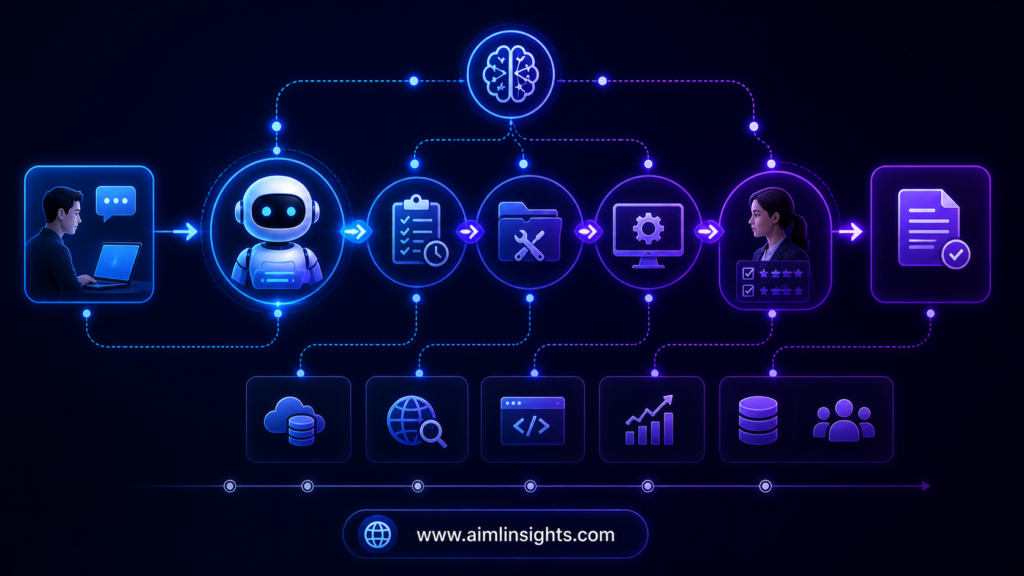
A chatbot usually waits for a question. An AI agent can take a task and move through several steps to complete it.
For example, a chatbot can answer, “Write a sales email.” An AI agent may go further. It can check a customer record, review previous conversations, draft a message, schedule a follow-up, and update a CRM system.
That is why companies are starting to describe these systems as digital workers.
Salesforce defines a digital worker as an AI software application that acts like a colleague, mimics human capabilities, and handles complex tasks. It also describes digital workers as AI agents that can function like virtual employees in roles that previously required human workers.
In simple terms, a digital worker is software that can do parts of a job, not just generate an answer.
This is the key difference. AI agents are moving from “help me think” to “help me do.”
Why Businesses Are Paying Attention Now?
Businesses are interested in AI agents because many teams are under pressure to do more work with fewer resources.
Customer support teams need faster replies. Sales teams need better lead research. HR teams need help screening candidates. Finance teams need faster reporting. IT teams need to handle support tickets without delays.
AI agents promise to reduce repetitive work across these areas.
Google recently launched Gemini Enterprise Agent Platform, a system designed to help businesses build, scale, govern, and optimize enterprise-grade agents. Google says the platform is meant to support agents grounded in company data and connected to business workflows.
Microsoft also describes Copilot Studio as a platform for building and managing agents that can connect to business data, be created using natural language, and be published across workplace channels.
This shows that AI agents are not just a startup trend. Big enterprise software companies are building infrastructure around them.
The business message is clear: AI is becoming part of the workplace operating system.
What AI Digital Workers Can Actually Do?
AI digital workers are most useful when the task has a clear process, repeated inputs, and measurable output.
They can help with customer support, document review, internal reporting, data entry, lead qualification, onboarding, scheduling, and research.
LinkedIn’s recent AI hiring tools are a good example. Reuters reported that LinkedIn’s agentic AI hiring products are on track to generate $450 million in sales in the coming year. These tools help recruiters by taking instructions, searching LinkedIn profiles, and identifying candidates for human follow-up.
That example matters because it shows the real direction of workplace AI. The AI is not fully replacing the recruiter. It is taking over part of the workflow that is time-consuming and repetitive.
A recruiter still decides whom to contact, how to evaluate the person, and whether the candidate is the right fit. But the AI agent reduces the manual search burden.
This is likely how many AI agents will enter workplaces: not as total job replacements, but as task-level assistants that slowly take over more parts of the work.
What This Means for Your Jobs?
The biggest question is simple: will AI agents take jobs?
The honest answer is more complicated than yes or no.
BCG’s 2026 analysis says task automation does not automatically equal job loss. Its model estimates that 50% to 55% of U.S. jobs may be reshaped by AI over the next two to three years, meaning many people may keep similar roles but face new expectations for how they work. BCG also says full job substitution may be slower, though some job losses are still possible over a longer period.
That means the first major impact may be job redesign.
A marketing assistant may spend less time drafting basic posts and more time planning campaigns. A customer service worker may handle complex cases while AI agents answer routine questions. A junior analyst may use AI to prepare research faster, but may also face pressure because some entry-level tasks can now be automated.
This is where the risk becomes real. Many early-career jobs are built around learning through simple tasks. If AI agents take over those tasks, companies will need new ways to train beginners.
The future of work may not only depend on whether AI replaces jobs. It may depend on whether companies redesign career paths properly.
Why Some Experts Are Still Cautious?
The excitement around AI agents is high, but the technology is not perfect.
TechCrunch recently reported on APEX-Agents, a benchmark testing how leading AI models perform on real white-collar tasks from areas such as consulting, investment banking, and law. The result was not a clear victory for AI. According to the report, even the best models struggled with many professional tasks and often returned wrong or incomplete answers.
This is important because businesses should not confuse a polished demo with reliable workplace performance.
An AI agent may work well when the task is simple and the data is clean. But real business work is messy. Instructions can be unclear. Documents can conflict. Customer cases can be emotional. Legal and financial decisions can carry serious consequences.
That is why human review remains essential.
The smarter approach is not to hand over everything to AI agents at once. Businesses should start with controlled workflows, clear approval steps, and measurable outcomes.
The Rise of the Human + AI Workforce
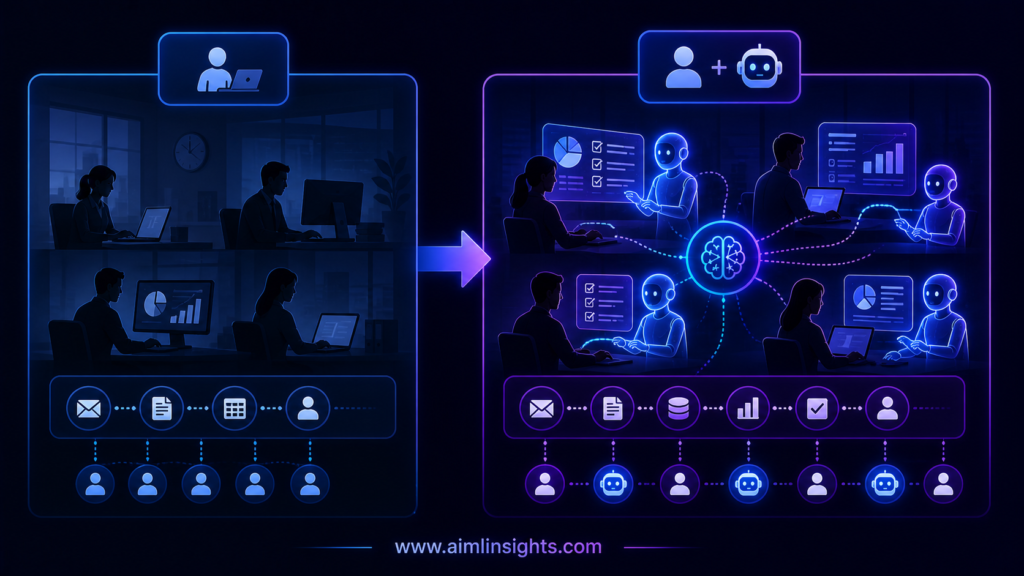
The most likely future is a hybrid workforce.
That means humans and AI agents work together. The AI handles repeated steps, gathers information, drafts outputs, and monitors workflows. The human sets goals, reviews decisions, handles exceptions, and manages trust.
Salesforce describes this direction as a digital labor force where autonomous AI agents support employees and customers around the clock.
PwC also says business leaders are at a crossroads with AI agents, noting that some AI investments have not delivered expected returns, while the next 12 to 24 months could bring more serious business transformation.
This balanced view matters.
AI agents can improve speed, but they do not automatically create good strategy. They can automate tasks, but they do not automatically understand company culture. They can answer customers, but they may still make mistakes that damage trust.
The best companies will not simply replace people with agents. They will redesign work so humans spend more time on judgment, relationships, creativity, and accountability.
What Businesses Should Do Before Using AI Agents?
Businesses should avoid rushing into AI agents without preparation.
The first step is to identify repetitive workflows. These may include support tickets, invoice checks, meeting summaries, sales research, HR screening, or internal knowledge search.
The second step is to decide what the AI agent is allowed to do. Can it only draft? Can it update records? Can it send messages? Can it approve refunds? Can it access customer data?
The third step is to add human approval for sensitive actions.
Google’s agent platform messaging focuses heavily on building, scaling, governing, and optimizing agents, which shows that governance is now part of enterprise AI adoption, not an afterthought.
SAP has also argued that in 2026, AI is no longer judged by novelty alone but by precision, governance, scalability, and business impact.
That is the right way to think about AI agents. A flashy AI demo is not enough. A useful digital worker must be accurate, secure, monitored, and aligned with real business goals.
What Employees Should Do Now?
Workers do not need to panic, but they should not ignore this shift.
The safest position is to learn how to work with AI agents before they become standard in your industry.
Employees should focus on skills that AI cannot easily replace: judgment, communication, domain knowledge, leadership, creativity, customer understanding, and ethical decision-making.
At the same time, workers should learn practical AI skills. That includes writing clear instructions, checking AI outputs, using AI for research, understanding automation limits, and knowing when not to rely on AI.
The goal is not to compete against software on speed. The goal is to become the person who can direct, review, and improve AI-powered work.
In many roles, the worker who knows how to manage AI agents may become more valuable than the worker who avoids them.
Simple Explanation for Beginners
Think of an AI agent like a smart digital assistant with a checklist.
A normal AI chatbot gives you an answer.
An AI agent can follow steps.
For example, you might say, “Prepare a weekly sales report.” The AI agent may collect sales numbers, compare them with last week, find changes, write a summary, create a chart, and send the draft to a manager for review.
That is why people call them digital workers.
They are not human. They do not have real understanding, emotions, or responsibility. But they can complete structured digital tasks much faster than people when they are properly connected to tools and data.
Benefits, Risks, and Limitations
The benefits are clear. AI agents can save time, reduce repetitive work, improve response speed, and help small teams handle more tasks.
But the risks are also serious.
AI agents can make mistakes. They can act on outdated data. They can misunderstand instructions. They can expose sensitive information if permissions are weak. They can also create pressure on workers if companies use automation mainly to cut labor costs.
TechCrunch has reported investor expectations that 2026 could be the year agents move from making workers more productive to automating work itself in some areas. That is why the job conversation is not imaginary. It is already part of business planning.
The limitation is simple: AI agents are powerful, but they still need boundaries.
For important decisions, humans must remain responsible.
Conclusion
AI agents are becoming digital workers, and the shift will affect both jobs and businesses.
For companies, these systems may reduce busywork, speed up operations, and create new ways to serve customers. For workers, they may change daily tasks, raise skill expectations, and reshape career paths.
The best outcome is not a workplace where humans disappear. The better goal is a workplace where AI agents handle repetitive digital tasks while people focus on judgment, creativity, relationships, and responsibility.
The companies that succeed will not be the ones that automate blindly. They will be the ones that build a clear human + AI workforce with training, governance, and trust at the center.
Key Takeaways
- AI agents are becoming digital workers that can complete multi-step tasks.
- Digital workers are different from basic chatbots because they can act across workflows.
- Businesses are adopting AI agents for support, sales, HR, finance, IT, and reporting.
- Jobs are more likely to be reshaped first, not instantly replaced everywhere.
- Human review, governance, and data security are essential.
- Workers should learn how to direct, review, and collaborate with AI agents.
- The future of work is likely to be human + AI, not human versus AI.
FAQ
What are AI agents?
AI agents are software systems that can understand a goal, plan steps, use tools, and complete tasks with less human input than a normal chatbot.
What are digital workers?
Digital workers are AI-powered software systems that can handle complex digital tasks, often acting like virtual employees inside business workflows.
Will AI agents replace jobs?
AI agents may replace some tasks and possibly some roles, but many jobs are more likely to be redesigned first. Human judgment, review, and communication will remain important.
How can businesses use AI agents?
Businesses can use AI agents for customer support, lead research, document review, internal reporting, onboarding, scheduling, and workflow automation.
What skills should workers learn?
Workers should learn AI prompting, output checking, workflow design, data privacy basics, communication, critical thinking, and how to manage AI-assisted work.
References:
- Salesforce explanation of digital workers. (Salesforce)
- Google Cloud Gemini Enterprise Agent Platform announcement. (Google Cloud)
- Microsoft Copilot Studio agent platform page. (Microsoft)
- Reuters report on LinkedIn AI hiring agents. (Reuters)
- BCG analysis on AI reshaping jobs. (BCG Global)
- TechCrunch report on agent reliability benchmark. (TechCrunch)
- PwC analysis on AI agents and future work. (PwC)