
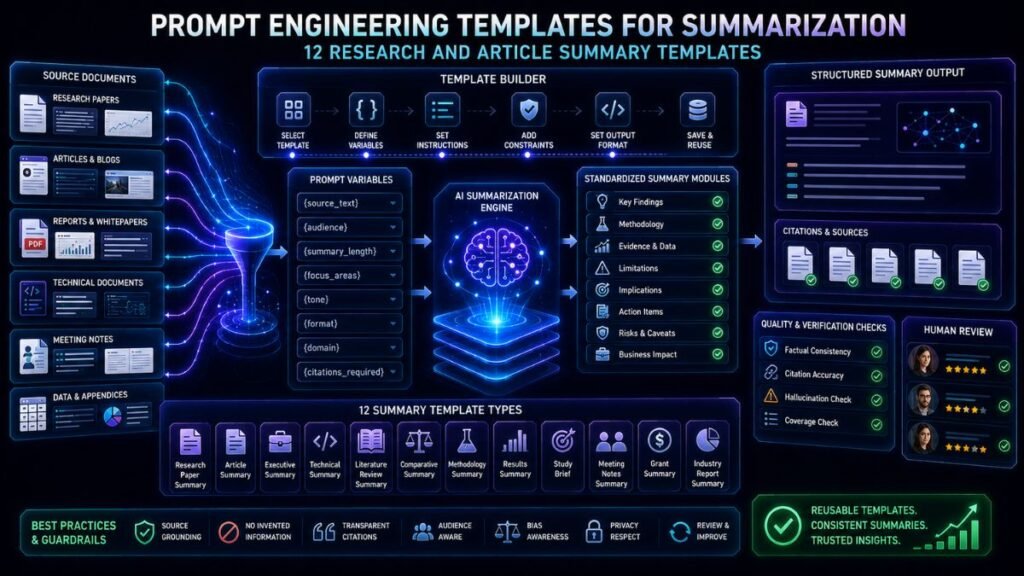
Prompt engineering templates for summarization help you turn messy, inconsistent AI outputs into repeatable summaries. Instead of asking “summarize this,” a reusable template defines the source, audience, format, length, focus, and verification rules. Use these templates for research papers, articles, business reports, technical documents, meetings, and study notes.
In simple terms
A summarization prompt is a single instruction. A summarization template is a reusable structure with placeholders.
For example, a prompt says:
“Summarize this article.”
A template says:
“Summarize this [document type] for [audience]. Focus on [priority]. Use [format]. Keep it under [length]. Use only the provided text. Mark anything that needs verification.”
That second version is easier to reuse across a team because everyone can fill in the same fields and get more consistent summaries.
Why Templates help Standardize Research Summaries
Templates help standardize research summaries because they force each summary to include the same core parts: research question, method, findings, evidence, limitations, and relevance. Without a template, one summary may focus on background, another may focus on results, and another may ignore limitations completely.
A good research summary template is especially useful for students, analysts, content teams, consultants, and researchers who compare multiple papers or reports. It makes summaries easier to scan, compare, and turn into decisions.
The basic structure of a good summary template
Use this structure for most AI summary prompts:
| Template part | What it controls |
| Role | The perspective the AI should use |
| Source | The text, article, paper, PDF, transcript, or report |
| Audience | Beginner, researcher, manager, CEO, student, technical team |
| Focus | Findings, risks, actions, arguments, evidence, business impact |
| Format | Bullets, table, brief, FAQ, checklist, executive summary |
| Rules | Use only provided text, do not invent citations, mark uncertainty |
This structure matches prompt engineering best practices because it reduces ambiguity, defines the output, and gives the AI a clearer job.
12 Best Prompt Templates for Summarization and Research
1. Basic summary template
Use this when you need a quick summary of an article, blog post, chapter, or note.
Template:
“Summarize the following [document type] for [audience]. Focus on the main idea, key supporting points, and conclusion. Keep it under [word count]. Use simple language and do not add information that is not in the source: [paste text].”
Best for: articles, blog posts, class notes, short reports.
2. Article summary template
Use this as a template for summarizing an article when you need more than a short overview.
Template:
“Summarize this article using the following format: main argument, key evidence, important examples, assumptions, limitations, and final takeaway. Write for [audience] and keep the summary [short/detailed]: [paste article].”
Best for: article reviews, content research, study notes.
3. Research paper summary template
This is the best prompt for summarizing a research paper when accuracy and structure matter.
Template:
“Summarize this research paper using these sections: research problem, research question, method, dataset or source material, key findings, limitations, practical relevance, and questions for further study. Use only the paper content and mark anything unclear: [paste paper text or notes].”
Best for: academic research, literature reviews, paper comparison.
4. Standardized research summary template
Use this when your team needs the same summary format for every paper.
Template:
“Create a standardized research summary for this paper. Use a table with columns for objective, method, sample, findings, evidence, limitations, relevance to [topic], and confidence level. Do not invent citations or results: [paste notes].”
Best for: research teams, literature matrices, review workflows.
5. Dense technical document summary template
This answers the query: what prompts get AI to summarize dense technical documents into simple language?
Template:
“Act as a technical communicator. Summarize this dense technical document for a non-technical [audience]. Explain the core idea, key technical issues, business impact, risks, and recommended next steps. Define technical terms in simple language and preserve accuracy: [paste document].”
Best for: engineering reports, audits, product documentation, technical updates.
6. Executive summary template
Use this when the reader is busy and needs decisions, not every detail.
Template:
“Act as a business analyst. Summarize this [report/document] for a non-technical executive. Focus on the business impact, strategic importance, risks, decisions needed, and recommended actions. Keep it concise and action-oriented: [paste text].”
Best for: leadership updates, audits, project reports, client briefs.
7. Business report summary template
This is a good prompt for generating a summary of a business report.
Template:
“Summarize this business report using these sections: context, key findings, numbers that matter, risks, opportunities, recommendations, and next steps. Include a short executive summary first: [paste report].”
Best for: market reports, project reports, financial summaries, operational reviews.
8. Meeting notes summary template
Use this when building a reusable prompt template for client meeting notes.
Template:
“Summarize these meeting notes into decisions, action items, owners, deadlines, client concerns, open questions, and follow-up tasks. Format the output as a table and do not guess missing details: [paste notes].”
Best for: team meetings, client calls, project updates.
9. TLDR prompt template
Use this when you need a short summary fast.
Template:
“Create a TLDR summary of this text in [number] bullets. Each bullet should capture one main idea. Then add one sentence explaining why the text matters: [paste text].”
Best for: quick scanning, Slack updates, email briefings.
10. Comparison summary template
Use this when summarizing several papers, articles, or reports together.
Template:
“Compare these sources in a table. Include source name, main claim, evidence used, strengths, limitations, contradictions, and relevance to [topic]. Then summarize the overall pattern in 150 words: [paste notes].”
Best for: literature reviews, competitor research, policy comparison.
11. Action-item summary template
Use this when the summary must lead to work, not just understanding.
Template:
“Summarize this document into action items. Include task, reason, owner if mentioned, deadline if mentioned, priority, and dependency. Mark missing owners or deadlines as ‘not specified’: [paste document].”
Best for: project documents, meetings, technical reports, internal updates.
12. Accuracy-check template
Use this after the AI creates a summary.
Template:
“Compare this summary against the original text. Identify missing points, distorted meaning, unsupported claims, and important caveats. Suggest a corrected version: [paste original text and summary].”
Best for: final review, research summaries, technical summaries, high-stakes content.
How to Choose the Right Summarization Template
Choose the template based on the job.
If you are summarizing a research paper, use the research paper summary template. If you are summarizing a dense technical report for leadership, use the executive or technical document template. If you are summarizing many sources, use the comparison template.
The best prompt to summarize an article is usually not the same as the best prompt for summarizing a research paper. Articles often need argument, evidence, and takeaway. Research papers need method, findings, limitations, and relevance.
Common mistakes to avoid
The biggest mistake is using one generic summary prompt for every document. A blog post, academic paper, meeting transcript, and technical audit need different summary structures.
Another mistake is leaving out the audience. A summary for a CEO should focus on business impact. A summary for a researcher should focus on method, evidence, and limitations.
Also avoid trusting the summary without checking the source. AI summaries can miss caveats, flatten disagreements, or overstate findings. For research and technical documents, add a verification step before using the output.
Suggested Read:
- Prompt Engineering for Beginners: A Practical Guide
- Prompts for Summarization
- 25 Prompt Engineering Techniques With Examples
- How to Write Better System Prompts
- Prompts for Academic Writing
FAQ: Prompt Engineering Templates for Summarization
What templates help standardize research summaries?
Templates that include research question, method, findings, evidence, limitations, relevance, and verification notes help standardize research summaries. They make papers easier to compare.
What is a good prompt for summarizing a research paper?
A good prompt asks for the research problem, method, data, key findings, limitations, and practical relevance. It should also tell the AI not to invent citations or unsupported results.
What is an example of a summarization prompt?
A simple example is: “Summarize the following passage in one sentence while preserving the main idea: [paste text].”
What prompt summarizes dense technical documents into simple language?
Use: “Act as a technical communicator. Summarize this document for a non-technical audience. Explain the core issue, business impact, risks, and next steps in simple language.”
Why use templates instead of one-off prompts?
Templates make summaries more consistent, reusable, and easier to review. They are especially useful for teams, research workflows, client notes, and recurring reports.
Final takeaway
Prompt engineering templates for summarization make AI summaries more consistent and useful. The best templates define the source, audience, focus, format, and accuracy rules. Use different templates for articles, research papers, technical reports, meetings, and executive summaries, then review the output against the original source.
For better results, connect these templates with broader prompt engineering techniques and build a reusable library for the summary tasks you repeat most often.