
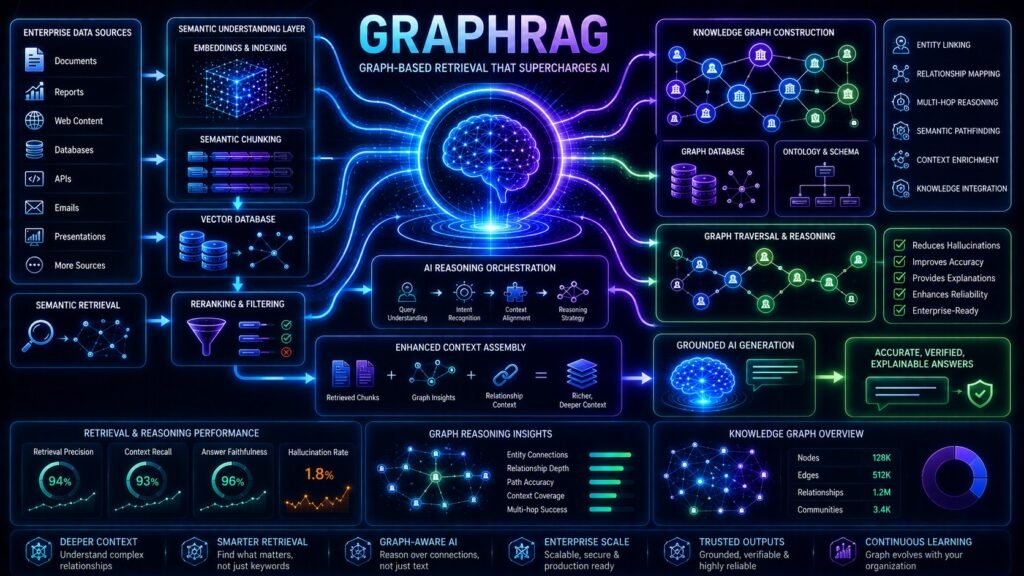
Modern AI systems are evolving far beyond simple chatbots and static retrieval pipelines. Organizations increasingly deploy intelligent AI architectures across:
- enterprise AI assistants
- customer support copilots
- autonomous research systems
- software engineering agents
- legal AI platforms
- healthcare AI systems
- AI workflow orchestration systems
- enterprise automation platforms
However, as enterprise AI becomes more sophisticated, traditional Retrieval-Augmented Generation (RAG) systems are beginning to face major limitations.
Basic RAG pipelines work well for:
- semantic retrieval
- grounded answer generation
- enterprise search
- contextual document access
But modern AI systems increasingly require capabilities such as:
- autonomous reasoning
- multi-step task planning
- adaptive retrieval
- dynamic tool usage
- memory management
- workflow orchestration
- contextual decision-making
This is where:
Agentic RAG
becomes important.
Agentic RAG is emerging as one of the most important next-generation AI architecture patterns because it combines:
- AI agents
- Retrieval-Augmented Generation
- autonomous reasoning
- memory systems
- orchestration frameworks
- contextual retrieval
into intelligent autonomous workflows.
Today, organizations increasingly adopt Agentic RAG architectures to build AI systems capable of:
- autonomous research
- dynamic enterprise retrieval
- intelligent workflow execution
- adaptive reasoning
- multi-agent collaboration
- grounded AI generation
Understanding Agentic RAG is becoming essential because autonomous retrieval systems are rapidly becoming foundational for enterprise AI infrastructure.
In this guide, you will learn what Agentic RAG is, how it works, how it differs from traditional RAG systems, enterprise use cases, architecture design, advantages, limitations, hallucination implications, and why Agentic RAG may define the future of enterprise AI systems.
In Simple Terms
What Is Traditional RAG?
Retrieval-Augmented Generation (RAG) retrieves relevant information before generating answers.
A standard RAG system usually follows a fixed workflow:
- retrieve relevant documents
- send retrieved context into an LLM
- generate grounded responses
This works well for many enterprise AI tasks.
However, traditional RAG systems are often static.
What Is Agentic RAG?
Agentic RAG combines RAG pipelines with autonomous AI agents.
Instead of following fixed retrieval workflows, AI agents dynamically decide:
- what to retrieve
- when to retrieve
- how to retrieve
- which tools to use
- whether additional reasoning is needed
- how to orchestrate workflows
This creates more adaptive and intelligent AI systems.
Easy Analogy
Imagine a normal RAG system as a librarian who retrieves books when asked.
Agentic RAG behaves more like a highly intelligent research assistant who can:
- ask follow-up questions
- search multiple sources
- validate information
- plan research steps
- coordinate tools
- refine retrieval strategies
before answering.
This dramatically improves AI autonomy.
Why Agentic RAG Became Important
Modern enterprise AI systems increasingly require more than basic retrieval.
Organizations now expect AI systems to:
- solve multi-step problems
- perform autonomous research
- interact with external systems
- manage workflows
- coordinate tasks dynamically
- reason iteratively
Traditional RAG systems struggle with these requirements because they rely heavily on fixed pipelines.
Agentic architectures solve this limitation.
The Core Problem With Traditional RAG
Traditional RAG systems often operate linearly:
Query → Retrieve → Generate
This approach works for simple question answering but struggles with:
- iterative reasoning
- complex workflows
- ambiguous queries
- dynamic planning
- multi-source retrieval
- adaptive decision-making
Agentic RAG introduces intelligent orchestration layers capable of dynamic reasoning.
Understanding How Agentic RAG Works
Agentic RAG combines multiple AI infrastructure layers together.
A modern Agentic RAG architecture may include:
- semantic retrieval systems
- vector databases
- AI agents
- orchestration frameworks
- reasoning engines
- memory systems
- planning modules
- tool-use systems
- Large Language Models
These components work together autonomously.
Core Components of Agentic RAG
| Component | Purpose |
| Retriever | Finds contextual information |
| Vector Database | Stores embeddings |
| AI Agent | Makes autonomous decisions |
| Memory System | Stores contextual history |
| Planner | Breaks tasks into steps |
| Tool Layer | Accesses external systems |
| LLM | Generates grounded responses |
This architecture enables adaptive AI workflows.
How AI Agents Work in Agentic RAG
AI agents are autonomous systems capable of:
- planning actions
- reasoning iteratively
- choosing tools
- evaluating outcomes
- refining retrieval
- coordinating workflows
Instead of fixed pipelines, agents dynamically orchestrate retrieval strategies.
Why Agentic RAG Improves Retrieval
Traditional retrieval systems often retrieve context once.
Agentic RAG can:
- retrieve multiple times
- refine queries dynamically
- verify retrieved information
- compare sources
- rerank results iteratively
- request additional context autonomously
This improves retrieval quality significantly.
Why Agentic RAG Reduces Hallucinations
Hallucinations remain one of the biggest challenges in enterprise AI systems.
Traditional RAG reduces hallucinations using grounding.
Agentic RAG improves this further by enabling:
- iterative validation
- contextual verification
- retrieval refinement
- multi-source comparison
- autonomous evidence checking
This creates more reliable grounded generation.
Why Agentic RAG Improves Multi-Step Reasoning
Enterprise AI tasks often involve multiple reasoning steps.
Examples include:
- researching legal regulations
- troubleshooting enterprise systems
- generating technical reports
- analyzing financial dependencies
- coordinating healthcare workflows
Traditional RAG may struggle with these workflows.
Agentic reasoning improves them dramatically.
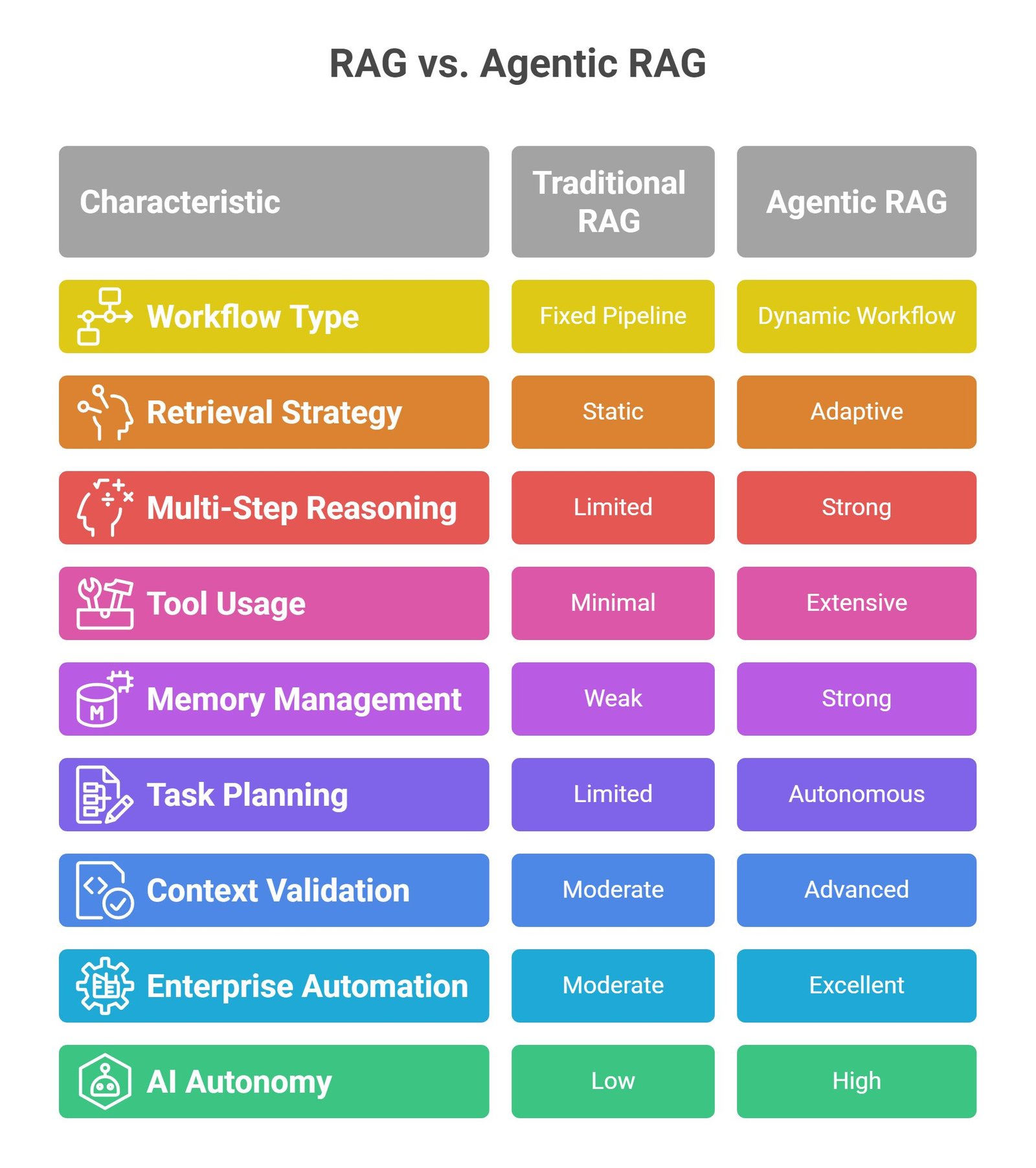
Agentic RAG vs Traditional RAG
One of the most important concepts to understand is:
Agentic RAG does not replace RAG.
Agentic RAG extends RAG.
Traditional RAG focuses on retrieval pipelines.
Agentic RAG adds autonomous orchestration and reasoning capabilities.
Key Differences Between RAG and Agentic RAG
| Category | Traditional RAG | Agentic RAG |
| Workflow Type | Fixed Pipeline | Dynamic Workflow |
| Retrieval Strategy | Static | Adaptive |
| Multi-Step Reasoning | Limited | Strong |
| Tool Usage | Minimal | Extensive |
| Memory Management | Weak | Strong |
| Task Planning | Limited | Autonomous |
| Context Validation | Moderate | Advanced |
| Enterprise Automation | Moderate | Excellent |
| AI Autonomy | Low | High |
Why Enterprises Are Interested in Agentic RAG
Modern organizations increasingly need AI systems capable of autonomous execution.
Examples include:
- AI research assistants
- enterprise copilots
- workflow automation agents
- AI engineering assistants
- autonomous customer support systems
- operational AI platforms
Traditional retrieval systems alone are insufficient for these environments.
Agentic orchestration improves intelligence significantly.
Major Advantages of Agentic RAG
Adaptive Retrieval
Agents dynamically refine retrieval strategies.
Better Autonomous Reasoning
Multi-step reasoning improves enterprise AI performance.
Stronger Contextual Grounding
Iterative validation strengthens factual reliability.
Better Workflow Automation
Agents coordinate complex tasks autonomously.
Improved Tool Orchestration
AI systems can access APIs, databases, and enterprise systems dynamically.
Better Contextual Memory
Memory layers improve reasoning continuity.
Major Limitations of Agentic RAG
Despite its advantages, Agentic RAG introduces major challenges.
Higher Infrastructure Complexity
Agentic architectures contain many moving components.
Increased Latency
Multi-step orchestration may slow responses.
Higher Operational Costs
Complex workflows increase inference and infrastructure expenses.
Difficult Evaluation
Autonomous systems are harder to benchmark reliably.
Reliability Challenges
Poorly designed agents may create unstable workflows.
Why Agentic RAG Matters for Enterprise AI
Enterprise AI increasingly depends on:
- autonomous workflows
- grounded reasoning
- contextual orchestration
- intelligent retrieval
- adaptive AI systems
- reasoning-aware automation
Agentic RAG improves all these capabilities.
This is why many organizations view Agentic RAG as a major next-generation AI architecture pattern.
Enterprise Use Cases for Agentic RAG
Autonomous Research Systems
AI agents retrieve, analyze, summarize, and validate information dynamically.
Customer Support AI Agents
Autonomous support agents troubleshoot issues using enterprise knowledge bases.
Software Engineering Agents
AI coding assistants retrieve documentation, APIs, and debugging context iteratively.
Healthcare AI Systems
Medical agents retrieve contextual clinical guidance dynamically.
Legal AI Assistants
Legal agents coordinate regulation retrieval and compliance reasoning workflows.
Cybersecurity Operations
AI agents investigate security threats autonomously using retrieval orchestration.
Agentic RAG and Multi-Agent Systems
One of the biggest trends in enterprise AI is:
Multi-agent orchestration
Different AI agents specialize in different tasks such as:
- retrieval
- reasoning
- planning
- evaluation
- summarization
- verification
This creates highly scalable AI systems.
Why Agentic RAG Is Better for Complex Enterprise Queries
Enterprise AI tasks often require:
- iterative reasoning
- adaptive retrieval
- contextual memory
- multi-step orchestration
- autonomous decision-making
Static retrieval pipelines struggle with these workflows.
Agentic systems improve them significantly.
Why Memory Matters in Agentic RAG
Memory systems are becoming increasingly important in autonomous AI architectures.
Agentic RAG may use:
- short-term memory
- long-term memory
- contextual memory
- retrieval history
- user interaction memory
This improves reasoning continuity dramatically.
Cost Comparison: Traditional RAG vs Agentic RAG
Agentic architectures introduce higher infrastructure costs.
Traditional RAG Costs
Traditional RAG typically requires:
- embeddings generation
- vector databases
- retrieval orchestration
- LLM inference
Agentic RAG Costs
Agentic systems additionally require:
- planning modules
- memory systems
- orchestration layers
- tool management infrastructure
- multi-agent coordination systems
This increases operational complexity significantly.
Common Enterprise Mistakes
Many organizations misunderstand Agentic RAG implementations.
Assuming Agents Eliminate Retrieval
Agents still depend heavily on retrieval quality.
Overengineering Early Systems
Not every workflow requires autonomous orchestration immediately.
Ignoring Evaluation Infrastructure
Agentic systems require extensive monitoring and benchmarking.
Underestimating Latency Costs
Multi-step reasoning increases response times.
Why Evaluation Matters for Agentic RAG
Organizations increasingly benchmark:
- retrieval precision
- task completion rates
- reasoning quality
- hallucination rates
- contextual grounding
- workflow reliability
- tool orchestration accuracy
Continuous evaluation improves enterprise AI reliability significantly.
Future of Agentic RAG
Agentic AI systems are evolving rapidly.
Major trends include:
- autonomous AI agents
- multi-agent orchestration
- reasoning-aware retrieval
- memory-augmented AI systems
- adaptive retrieval pipelines
- graph-enhanced agentic systems
- multimodal autonomous agents
Future enterprise AI systems will increasingly combine:
- retrieval
- reasoning
- planning
- orchestration
- memory
- autonomous execution
into unified intelligence architectures.
Suggested
- What Is RAG in AI
- How RAG Works
- Reducing Hallucinations in RAG
- RAG Evaluation Metrics
- Query Rewriting for RAG
FAQ: Agentic RAG Explained
What is Agentic RAG?
Agentic RAG combines Retrieval-Augmented Generation with autonomous AI agents capable of dynamic reasoning and workflow orchestration.
How does Agentic RAG work?
AI agents dynamically manage retrieval, planning, reasoning, and tool usage before generating grounded responses.
What is the difference between RAG and Agentic RAG?
Traditional RAG follows fixed retrieval pipelines, while Agentic RAG uses autonomous agents for adaptive orchestration.
Does Agentic RAG reduce hallucinations?
Yes. Iterative retrieval refinement and contextual validation improve grounded generation significantly.
Why is Agentic RAG important for enterprise AI?
Enterprise systems increasingly require autonomous workflows, adaptive reasoning, and intelligent orchestration capabilities.
Final Takeaway
Understanding Agentic RAG is becoming increasingly important because enterprise AI systems now require far more than static retrieval pipelines.
Modern AI architectures increasingly depend on:
- autonomous reasoning
- adaptive retrieval
- contextual orchestration
- grounded AI generation
- workflow automation
- intelligent planning
- memory-aware reasoning
Agentic RAG extends traditional Retrieval-Augmented Generation by combining semantic retrieval with autonomous AI agents and dynamic orchestration systems.
Organizations that understand Agentic RAG architectures can build more scalable, intelligent, grounded, and production-ready enterprise AI systems.
That capability is becoming foundational for enterprise copilots, autonomous research systems, software engineering agents, healthcare AI assistants, cybersecurity platforms, legal intelligence systems, and next-generation AI automation architectures.