
RAG for Enterprise Search: How AI Is Transforming Internal Knowledge Retrieval
Enterprise search has always been one of the biggest challenges inside modern organizations. Companies generate enormous amounts of information every day, but employees often struggle to find the right data quickly.
Critical knowledge becomes scattered across:
- PDFs
- cloud storage platforms
- enterprise wikis
- support documentation
- internal databases
- emails
- spreadsheets
- operational manuals
Traditional search systems often fail because they rely heavily on keyword matching instead of understanding meaning and context.
That is exactly why Retrieval-Augmented Generation (RAG) became one of the most important technologies in enterprise AI.
Instead of relying only on static keyword search or pretrained model memory, RAG-powered enterprise search systems retrieve relevant information dynamically before generating responses.
This allows organizations to build AI-powered enterprise search assistants that are more accurate, context-aware, scalable, and useful for real business workflows.
Today, many advanced enterprise AI systems use RAG for:
- internal knowledge discovery
- employee copilots
- customer support search
- document intelligence
- compliance retrieval
- operational search automation
In this guide, you will learn how RAG for enterprise search works, why businesses are rapidly adopting retrieval-based AI systems, and how RAG is transforming enterprise knowledge management.
In Simple Terms
What Is RAG for Enterprise Search?
RAG stands for:
Retrieval-Augmented Generation
In enterprise search systems, RAG allows AI applications to retrieve information from company knowledge sources before generating answers.
Instead of relying only on model memory, the system first searches:
- internal documents
- enterprise databases
- support systems
- cloud files
- PDFs
- operational manuals
- company policies
The retrieved information is then added to the prompt sent to the language model.
This allows the AI to generate grounded and context-aware answers instead of generic responses.
Think of RAG enterprise search as combining:
- semantic search
- AI reasoning
- enterprise knowledge retrieval
- conversational AI
into one intelligent system.
Why Traditional Enterprise Search Often Fails
Traditional enterprise search systems have existed for years, but many organizations still struggle with information discovery.
Employees often waste hours searching across disconnected systems just to find simple answers.
Understanding these limitations explains why RAG-powered enterprise search is growing rapidly.
Keyword Search Is Limited
Traditional enterprise search systems rely heavily on exact keyword matching.
This creates problems because employees may phrase questions differently from how documents are written.
For example:
An employee may search:
“How do expense reimbursements work?”
But the document may contain:
“employee travel compensation policy”
Traditional keyword search may fail to retrieve relevant information.
RAG systems solve this problem using semantic search and embeddings.
Enterprise Data Is Fragmented
Most companies store information across multiple disconnected platforms such as:
- Google Drive
- SharePoint
- Confluence
- Notion
- CRM systems
- ticketing platforms
- PDFs
- cloud databases
Traditional enterprise search struggles to unify these systems effectively.
RAG systems can retrieve information across multiple enterprise sources more intelligently.
Information Changes Constantly
Enterprise information changes rapidly.
Examples include:
- HR policies
- pricing documents
- operational workflows
- compliance rules
- product documentation
- onboarding instructions
Traditional AI systems become outdated quickly because they rely on static training data.
RAG solves this by retrieving updated information dynamically.
Employees Need Conversational Search
Modern users increasingly expect natural language interactions instead of complex search syntax.
Employees want to ask questions like:
- “What is the latest remote work policy?”
- “How do I escalate enterprise support issues?”
- “Where is the latest compliance checklist?”
RAG systems enable conversational enterprise search experiences.
Easy Analogy
Imagine two employees trying to answer an operational question.
Employee A
Searches manually across folders, PDFs, and documentation.
Employee B
Uses an intelligent AI assistant that searches all enterprise systems instantly before generating a summarized answer.
Employee B uses a RAG-powered enterprise search workflow.
That second experience is dramatically faster and more efficient.
This is why retrieval-based AI systems are transforming enterprise productivity.
How RAG for Enterprise Search Works
Understanding the RAG workflow helps explain why these systems are becoming foundational enterprise AI infrastructure.
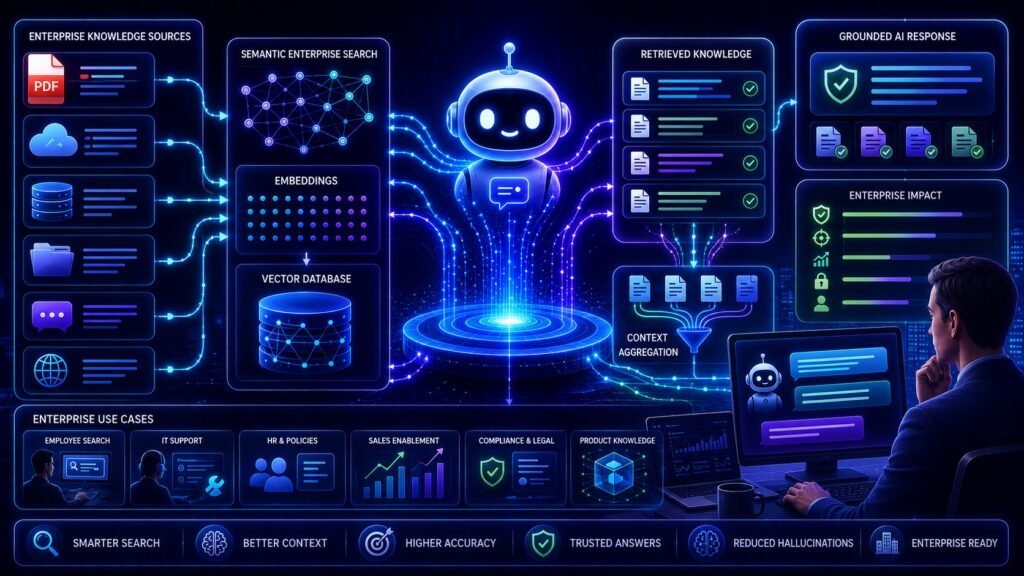
Step 1: Enterprise Knowledge Sources Are Collected
The first stage involves collecting enterprise data sources such as:
- PDFs
- cloud documents
- support knowledge bases
- internal wikis
- operational manuals
- databases
- policy files
- CRM records
This collection becomes the enterprise knowledge base.
The quality of this data strongly affects retrieval performance.
Poor documentation produces weak AI outputs.
Step 2: Documents Are Split Into Chunks
Large enterprise files are divided into smaller sections called chunks.
For example:
A 400-page operations manual may be divided into hundreds of searchable text segments.
Chunking improves semantic retrieval precision because smaller sections are easier to match contextually.
Choosing the right chunk size is one of the most important optimization tasks in enterprise RAG systems.
Step 3: Embeddings Are Created
The chunks are converted into embeddings.
What Are Embeddings?
Embeddings are vector representations of meaning.
Instead of matching exact keywords, embeddings allow enterprise AI systems to understand semantic similarity.
For example:
- “travel reimbursement policy”
- “expense compensation process”
- “employee expense rules”
may all generate similar embeddings.
This enables semantic enterprise search instead of traditional keyword search.
Step 4: Embeddings Are Stored in a Vector Database
The embeddings are stored inside vector databases such as:
- Pinecone
- Weaviate
- Chroma
- Milvus
These databases are optimized for semantic retrieval at scale.
Unlike traditional search systems, vector databases retrieve information based on contextual meaning instead of exact text matching.
This dramatically improves enterprise search relevance.
Step 5: Employees Ask Questions
Users interact with the system conversationally.
Example:
“What is the current enterprise reimbursement policy?”
This initiates the retrieval process.
Step 6: Query Embeddings Are Generated
The user query is converted into embeddings using the same embedding model.
This allows semantic comparison between:
- user intent
- enterprise documents
Even if the exact wording differs, relevant information can still be retrieved.
Step 7: Retrieval Happens
The retriever searches the vector database for the most relevant document chunks.
This stage is what makes RAG different from traditional enterprise search systems.
Instead of returning keyword matches only, the AI retrieves semantically relevant information.
This dramatically improves retrieval quality.
Step 8: Retrieved Information Is Added to the Prompt
The retrieved enterprise information is inserted into the prompt sent to the language model.
The AI now receives:
- user query
- enterprise context
- retrieved documents
- system instructions
This allows the AI to generate grounded responses instead of generic outputs.
Step 9: The AI Generates the Final Response
The language model generates a final conversational answer using:
- retrieved enterprise knowledge
- contextual information
- reasoning capabilities
- natural language generation
This creates an intelligent enterprise search experience.
Why Enterprises Are Adopting RAG Search Systems
RAG-powered enterprise search systems provide major operational and productivity advantages.
Faster Knowledge Discovery
Employees spend less time searching manually across disconnected systems.
This improves operational efficiency significantly.
Better Accuracy
The AI retrieves real enterprise information before answering.
This improves factual grounding and reduces misinformation.
Reduced Hallucinations
RAG systems reduce hallucinations because answers are based on retrieved enterprise data instead of memory alone.
Conversational Enterprise Search
Employees can ask questions naturally instead of using complex keyword search syntax.
This improves usability dramatically.
Better Enterprise Productivity
Teams can retrieve information faster, onboard employees more efficiently, and reduce operational friction.
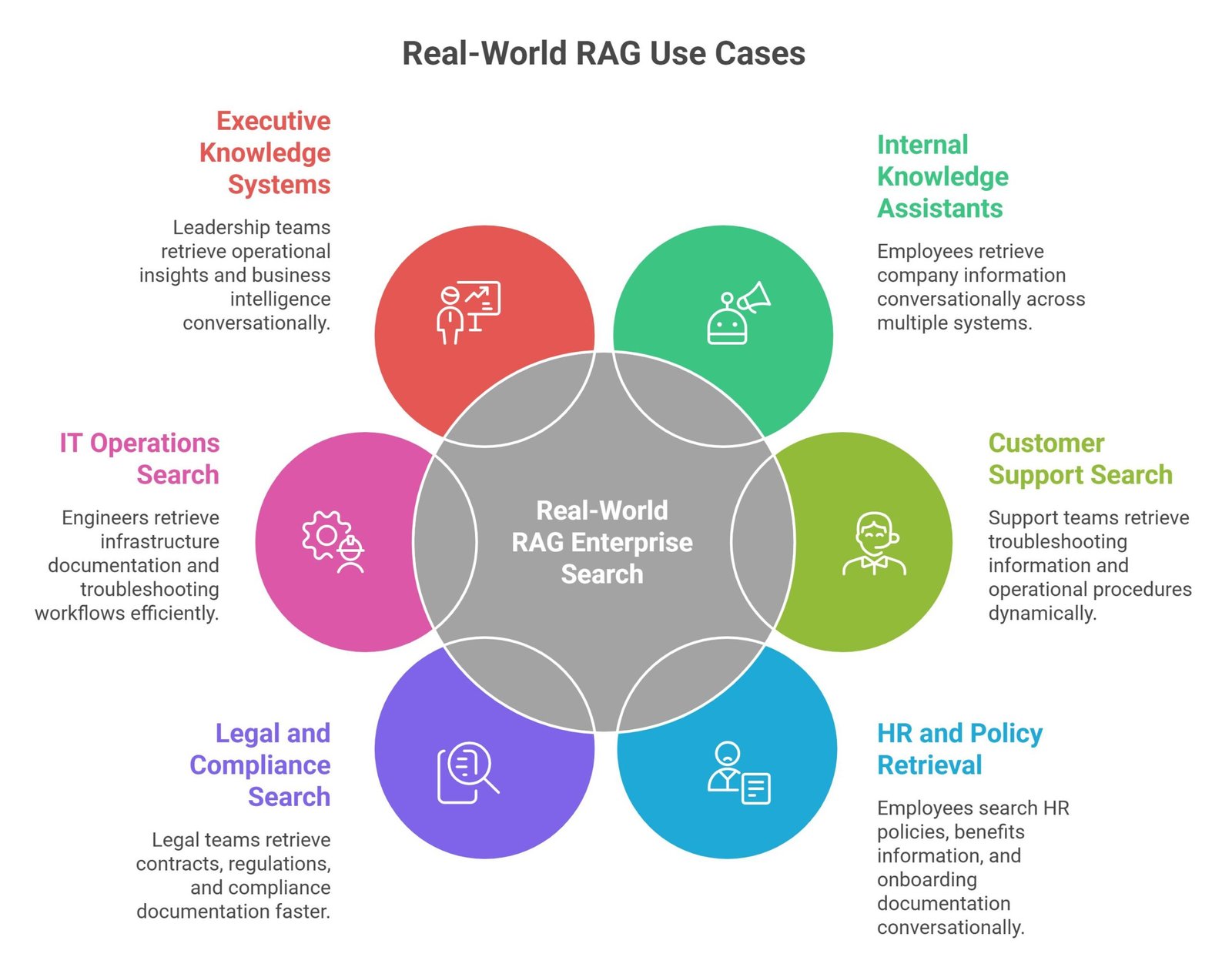
Real-World RAG Enterprise Search Use Cases
Internal Knowledge Assistants
Employees retrieve company information conversationally across multiple systems.
Customer Support Search
Support teams retrieve troubleshooting information and operational procedures dynamically.
HR and Policy Retrieval
Employees search HR policies, benefits information, and onboarding documentation conversationally.
Legal and Compliance Search
Legal teams retrieve contracts, regulations, and compliance documentation faster.
IT Operations Search
Engineers retrieve infrastructure documentation and troubleshooting workflows efficiently.
Executive Knowledge Systems
Leadership teams retrieve operational insights and business intelligence conversationally.
RAG Enterprise Search vs Traditional Search
| Feature | Traditional Enterprise Search | RAG Enterprise Search |
| Keyword matching | Strong | Moderate |
| Semantic understanding | Weak | Strong |
| Conversational interaction | Limited | Strong |
| Hallucination reduction | Weak | Stronger |
| Enterprise AI integration | Limited | High |
| Context-aware responses | Weak | Strong |
Common Challenges in RAG Enterprise Search
While RAG enterprise systems are powerful, they still face several challenges.
Poor Data Quality
Weak enterprise documentation creates weak retrieval quality.
Security and Permissions
Enterprise systems must ensure users only access authorized information.
This is especially important for sensitive business data.
Infrastructure Complexity
RAG systems require:
- embeddings
- vector databases
- orchestration pipelines
- retrieval systems
- monitoring infrastructure
This increases technical complexity.
Latency
Retrieval adds additional processing time before response generation.
Knowledge Base Maintenance
Enterprise data must stay updated for retrieval quality to remain high.
Future of RAG for Enterprise Search
RAG enterprise systems are evolving rapidly.
Major trends include:
- multimodal enterprise search
- AI agents with retrieval capabilities
- real-time enterprise retrieval
- personalized enterprise copilots
- graph-based retrieval systems
- autonomous workflow assistants
Many experts believe retrieval-powered enterprise AI will become standard infrastructure for modern organizations.
Suggested Read:
- RAG for Beginners
- How RAG Works
- RAG Explained Simply
- RAG Use Cases
- LLM for Knowledge Bases
- LLM for Document Search
FAQ :RAG for Enterprise Search
What is RAG for enterprise search?
RAG for enterprise search allows AI systems to retrieve enterprise information before generating responses.
Why do enterprises use RAG?
RAG improves search accuracy, reduces hallucinations, and enables conversational knowledge discovery.
How does RAG improve enterprise search?
RAG uses semantic retrieval instead of keyword-only matching.
What are embeddings in enterprise RAG?
Embeddings are vector representations of meaning used for semantic search.
Does RAG replace traditional search?
Not entirely. RAG enhances enterprise search with AI retrieval and conversational capabilities.
Final Takeaway
Understanding RAG for enterprise search is important because retrieval-powered AI systems are becoming foundational enterprise infrastructure.
By combining semantic retrieval with language generation, RAG enables organizations to build intelligent enterprise search systems that are more accurate, conversational, scalable, and useful for real business workflows.
That simple architectural shift is transforming how enterprises discover, manage, and interact with internal knowledge.