
Iterative Prompting Explained: How to Improve AI Outputs Step by Step
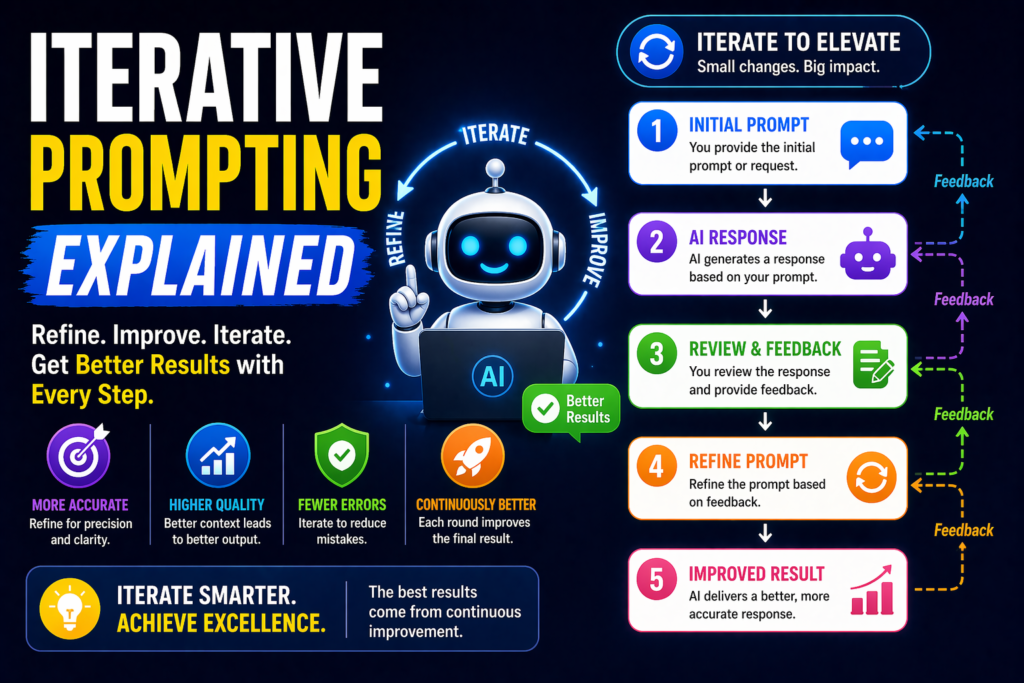
Iterative prompting is one of the most practical ways to get better AI results. Instead of expecting a perfect answer from the first prompt, you improve outputs through multiple rounds of feedback and refinement.
This method helps turn average responses into high-quality results.
In this guide, you’ll learn what iterative prompting is, how it works, when to use it, and how to build an effective improvement loop.
In simple terms
Iterative prompting means:
Prompt, review, refine, repeat.
Instead of:
“Write a landing page.”
Use:
- Draft landing page
- Improve headline
- Strengthen benefits
- Simplify wording
- Final polish
Each round improves quality.
What is Iterative Prompting?
Iterative prompting is a prompt engineering technique where you repeatedly refine prompts or outputs over several rounds to reach a better final result.
The process often looks like:
- create first version
- review weaknesses
- give targeted feedback
- regenerate improved output
- repeat until satisfied
It is ideal when quality matters more than speed.
Why Iterative Prompting Works
Many AI outputs are decent initially but improve significantly with feedback.
Iterative prompting helps by:
- correcting weak sections
- improving clarity
- increasing relevance
- refining tone
- reducing errors
- customizing outputs
Instead of one-shot prompting, you collaborate with the AI.
Simple Iterative Prompting Examples
Example 1: Blog Writing
Round 1: Write blog intro
Round 2: Make it more engaging
Round 3: Add SEO keyword naturally
Round 4: Shorten to 60 words
Example 2: Coding
Round 1: Write Python script
Round 2: Fix bugs
Round 3: Improve speed
Round 4: Add comments
Example 3: Resume Writing
Round 1: Write summary
Round 2: Make it stronger for recruiters
Round 3: Add metrics
Round 4: Reduce word count
Example 4: Business Ideas
Round 1: Generate ideas
Round 2: Filter profitable ideas
Round 3: Improve practicality
Round 4: Rank top 3
Best use cases for Iterative Prompting
Iterative prompting works best for:
1. Content Creation
Blogs, ads, emails, scripts.
2. Coding Tasks
Debugging, refactoring, optimization.
3. Design and copy feedback
Headlines, CTAs, UX copy.
4. Research Outputs
Reports, summaries, comparisons.
5. Decision-Making
Refining options and recommendations.
Iterative Prompting vs Prompt Chaining
| Method | How It Works | Best For |
| Iterative Prompting | Improve through repeated rounds | Quality refinement |
| Prompt Chaining | Multi-step workflow stages | Complex tasks |
| Few Shot Prompting | Uses examples | Consistency |
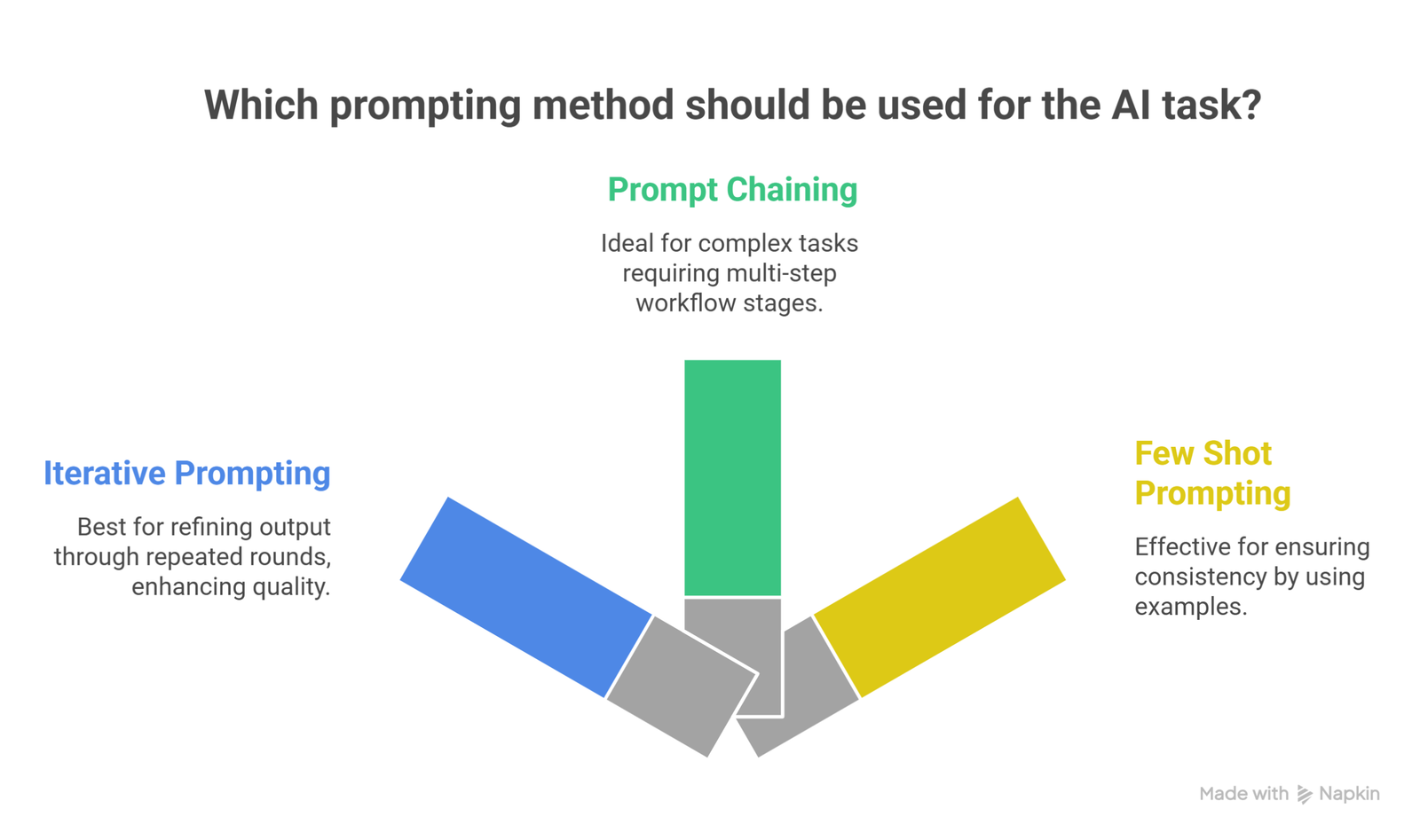
Use iterative prompting when the first answer needs improvement.
How to use Iterative Prompting Effectively
1. Start simple
Get a fast first draft before refining.
2. Give Specific Feedback
Weak:
“Make it better.”
Better:
“Make tone more professional and shorten by 20%.”
3. Change One Variable at a Time
Improve headline, then clarity, then formatting.
4. Save Strong Versions
Track best outputs across rounds.
5. Stop when gains become small
Too many rounds can waste time.
Common mistakes
Vague Feedback
Unclear requests create random changes.
Too many changes at once
Harder to control output quality.
No Clear Goal
Need to know what “better” means.
Endless Revisions
Use a stopping point.
Ignoring Strong Earlier Drafts
Sometimes version 2 beats version 5.
Copy-paste Iterative Prompt Templates
Writing
“Draft an article about [topic]. Then improve clarity, engagement, and SEO.”
Coding
“Write code for [task]. Then optimize speed and readability.”
Marketing
“Create ad copy for [product]. Then improve CTR and urgency.”
Resume
“Write a resume summary for [role]. Then make it more results-focused.”
When not to use Iterative Prompting
It may be unnecessary for:
- quick facts
- translations
- simple summaries
- one-line outputs
- low-priority tasks
Use it when output quality matters.
Suggested Read:
- What Is Prompt Engineering? Complete Beginner Guide
- Prompt Chaining Explained
- Reflective Prompting Explained
- Prompt Engineering Best Practices
- How to Write Better System Prompts
- ChatGPT Prompting Guide
FAQ: Iterative Prompting
What is iterative prompting?
A method where you improve AI outputs through multiple rounds of refinement.
Does iterative prompting improve quality?
Often yes, especially for writing and coding.
Is it useful for ChatGPT?
Yes. It works extremely well for practical tasks.
How many rounds should I use?
Usually 2 to 5 rounds are enough.
Final takeaway
Iterative prompting is one of the most useful real-world AI techniques because it treats prompting as a process, not a one-time request.
For writing, coding, research, and marketing, repeated refinement often produces far better results than the first draft.
If your first output feels average, iterate.