
What Is a Large Language Model? Explained Simply
A large language model, or LLM, is an AI system trained on huge amounts of text so it can understand and generate language. It does not “know” things the way a person does. Instead, it learns patterns in words, sentences, and context, then uses those patterns to predict what comes next. That is why LLMs can answer questions, summarize documents, write drafts, and help with many language-based tasks.
In simple terms
Think of a large language model as a very advanced prediction engine for language. You give it a prompt, and it tries to continue in the most likely and useful way based on the patterns it learned during training.
That may sound simple, but the results can feel powerful because language covers so many tasks: writing, explaining, translating, classifying, coding, brainstorming, and summarizing.
What does “Large Language Model” actually mean?
The phrase has three parts.
- Language means the model works with text, and in many cases code, which is also a structured form of language.
- Model means it is a mathematical system trained to recognize patterns and generate outputs.
- Large usually refers to the scale of training data, model size, and computational complexity. Modern LLMs are trained on enormous text datasets and contain many parameters, which are the internal values that help the model map input patterns to output predictions.
So when people say “LLM,” they usually mean a text-trained AI model that can perform many language tasks from one general foundation.
How does an Large Language Model work?
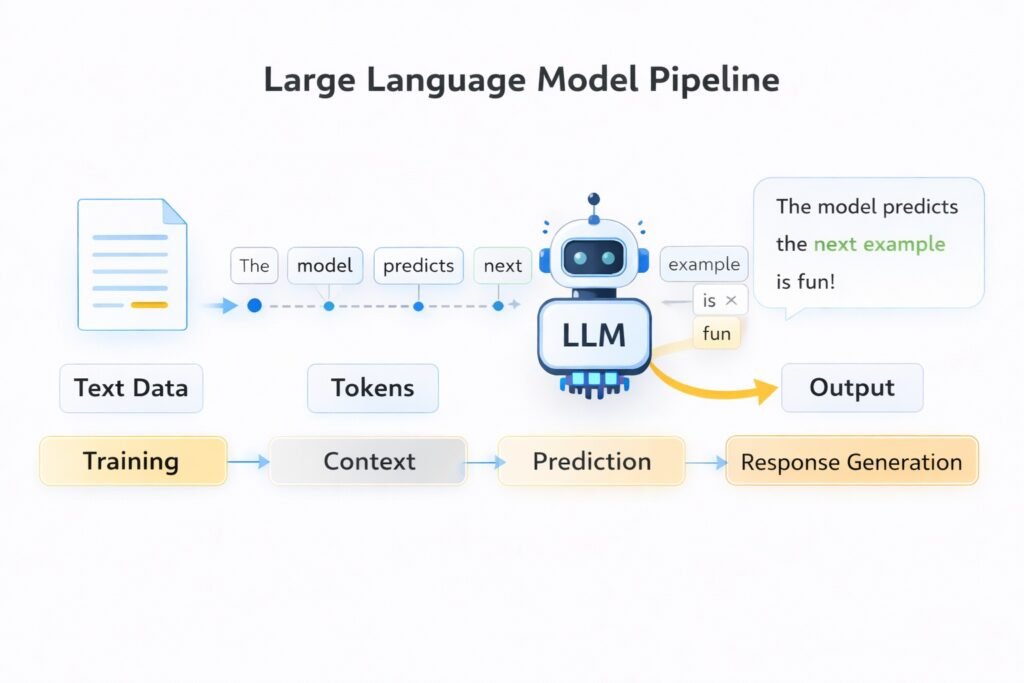
At a beginner level, an LLM works in four broad stages:
- Training on massive text data : The model is exposed to huge amounts of text from books, articles, websites, code, documentation, and other sources. During training, it learns statistical relationships between words and phrases.
- Breaking text into tokens :LLMs do not read text exactly as humans do. They process text as smaller units called tokens. A token may be a whole word, part of a word, punctuation, or another text fragment.
- Predicting the next token :When you enter a prompt, the model examines the context and predicts the next most likely token. It keeps doing this repeatedly, one step at a time, until it produces a full answer.
- Using context to stay coherent :The model does not just predict random words. It uses the previous tokens in the conversation or prompt window to stay on topic and generate more relevant output.
This is why a well-written prompt often leads to a much better answer. The model depends heavily on the context it is given.
Why are Large Language Models so useful?
Large language models are useful because language sits at the center of many real tasks. If a system can understand instructions and generate usable text, it can support a wide range of workflows.
Common LLM use cases include:
- answering questions
- summarizing long documents
- rewriting text in a different tone
- generating code or explaining code
- translating content
- classifying text
- extracting information from documents
- brainstorming titles, ideas, or outlines
That flexibility is one reason LLMs became such an important category in modern AI. One foundation model can support many downstream tasks without building a separate system for each one.
Examples of large language models
Many well-known AI systems fall into the LLM category. Some are general-purpose chat assistants. Others are optimized for coding, enterprise use, or research workflows.
Examples include:
- GPT-style models
- Claude models
- Gemini models
- Llama-family models
- other open-source and commercial LLMs
What matters most for beginners is not memorizing brand names. It is understanding that these tools are built on the same general idea: large-scale language prediction shaped into useful applications.
LLM vs traditional chatbot
This is a common source of confusion.
- A traditional chatbot usually follows fixed rules, scripted flows, or limited response patterns. It is built for narrow interactions.
- An LLM-powered assistant is more flexible. It can adapt to many prompts, generate new wording, and handle a wider range of tasks without needing a hardcoded answer for each case.
| Traditional chatbot | LLM-based system |
| Often rule-based | Pattern-based generation |
| Narrow task scope | Broad task flexibility |
| Limited responses | Dynamic responses |
| Usually scripted | Context-aware generation |
| Best for fixed workflows | Best for open-ended language tasks |
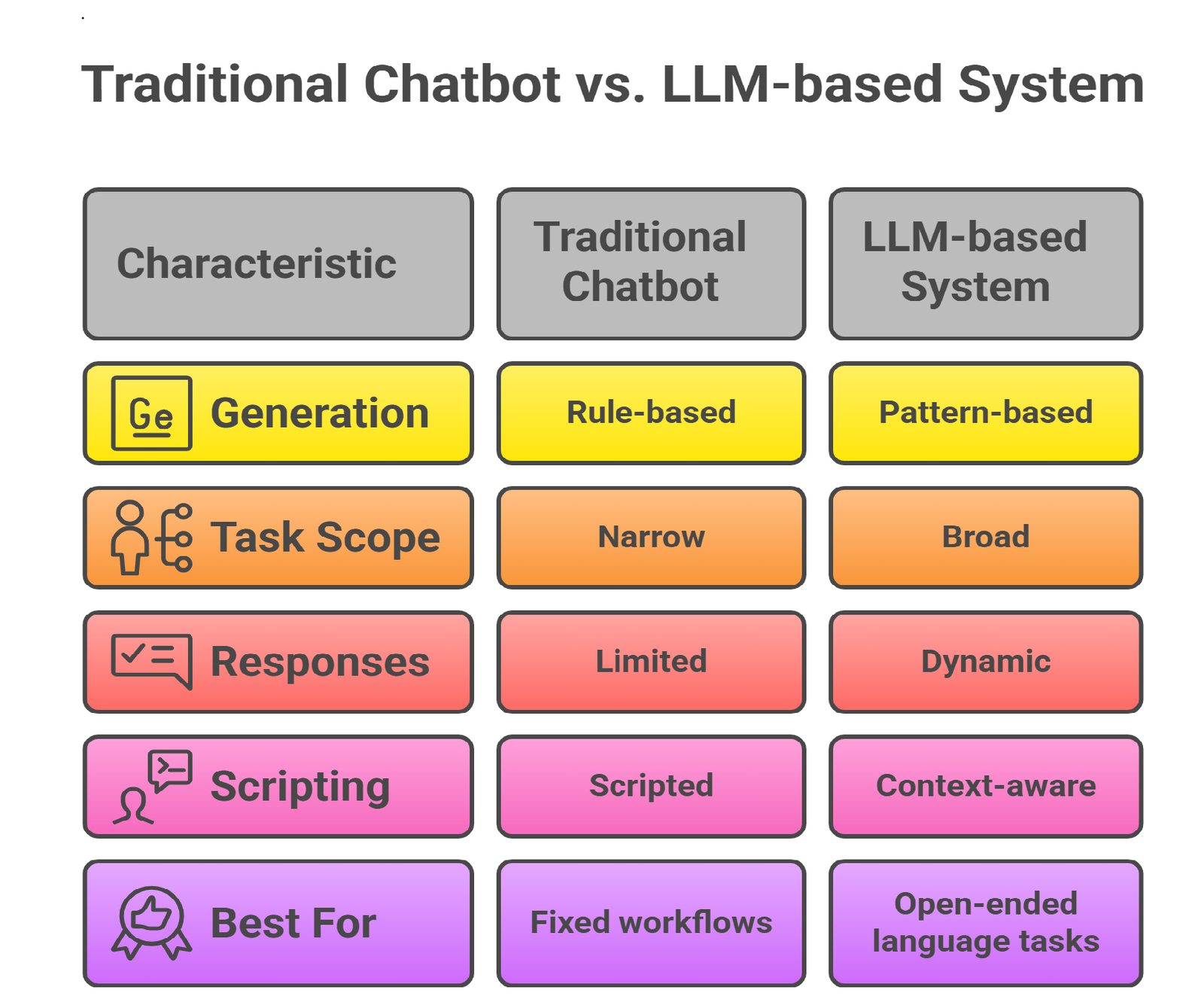
That does not mean LLMs are always better. In some business cases, structured chatbots are easier to control. But LLMs are much more capable when the task requires flexible language understanding.
Large Language Model vs generative AI
An LLM is one type of generative AI.
- Generative AI is the broader category. It includes systems that generate text, images, audio, video, or code.
- LLMs are specifically focused on language. So every LLM belongs to generative AI, but not all generative AI systems are LLMs.
This distinction matters because beginners often use the terms as if they mean the same thing.
Real-world use cases of Large Language Models
- Content and writing :LLMs can help draft articles, rewrite content, suggest headlines, and structure ideas.
- Customer support :They can power assistants that answer common questions, summarize support cases, and help agents reply faster.
- Research and knowledge work : LLMs can summarize reports, compare documents, extract themes, and help users explore complex topics more quickly.
- Coding and technical work: Many LLMs assist with code generation, debugging, documentation, and explanation.
- Internal business workflows : Companies use LLMs in search, document assistants, data extraction, meeting notes, and workflow automation.
These use cases explain why LLMs matter far beyond chat interfaces.
Limitations of large language models
LLMs are useful, but they are not reliable in every situation.
- One major issue is hallucination. The model may produce a fluent answer that sounds correct but is inaccurate or invented.
- Another issue is context limitation. The model only sees the information inside its current context window and what it learned during training. If the needed information is missing, outdated, or ambiguous, the answer may suffer.
- There is also the challenge of reasoning reliability. LLMs can appear highly intelligent, but they may still fail at tasks that need precise logic, factual grounding, or consistent multi-step decisions.
This is why many real systems combine LLMs with retrieval, tools, rules, and human review rather than trusting the model alone.
Why LLMs matter in modern AI
- LLMs matter because they changed how people interact with software. Instead of learning rigid interfaces, users can increasingly describe goals in natural language.
- That shift affects search, education, business tools, coding, support, and content creation. It also connects to other major AI categories like prompt engineering, RAG, multimodal AI, and AI agents.
In many ways, LLMs became the language layer behind a large part of modern AI products.
Suggested Read
- Prompt Engineering for Beginners: A Practical Guide
- What Is RAG in AI? A Beginner-Friendly Guide
- What Is Multimodal AI? Simple Explanation With Examples
FAQ: What Is a Large Language Model?
What is a large language model in simple words?
It is an AI system trained on huge amounts of text so it can understand prompts and generate language-based responses.
Is Chat GPT an LLM?
Chat GPT is an application built on large language model technology. The interface is the product, while the underlying language model is the core AI engine.
Do LLMs understand meaning like humans do?
Not in the human sense. They learn language patterns and context relationships, then generate likely outputs based on those patterns.
What can large language models do?
They can answer questions, summarize text, rewrite content, generate code, classify information, and support many language-heavy tasks.
Are LLMs always accurate?
No. They can be helpful, but they can also hallucinate, miss nuance, or give outdated or weak answers without proper context and verification.
Final takeaway
A large language model is an AI system trained to work with language at scale. Its core ability is prediction, but that prediction becomes powerful when applied to real tasks like writing, summarization, coding, search, and assistance. For beginners, the key idea is simple: an LLM is not a magic brain. It is a language model that becomes useful when paired with clear prompts, good context, and careful verification.