

What Is Prompt Engineering? A Beginner-Friendly Practical Guide
Prompt engineering for beginners is the practice of writing clearer, better-structured inputs so an AI model produces more useful outputs. If you are looking for a prompt engineering for dummies style explanation, it’s simply about learning how to talk to AI so it gives you exactly what you want. Understanding ai prompts for beginners is the first step toward mastering these powerful tools.
In simple terms
Think of prompt engineering as learning how to brief an assistant properly. If you ask vaguely, you usually get vague output. If you explain the task, the audience, the constraints, and the format you want, the result is usually more accurate and more usable.
A beginner does not need advanced jargon to start. You only need to understand one idea: AI tools respond better when your instructions are specific.
What is Prompt Engineering? The Basics for Beginners
Prompt engineering is the process of designing prompts so AI systems can understand the task more clearly and respond in a more helpful way. A prompt can be a question, an instruction, a block of context, an example, or a combination of all of these.
For example, compare these two prompts:
Weak prompt:
“Write about prompt engineering.”Better prompt:
“Write a 300-word beginner-friendly explanation of prompt engineering in simple English. Include one real example, one common mistake, and a short conclusion.”
The second prompt works better because it defines the task, length, audience, and structure. That is the core idea behind prompt engineering.
Why prompt engineering matters?
Prompt engineering matters because most AI tools are flexible, but not mind readers. They can generate text, summarize notes, explain code, compare tools, write emails, extract information, and brainstorm ideas. But the quality of the response often depends on how clearly the task is framed.
Good prompt engineering helps you:
- reduce vague or generic outputs
- improve relevance
- control structure and tone
- save editing time
- make AI more useful for real work
This is one reason prompt engineering became such an important category in modern AI workflows. It is practical, accessible, and useful across writing, research, coding, education, and business tasks.
How to Get Started with AI Prompting?
If you want to know how to learn ai prompting, the best way is through consistent practice and ai prompt training for beginners. You don’t need a technical background; you just need to understand the basics of prompt engineering.
To get started with prompt learning, begin by using your daily tasks—like summarizing emails or drafting LinkedIn posts—as your ai prompt basics training ground. By experimenting with different prompt design techniques, you will quickly see how small changes in your “raw logs” (your history of inputs) can lead to vastly better results.
How prompt engineering works?
A prompt usually works best when it contains a few key ingredients.
- Task
Tell the model what you want it to do.
Examples:
- summarize this article
- compare two tools
- write a product description
- explain this concept for beginners
- Context
Give the background needed for a better answer.
Examples:
- the audience is college students
- this article is for a beginner AI blog
- the tone should be professional but simple
- the comparison should focus on pricing and ease of use
- Constraints
Set limits so the output stays useful.
Examples:
- keep it under 200 words
- avoid jargon
- do not use bullet points
- include only practical examples
- Output format
Tell the model how the answer should be organized.
Examples:
- use a table
- write in three short paragraphs
- include headings and FAQs
- return the answer as JSON
When these pieces are missing, the model often fills in the gaps on its own. Sometimes that works. Often it leads to weak output.
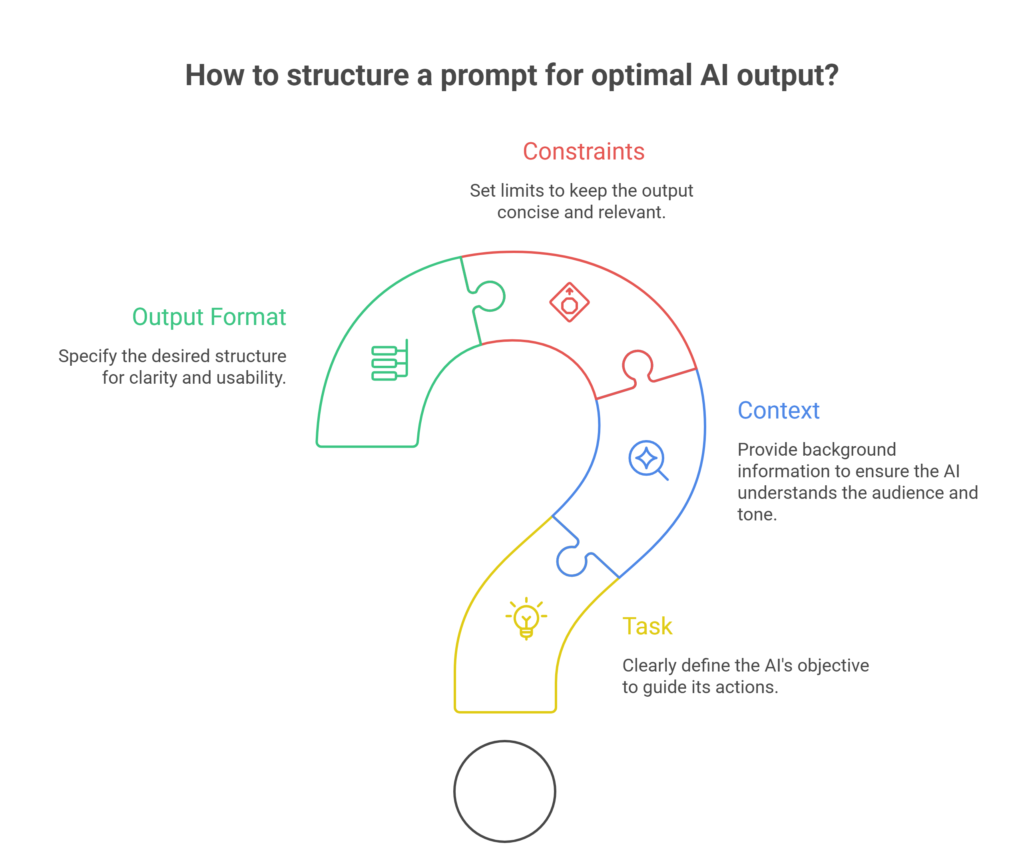
A Simple Prompt Engineering Quick Guide: The Formula
This simple prompt engineering guide uses a formula that works for almost any AI model:
Role + task + context + constraints + format
Here is a simple example:
“Act as a beginner-friendly coding tutor. Explain what an API is to a non-technical reader. Use simple language, keep it under 150 words, and include one everyday example.”
This formula is not magic. It just forces clarity. And clarity is usually what improves results.
Common prompt engineering techniques
Prompt engineering does not always mean writing long prompts. Sometimes even small improvements make a big difference. Here are a few beginner-friendly techniques.
| Technique | What it does | Simple example |
| Clear instruction | Defines the task directly | “Summarize this in 5 bullet points” |
| Role prompting | Sets a useful perspective | “Act as a hiring manager” |
| Context setting | Adds background | “This is for first-year students” |
| Format control | Shapes the response | “Return as a comparison table” |
| Example-based prompting | Shows what good output looks like | “Follow this example format” |
| Constraint prompting | Limits unwanted output | “Avoid jargon and keep it short” |
These techniques are beginner-friendly because they improve output without requiring technical knowledge.
Prompt engineering examples
Example 1: Summarization
Basic prompt:
“Summarize this article.”Better prompt:
“Summarize this article in 5 bullet points for a beginner reader. Focus on the main ideas, avoid technical jargon, and include one practical takeaway.”
The second version gives the model more direction, so the result is usually cleaner and more useful.
Example 2: Research support
Basic prompt:
“Tell me about vector databases.”Better prompt:
“Explain vector databases for a beginner learning RAG. Define the term in simple language, describe why they matter, and include one example of how they are used in a retrieval pipeline.”
Again, the better prompt narrows the audience, goal, and structure.
Example 3: Writing assistance
Basic prompt:
“Write a LinkedIn post about AI agents.”Better prompt:
“Write a 150-word LinkedIn post about AI agents for a business audience. Use a professional tone, include one real-world use case, and end with a question to encourage engagement.”
This makes the output easier to publish with fewer edits.
Prompt engineering vs just asking questions
Many beginners assume prompt engineering is only for advanced users. It is not. The difference between casual prompting and prompt engineering is usually just intention.
Casual prompting:
“Give me ideas for a blog.”Prompt engineering:
“Give me 10 blog ideas for an AI education website. Focus on beginner-friendly Prompt Engineering topics with informational search intent. For each idea, include a target keyword and title angle.”
Both are prompts. One is simply more structured and goal-aware.
Real-world use cases
Prompt engineering is useful anywhere AI is used for repeatable tasks.
A student can use it to ask for simpler explanations, better study notes, or practice questions.
A marketer can use it to draft copy in a defined tone, generate campaign variations, or summarize customer feedback.
A developer can use it to debug code, generate test cases, or explain technical concepts in plain language.
A researcher can use it to compare sources, extract themes, or turn dense material into structured notes.
Prompt engineering for AI agents: As AI becomes more autonomous, learning how to write instructions for agents that can browse the web or execute code is becoming a vital skill for the future.
The common pattern is the same: clearer instructions usually produce more useful output.
Mistakes beginners should avoid
One common mistake is being too vague. If the model does not know the audience, goal, or format, the output often becomes generic.
Another mistake is overloading the prompt with too many goals at once. Asking for a summary, comparison, critique, rewrite, and social post in one instruction usually creates messy results.
A third mistake is assuming the first answer is the final answer. Prompt engineering is often iterative. You ask, review, refine, and improve.
Beginners should also avoid treating confident output as guaranteed truth. Prompt engineering improves usefulness, but it does not remove the need to verify important facts.
Suggested Read:
FAQ: Prompt engineering for beginners
Is prompt engineering hard to learn?
No. Beginners can improve quickly by learning a few habits: be specific, add context, define the format, and refine prompts based on the output.
How can I become an AI prompt engineer as a beginner?
To become an AI prompt engineer, focus on mastering prompting for beginners and documenting your results. Start with ai prompting training for beginners by following expert blogs like AIML Insights, experimenting with different LLMs, and building a portfolio of effective prompts.
Do I need coding skills for prompt engineering?
No. Most beginner prompt engineering is about communication, not programming. Coding helps in some advanced workflows, but it is not required to start.
What is the best prompt structure for beginners?
A simple and effective structure is: role, task, context, constraints, and output format.
Is prompt engineering still useful with better AI models?
Yes. Stronger models still respond better to clearer instructions. Better models reduce some friction, but they do not remove the value of good prompting.
What should I practice first?
Start with everyday use cases: summarization, explanation, rewriting, idea generation, and structured outputs such as tables or checklists.
Final takeaway
Prompt engineering for beginners is really about one skill: giving AI better instructions. You do not need complex frameworks to start. Focus on clarity, context, constraints, and output format. Once that becomes natural, AI tools become more reliable, faster to use, and easier to fit into real workflows.
If you are building your Prompt Engineering knowledge further, the best next step is to move from basic prompting into specific techniques, prompt safety, and system prompt design. For more information, consultation, or any service related inquiry, please reach out to our team (Click Here).