
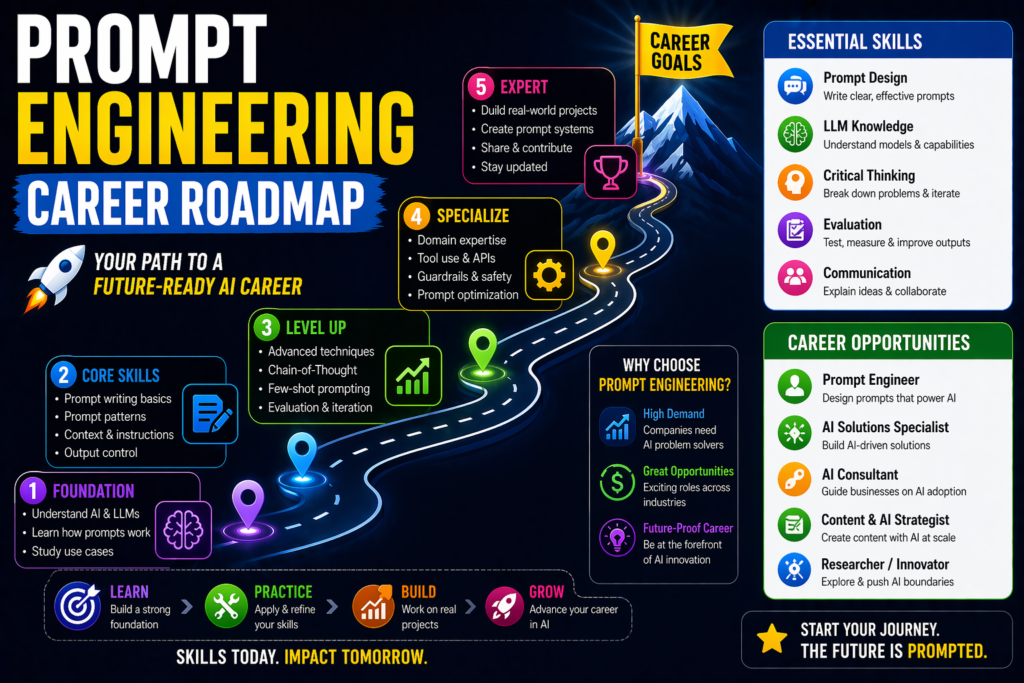
Prompt Engineering Career Roadmap: Skills, Salary, and Step-by-Step Plan
Prompt engineering has grown from a niche skill into a valuable career path across startups, SaaS companies, agencies, consulting firms, and enterprise AI teams. Companies need professionals who can improve AI outputs, automate workflows, reduce hallucinations, and turn models into business results.
If you want to enter this field, this guide gives you a realistic prompt engineering career roadmap for 2026.
In simple terms
A prompt engineering career means:
Using AI models strategically to solve real business problems through better prompts, workflows, testing, and optimization.
It is not only writing clever prompts. It is about results.
Is Prompt Engineering a real career?
Yes, but job titles vary.
Common roles include:
- Prompt Engineer
- AI Content Specialist
- LLM Operations Specialist
- Conversational AI Designer
- AI Workflow Builder
- AI Automation Consultant
- Applied AI Specialist
Many companies hire under broader AI titles rather than only “Prompt Engineer.”
Why companies Hire Prompt Engineers
Businesses want to use AI for:
- customer support automation
- content production
- internal knowledge search
- coding assistance
- analytics workflows
- sales enablement
- research acceleration
They need people who can make models useful, reliable, and cost-efficient.
Prompt Engineering Career Roadmap
Stage 1: Learn AI Foundations (Weeks 1–4)
Understand basics such as:
- what LLMs are
- tokens and context windows
- temperature and creativity settings
- hallucinations
- prompt structure
- model limitations
Goal: Know how AI systems behave.
Stage 2: Master Core Prompting Skills (Weeks 4–8)
Learn techniques such as:
- zero-shot prompting
- few-shot prompting
- role prompting
- chain-of-thought prompting
- structured prompting
- iterative prompting
Goal: Improve outputs consistently.
Stage 3: Learn Business Use Cases (Weeks 8–12)
Practice prompts for:
- content writing
- summarization
- customer support
- classification
- extraction
- sales outreach
- research
Goal: Solve practical problems, not theory only.
Stage 4: Learn Prompt Evaluation (Months 3–4)
Most beginners skip this step.
Learn to test prompts using:
- A/B testing
- scorecards
- benchmark datasets
- user feedback
- cost analysis
Goal: Prove which prompt performs better.
Stage 5: Build Technical Skills (Months 4–6)
Helpful skills include:
- spreadsheets
- no-code automation tools
- API basics
- Python basics
- JSON formatting
- workflow tools
Goal: Move from prompts to production systems.
Stage 6: Build Portfolio Projects
Create real examples such as:
Project 1
Customer support chatbot workflow
Project 2
SEO content generation system
Project 3
Resume screening prompt pipeline
Project 4
Research summarization assistant
Project 5
Sales email personalization workflow
Portfolio beats certificates alone.
Stage 7: Apply for Jobs or Freelance
Target:
- startups
- SaaS companies
- agencies
- AI consultancies
- enterprise transformation teams
- freelancing clients
Skills Required for Prompt Engineering Careers
Core Skills
- writing clear prompts
- analytical thinking
- testing mindset
- structured communication
- problem-solving
AI Skills
- LLM behavior
- hallucination reduction
- prompt safety
- model comparison
- RAG basics
Technical Skills
- APIs
- automation tools
- spreadsheets
- Python (helpful)
- data formatting
Business Skills
- ROI thinking
- workflow design
- stakeholder communication
Do you need coding?
Not always.
Non-technical roles
Focus on content ops, support systems, business workflows.
Technical roles
Often require APIs, Python, integrations, evaluation systems.
Best strategy: Learn light technical skills.
Salary expectations
Varies by country, company, and skill level.
Typical ranges depend on:
- AI maturity of company
- technical depth
- portfolio quality
- industry niche
- ability to automate ROI tasks
Candidates with workflow + business + technical skills usually earn more.
Best tools to learn
- OpenAI tools
- Anthropic tools
- Google AI tools
- spreadsheet tools
- automation platforms
- analytics tools
- prompt testing tools
Common Mistakes Beginners Make
- only learning tricks, not systems
- no portfolio
- ignoring evaluation
- ignoring business outcomes
- no technical basics
- expecting “prompt engineer” title only
30-Day starter plan
Week 1
Learn LLM basics.
Week 2
Practice prompting daily.
Week 3
Build one workflow project.
Week 4
Publish portfolio + apply to jobs.
Best career paths after Prompt Engineering
- AI Product Manager
- LLM Engineer
- AI Consultant
- Automation Specialist
- AI Operations Lead
- Applied AI Strategist
Suggested Read:
- What Is Prompt Engineering? Complete Beginner Guide
- Prompt Engineering Interview Questions
- Prompt Evaluation Methods
- Testing Prompts Systematically
- Prompt Safety Best Practices
- Best Prompts for ChatGPT
FAQ: Prompt Engineering Career Roadmap
Is prompt engineering a long-term career?
Yes, especially when combined with technical or domain expertise.
Can freshers start?
Yes, if they build portfolio projects.
Is coding mandatory?
No, but helpful.
Are certifications enough?
No. Employers value proof of skill.
Final takeaway
Prompt engineering is less about writing one clever sentence and more about improving AI systems for real outcomes. The strongest career path combines prompting, evaluation, business thinking, and lightweight technical skills.
Start small, build projects, measure results, and grow into broader AI roles over time.