
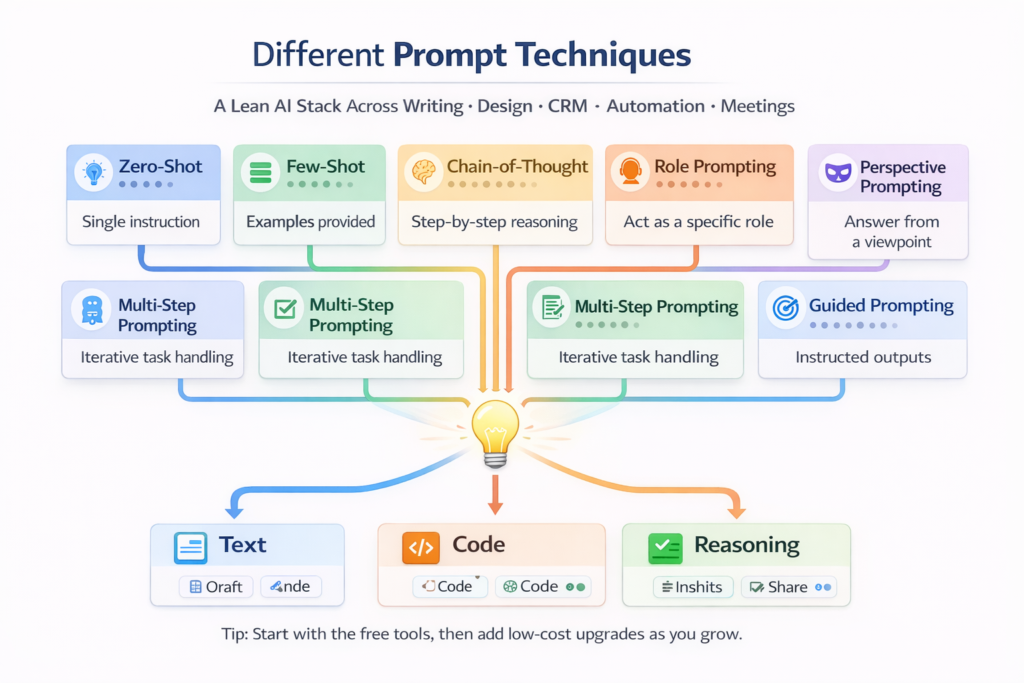
25 Prompt Engineering Techniques With Examples
Prompt engineering is the skill of asking AI the right way to get better results. Small changes in wording can completely change the output. The most effective prompt engineering techniques help you control structure, reasoning, tone, and accuracy instead of relying on guesswork.
In this guide, you will learn 25 practical prompt engineeringtechniques with simple examples you can use immediately.
In simple terms
Think of AI like a smart assistant that follows instructions literally. If your instructions are vague, the output will be vague. If your instructions are structured, specific, and contextual, the output improves dramatically.
Core idea behind all prompt techniques
Most techniques improve one of these:
- clarity
- context
- structure
- reasoning
- constraints
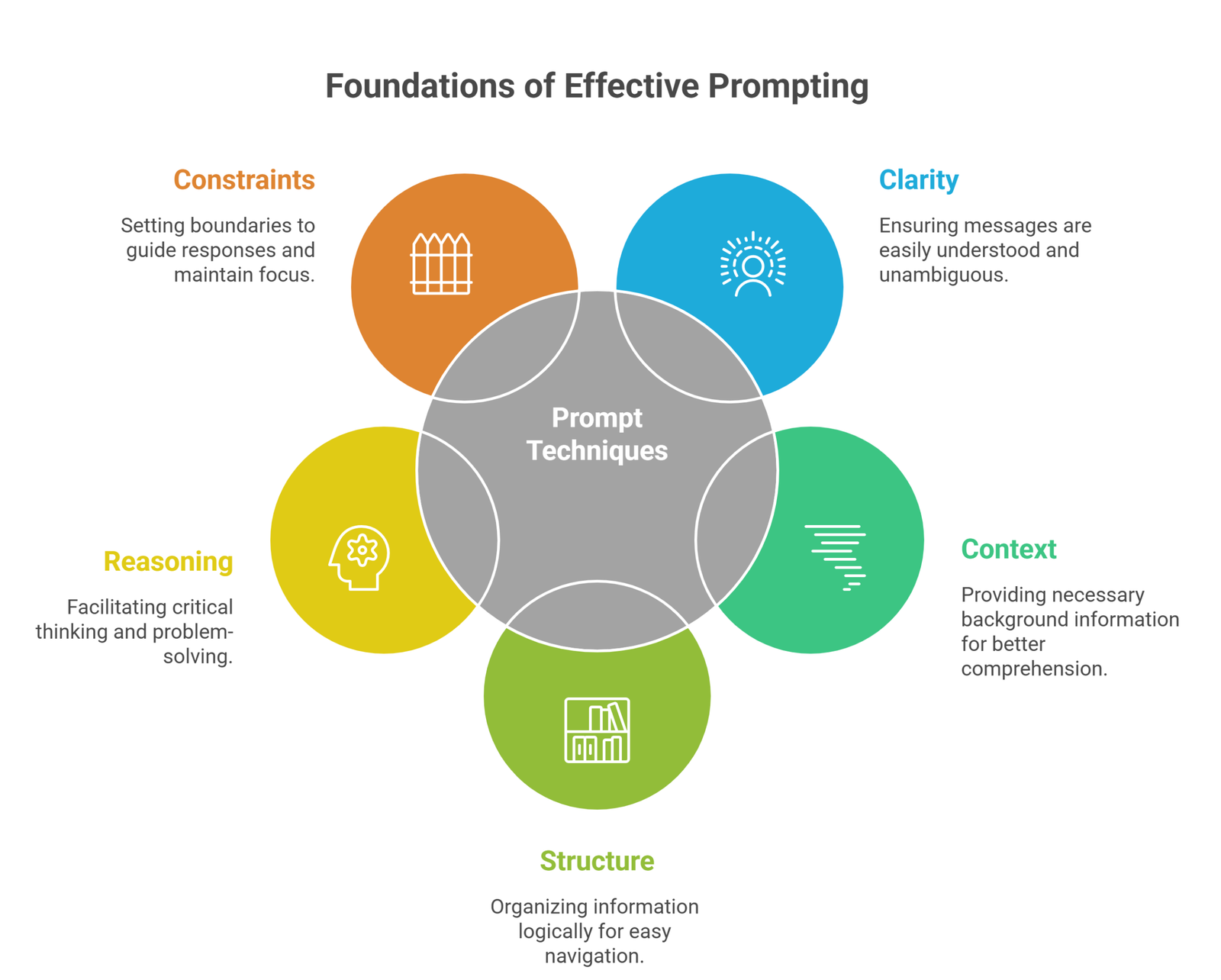
The techniques below are grouped around these improvements.
25 Prompt Engineering Techniques
Zero-shot prompting
Ask directly without examples.
Example:
“Explain blockchain in simple terms.”
Best for: quick tasks
Provide examples before asking.
Example:
“Translate:
Hello → Hola
Goodbye → Adiós
Thank you → ?”
Assign a role to the AI.
Example:
“You are a senior data scientist. Explain overfitting.”
Instruction-based prompting
Clear, direct instructions.
Example:
“Write a 200-word blog intro about AI in healthcare.”
Chain-of-thought prompting
Ask the model to reason step-by-step.
Example:
“Explain step by step how to solve this equation.”
Step-by-step prompting
Force structured reasoning.
Example:
“Break this problem into steps before answering.”
Output format control
Define exact format.
Example:
“Answer in bullet points.”
Constraint prompting
Add limits.
Example:
“Explain in under 50 words.”
Context injection
Provide background.
Example:
“This is for a beginner audience…”
Define tone/personality.
Example:
“Explain like a teacher speaking to a 10-year-old.”
Refine outputs step-by-step.
Example:
“Make this shorter.” → “Now simplify tone.”
Rewriting prompts
Improve existing text.
Example:
“Rewrite this paragraph to sound more professional.”
Summarization prompting
Condense content.
Example:
“Summarize this article in 5 points.”
Expansion prompting
Expand ideas.
Example:
“Expand this outline into a full blog.”
Comparative prompting
Ask for comparison.
Example:
“Compare React vs Angular in a table.”
Critique prompting
Ask for feedback.
Example:
“Review this code and suggest improvements.”
Self-consistency prompting
Ask for multiple answers and pick best.
Example:
“Give 3 possible answers and choose the best one.”
Combine tasks.
Example:
“Summarize this text and create 3 questions.”
Template prompting
Use reusable prompt structures.
Example:
“Topic: X
Audience: Y
Tone: Z
Write a blog.”
Instruction + example hybrid
Combine rules + examples.
Example:
“Write like this example but on a new topic.”
Negative prompting
Specify what NOT to do.
Example:
“Do not use jargon.”
Question decomposition
Break complex queries.
Example:
“Break this question into smaller parts first.”
Prompt chaining
Use outputs as inputs.
Example:
Step 1: Outline
Step 2: Expand
Step 3: Edit
Tool-aware prompting
Ask AI to use tools/features.
Example:
“Analyze this uploaded CSV and summarize trends.”
Ask AI to judge outputs.
Example:
“Rate this answer from 1–10 and explain why.”
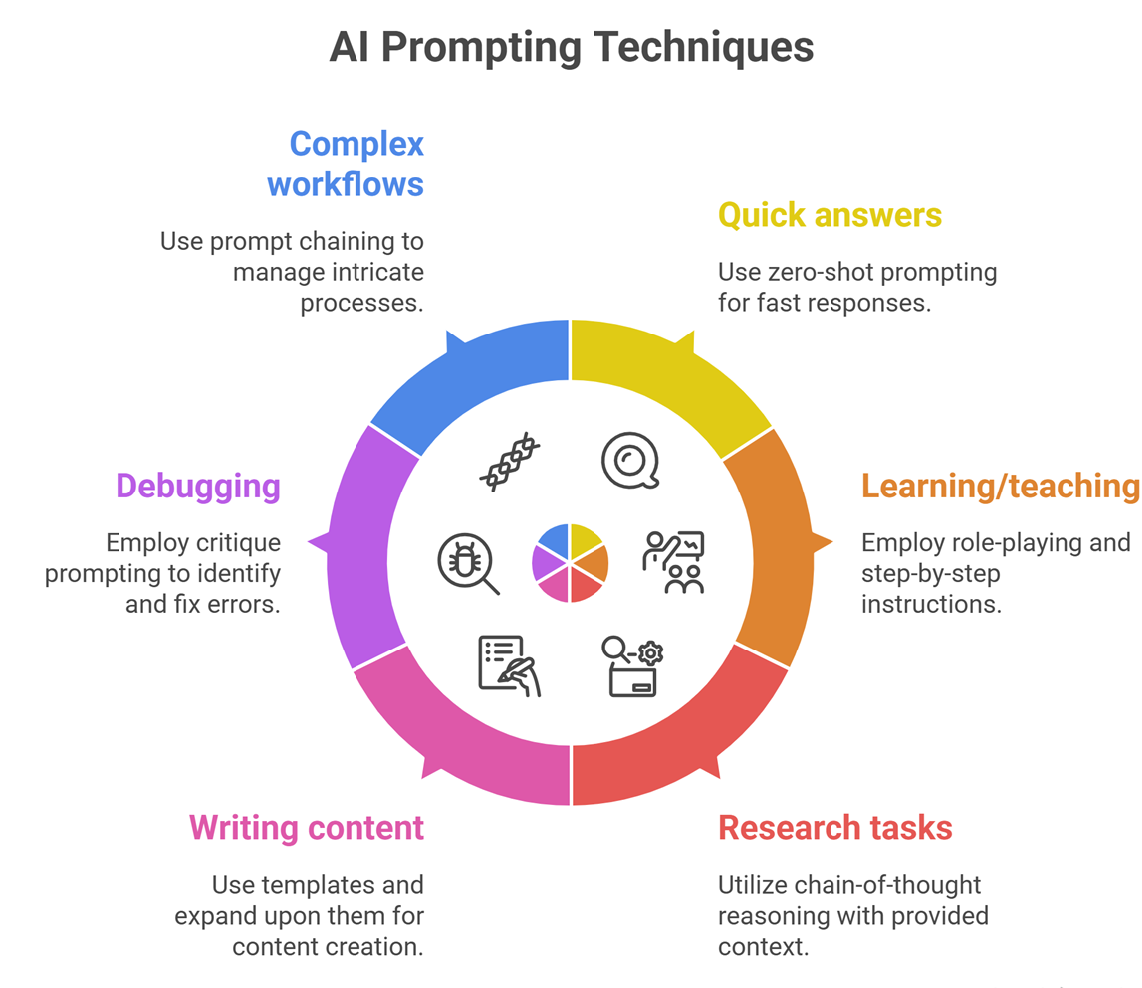
When to use which technique: Prompt Engineering Techniques
| Situation | Best technique |
| Quick answers | Zero-shot |
| Learning/teaching | Role + step-by-step |
| Research tasks | Chain-of-thought + context |
| Writing content | Template + expansion |
| Debugging | Critique prompting |
| Complex workflows | Prompt chaining |
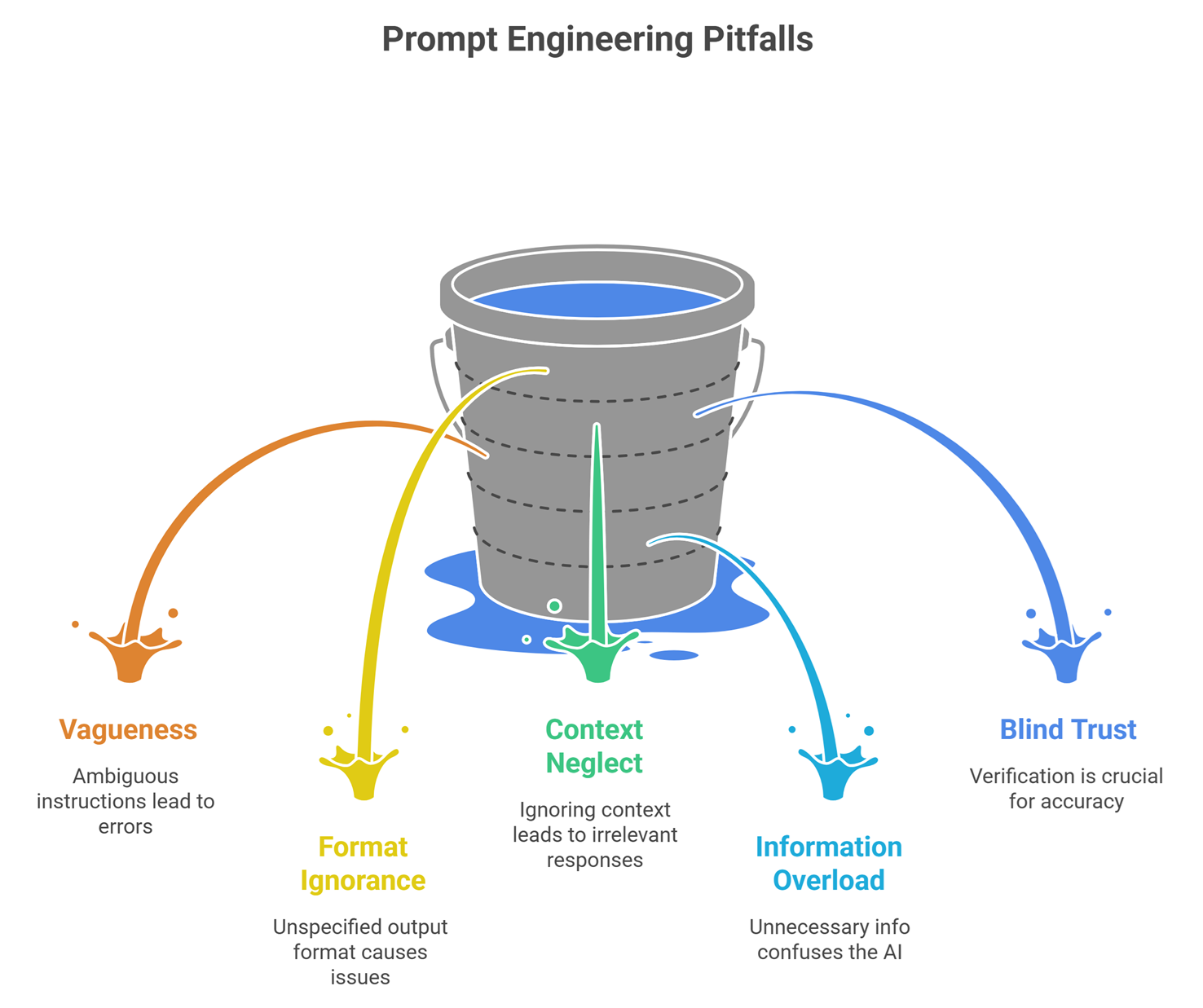
Common mistakes to avoid
- Being too vague
- Not specifying output format
- Ignoring context
- Overloading prompts with unnecessary info
- Trusting outputs without verification
Suggested Read:
- Prompt Engineering for Beginners: A Practical Guide
- Zero-Shot vs Few-Shot Prompting Explained
- Best Prompt Templates for Summarization and Research
- What Is Prompt Injection? Examples and Risks
- AI Tools for Research and Writing in 2026
FAQ: Prompt Engineering Techniques
What is the most important prompt technique?
Clarity + structure. Even simple prompts improve dramatically when instructions are clear.
Are advanced techniques necessary?
Not always. Most gains come from role prompting, structure, and examples.
Can prompt engineering replace fine-tuning?
For many use cases, yes. Prompting is faster and cheaper.
Final takeaway
Prompt engineering is not about memorizing tricks. It is about understanding how to guide AI. Start with simple techniques like role prompting, structure, and examples. Then move into chaining, reasoning, and evaluation for more complex tasks.
The better your prompts, the better your results.